Giorgia Di Lorenzo, Francescopaolo Iavarone, Marianna Maddaluno, Paolo Grumati, Carmine Settembre
{"title":"RETREG3/FAM134C phosphorylation by CSNK2 regulates reticulophagy during starvation.","authors":"Giorgia Di Lorenzo, Francescopaolo Iavarone, Marianna Maddaluno, Paolo Grumati, Carmine Settembre","doi":"10.1080/27694127.2022.2131212","DOIUrl":null,"url":null,"abstract":"<p><p>Starvation is the most potent physiological inducer of autophagy, the catabolic process which degrades unessential cytosolic components to sustain cellular homeostasis and survival. During starvation, the mechanisms of autophagy activation have been extensively investigated; however, less is known about how substrate selection occurs. In this punctum, we summarize our recent findings that delineate a novel signaling pathway that promotes selective autophagic removal of parts of the endoplasmic reticulum (reticulophagy) during starvation. We demonstrate that the inhibition of MTORC1 results in the activation of the reticulophagy receptor RETREG3/FAM134C by preventing its phosphorylation by CSNK2/CK2. <i>In vivo</i>, RETREG3 depletion impairs MTORC1-dependent regulation of lipid metabolism in liver. Last, we describe a novel approach to study selective autophagy <i>in vivo</i>, which might be exploited to identify novel physiological roles of autophagy.</p>","PeriodicalId":72341,"journal":{"name":"Autophagy reports","volume":" ","pages":"519-522"},"PeriodicalIF":0.0000,"publicationDate":"2022-10-06","publicationTypes":"Journal Article","fieldsOfStudy":null,"isOpenAccess":false,"openAccessPdf":"https://www.ncbi.nlm.nih.gov/pmc/articles/PMC11864654/pdf/","citationCount":"0","resultStr":null,"platform":"Semanticscholar","paperid":null,"PeriodicalName":"Autophagy reports","FirstCategoryId":"1085","ListUrlMain":"https://doi.org/10.1080/27694127.2022.2131212","RegionNum":0,"RegionCategory":null,"ArticlePicture":[],"TitleCN":null,"AbstractTextCN":null,"PMCID":null,"EPubDate":"2022/1/1 0:00:00","PubModel":"eCollection","JCR":"","JCRName":"","Score":null,"Total":0}
引用次数: 0
Abstract
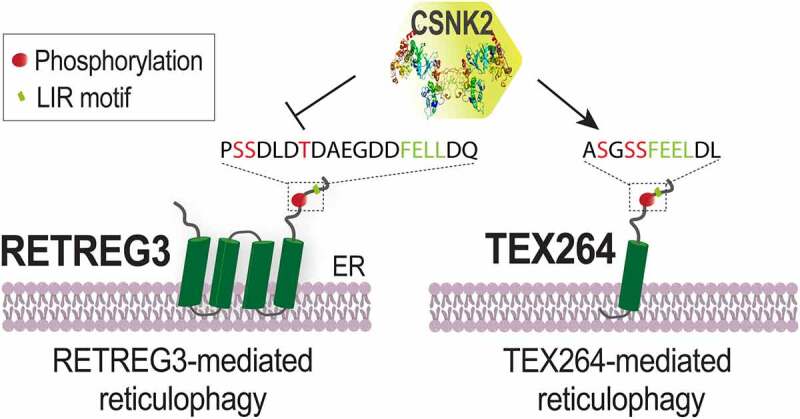
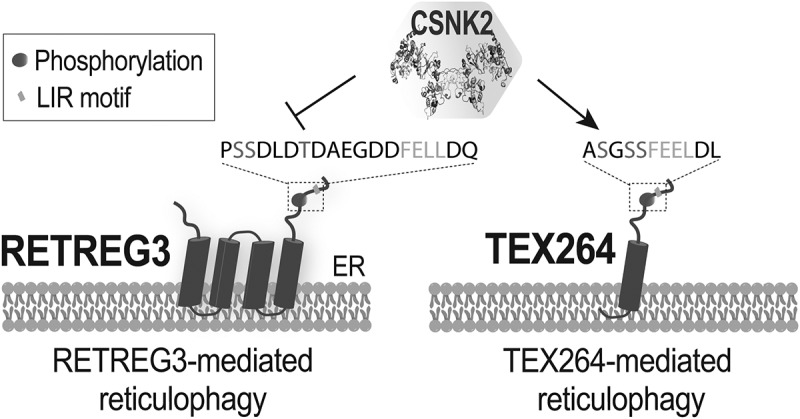
Starvation is the most potent physiological inducer of autophagy, the catabolic process which degrades unessential cytosolic components to sustain cellular homeostasis and survival. During starvation, the mechanisms of autophagy activation have been extensively investigated; however, less is known about how substrate selection occurs. In this punctum, we summarize our recent findings that delineate a novel signaling pathway that promotes selective autophagic removal of parts of the endoplasmic reticulum (reticulophagy) during starvation. We demonstrate that the inhibition of MTORC1 results in the activation of the reticulophagy receptor RETREG3/FAM134C by preventing its phosphorylation by CSNK2/CK2. In vivo, RETREG3 depletion impairs MTORC1-dependent regulation of lipid metabolism in liver. Last, we describe a novel approach to study selective autophagy in vivo, which might be exploited to identify novel physiological roles of autophagy.



 京公网安备 11010802042870号
京ICP备2023020795号-1
京公网安备 11010802042870号
京ICP备2023020795号-1

 分享
分享

 求助内容:
求助内容: 应助结果提醒方式:
 扫码关注我们
