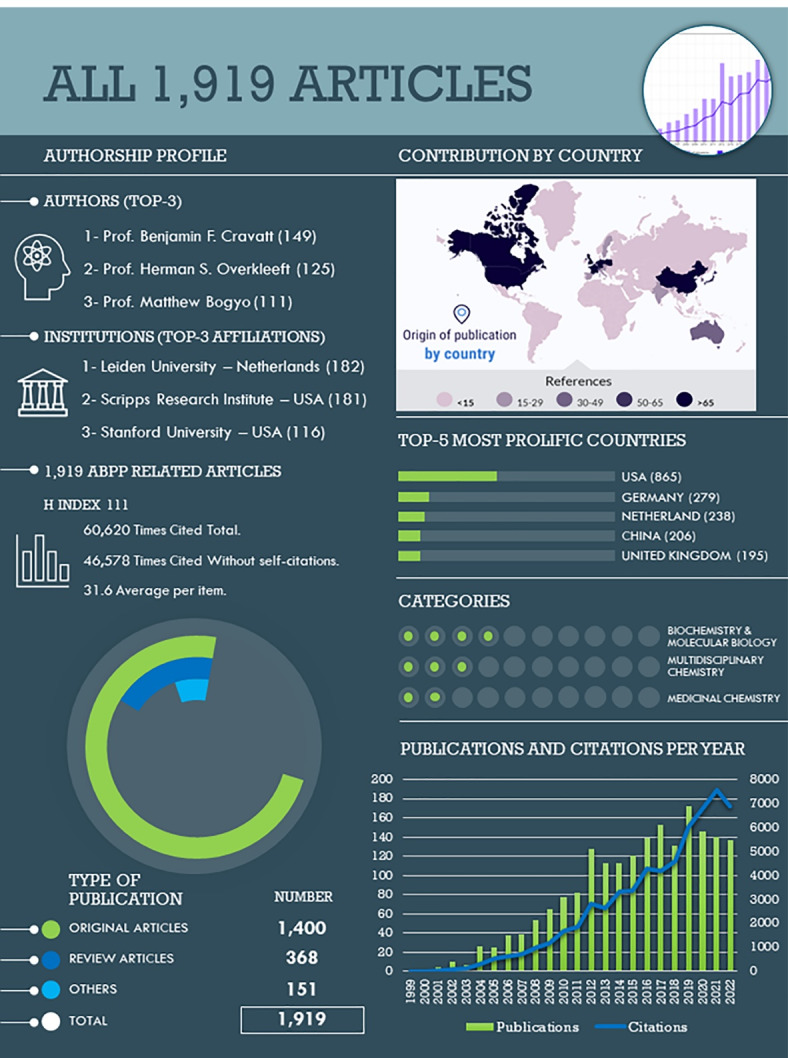
{"title":"Mapping the Evolution of Activity-Based Protein Profiling: A Bibliometric Review.","authors":"Exequiel Oscar Jesus Porta","doi":"10.34172/apb.2023.082","DOIUrl":null,"url":null,"abstract":"<p><p>Activity-based protein profiling (ABPP) is a chemoproteomic approach that employs small-molecule probes to directly evaluate protein functionality within complex proteomes. This technology has proven to be a potent strategy for mapping ligandable sites in organisms and has significantly impacted drug discovery processes by enabling the development of highly selective small-molecule inhibitors and the identification of new therapeutic molecular targets. Despite being nearly a quarter of a century old as a chemoproteomic tool, ABPP has yet to undergo a bibliometric analysis. In order to gauge its scholarly impact and evolution, a bibliometric analysis was performed, comparing all 1919 reported articles with the articles published in the last five years. Through a comprehensive data analysis, including a 5-step workflow, the most influential articles were identified, and their bibliometric parameters were determined. The 1919 analyzed articles span from 1999 to 2022, providing a comprehensive overview of the historical and current state of ABPP research. This analysis presents, for the first time, the characteristics of the most influential ABPP articles, offering valuable insight into the research conducted in this field and its potential future directions. The findings underscore the crucial role of ABPP in drug discovery and novel therapeutic target identification, as well as the need for continued advancements in the development of novel chemical probes and proteomic technologies to further expand the utility of ABPP.</p>","PeriodicalId":3,"journal":{"name":"ACS Applied Electronic Materials","volume":" ","pages":"639-645"},"PeriodicalIF":4.7000,"publicationDate":"2023-11-01","publicationTypes":"Journal Article","fieldsOfStudy":null,"isOpenAccess":false,"openAccessPdf":"https://www.ncbi.nlm.nih.gov/pmc/articles/PMC10676541/pdf/","citationCount":"1","resultStr":null,"platform":"Semanticscholar","paperid":null,"PeriodicalName":"ACS Applied Electronic Materials","FirstCategoryId":"1085","ListUrlMain":"https://doi.org/10.34172/apb.2023.082","RegionNum":3,"RegionCategory":"材料科学","ArticlePicture":[],"TitleCN":null,"AbstractTextCN":null,"PMCID":null,"EPubDate":"2023/5/20 0:00:00","PubModel":"Epub","JCR":"Q1","JCRName":"ENGINEERING, ELECTRICAL & ELECTRONIC","Score":null,"Total":0}
引用次数: 1
Abstract
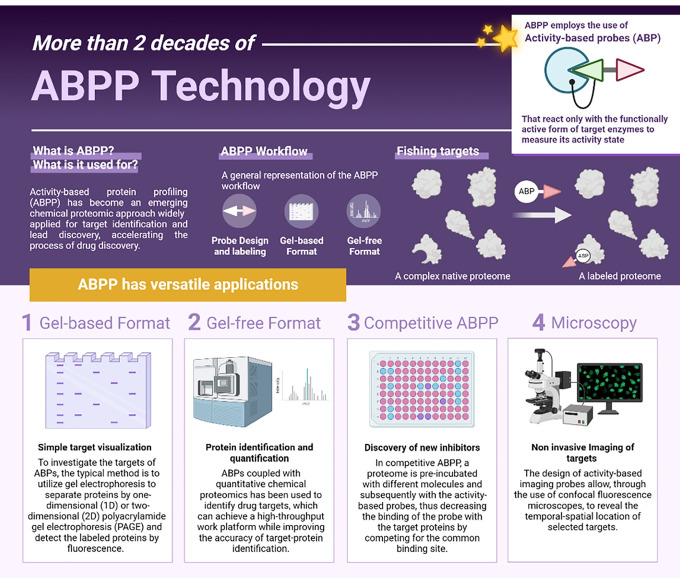
Activity-based protein profiling (ABPP) is a chemoproteomic approach that employs small-molecule probes to directly evaluate protein functionality within complex proteomes. This technology has proven to be a potent strategy for mapping ligandable sites in organisms and has significantly impacted drug discovery processes by enabling the development of highly selective small-molecule inhibitors and the identification of new therapeutic molecular targets. Despite being nearly a quarter of a century old as a chemoproteomic tool, ABPP has yet to undergo a bibliometric analysis. In order to gauge its scholarly impact and evolution, a bibliometric analysis was performed, comparing all 1919 reported articles with the articles published in the last five years. Through a comprehensive data analysis, including a 5-step workflow, the most influential articles were identified, and their bibliometric parameters were determined. The 1919 analyzed articles span from 1999 to 2022, providing a comprehensive overview of the historical and current state of ABPP research. This analysis presents, for the first time, the characteristics of the most influential ABPP articles, offering valuable insight into the research conducted in this field and its potential future directions. The findings underscore the crucial role of ABPP in drug discovery and novel therapeutic target identification, as well as the need for continued advancements in the development of novel chemical probes and proteomic technologies to further expand the utility of ABPP.
期刊介绍:
ACS Applied Electronic Materials is an interdisciplinary journal publishing original research covering all aspects of electronic materials. The journal is devoted to reports of new and original experimental and theoretical research of an applied nature that integrate knowledge in the areas of materials science, engineering, optics, physics, and chemistry into important applications of electronic materials. Sample research topics that span the journal's scope are inorganic, organic, ionic and polymeric materials with properties that include conducting, semiconducting, superconducting, insulating, dielectric, magnetic, optoelectronic, piezoelectric, ferroelectric and thermoelectric.
Indexed/Abstracted:
Web of Science SCIE
Scopus
CAS
INSPEC
Portico




 京公网安备 11010802042870号
京ICP备2023020795号-1
京公网安备 11010802042870号
京ICP备2023020795号-1

 分享
分享
 求助内容:
求助内容: 应助结果提醒方式:
 扫码关注我们
