{"title":"Cobalt- and Cadmium-Based Metal–Organic Frameworks as High-Performance Anodes for Sodium Ion Batteries and Lithium Ion Batteries","authors":"Caifu Dong, Liqiang Xu*","doi":"10.1021/acsami.6b15757","DOIUrl":null,"url":null,"abstract":"<p >Two multifunctional metal–organic frameworks (MOFs) with the same coordination mode, [Co(L)(H<sub>2</sub>O)]<sub><i>n</i></sub>·2<i>n</i>H<sub>2</sub>O [defined as “Co(L) MOF”] and [Cd(L)(H<sub>2</sub>O)]<sub><i>n</i></sub>·2<i>n</i>H<sub>2</sub>O [defined as “Cd(L) MOF”] (L = 5-aminoisophthalic acid) have been fabricated via a simple and versatile scalable solvothermal approach at 85 °C for 24 h. The relationship between the structure of the electrode materials (especially the coordination water and different metal ions) and the electrochemical properties of MOFs have been investigated for the first time. And then the possible electrochemical mechanisms of the electrodes have been studied and proposed. In addition, MOFs/RGO hybrid materials were prepared via ball milling, which demonstrated better electrochemical performances than those of individual Co(L) MOF and Cd(L) MOF. For example, when Co(L) MOF/RGO was applied as anode for sodium ion batteries (SIBs), it retained 206 mA h g<sup>–1</sup> after 330 cycles at 500 mA g<sup>–1</sup> and 1185 mA h g<sup>–1</sup> could be obtained after 50 cycles at 100 mA g<sup>–1</sup> for lithium-ion batteries (LIBs). The high-discharge capacity, excellent cyclic stability combined with the facile synthesis procedure enable Co(L) MOF- and Cd(L) MOF-based materials to be prospective anode materials for SIBs and LIBs.</p>","PeriodicalId":5,"journal":{"name":"ACS Applied Materials & Interfaces","volume":"9 8","pages":"7160–7168"},"PeriodicalIF":8.2000,"publicationDate":"2017-02-06","publicationTypes":"Journal Article","fieldsOfStudy":null,"isOpenAccess":false,"openAccessPdf":"https://sci-hub-pdf.com/10.1021/acsami.6b15757","citationCount":"128","resultStr":null,"platform":"Semanticscholar","paperid":null,"PeriodicalName":"ACS Applied Materials & Interfaces","FirstCategoryId":"88","ListUrlMain":"https://pubs.acs.org/doi/10.1021/acsami.6b15757","RegionNum":2,"RegionCategory":"材料科学","ArticlePicture":[],"TitleCN":null,"AbstractTextCN":null,"PMCID":null,"EPubDate":"","PubModel":"","JCR":"Q1","JCRName":"MATERIALS SCIENCE, MULTIDISCIPLINARY","Score":null,"Total":0}
引用次数: 128
Abstract
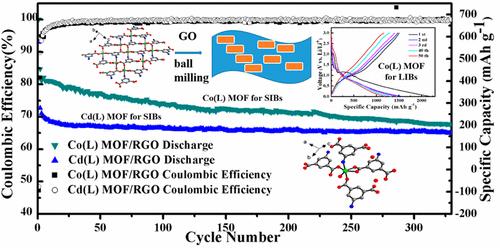
Two multifunctional metal–organic frameworks (MOFs) with the same coordination mode, [Co(L)(H2O)]n·2nH2O [defined as “Co(L) MOF”] and [Cd(L)(H2O)]n·2nH2O [defined as “Cd(L) MOF”] (L = 5-aminoisophthalic acid) have been fabricated via a simple and versatile scalable solvothermal approach at 85 °C for 24 h. The relationship between the structure of the electrode materials (especially the coordination water and different metal ions) and the electrochemical properties of MOFs have been investigated for the first time. And then the possible electrochemical mechanisms of the electrodes have been studied and proposed. In addition, MOFs/RGO hybrid materials were prepared via ball milling, which demonstrated better electrochemical performances than those of individual Co(L) MOF and Cd(L) MOF. For example, when Co(L) MOF/RGO was applied as anode for sodium ion batteries (SIBs), it retained 206 mA h g–1 after 330 cycles at 500 mA g–1 and 1185 mA h g–1 could be obtained after 50 cycles at 100 mA g–1 for lithium-ion batteries (LIBs). The high-discharge capacity, excellent cyclic stability combined with the facile synthesis procedure enable Co(L) MOF- and Cd(L) MOF-based materials to be prospective anode materials for SIBs and LIBs.
两种具有相同配位模式的多功能金属有机骨架(mof)采用简单、通用、可扩展的溶剂热方法,在85℃条件下制备了[Co(L)(H2O)]n·2nH2O[定义为“Co(L) MOF”]和[Cd(L)(H2O)]n·2nH2O[定义为“Cd(L) MOF”](L = 5-氨基间苯二甲酸)。首次研究了电极材料的结构(特别是配位水和不同金属离子)与MOF的电化学性能之间的关系。然后对电极的可能电化学机理进行了研究和提出。此外,通过球磨法制备了MOFs/RGO杂化材料,其电化学性能优于单独的Co(L) MOF和Cd(L) MOF。例如,当Co(L) MOF/RGO作为钠离子电池(SIBs)的阳极时,在500 mA g-1下循环330次后可保持206 mA h - 1,锂离子电池(LIBs)在100 mA g-1下循环50次后可获得1185 mA h - 1。Co(L) MOF和Cd(L) MOF基材料具有高放电容量、优异的循环稳定性和简便的合成工艺,是sib和lib极具前景的负极材料。
期刊介绍:
ACS Applied Materials & Interfaces is a leading interdisciplinary journal that brings together chemists, engineers, physicists, and biologists to explore the development and utilization of newly-discovered materials and interfacial processes for specific applications. Our journal has experienced remarkable growth since its establishment in 2009, both in terms of the number of articles published and the impact of the research showcased. We are proud to foster a truly global community, with the majority of published articles originating from outside the United States, reflecting the rapid growth of applied research worldwide.



 京公网安备 11010802042870号
京ICP备2023020795号-1
京公网安备 11010802042870号
京ICP备2023020795号-1

 分享
分享
 求助内容:
求助内容: 应助结果提醒方式:
 扫码关注我们
