Cik Jamla Farhan bt Yahya, Thomas Shean Yaw Choong, Fan Li, W. Ghani, F. A. Aziz, S. Jamil
{"title":"Tailing Ash for the Removal of Methylene Blue from Aqueous Solutions by Batch Adsorption","authors":"Cik Jamla Farhan bt Yahya, Thomas Shean Yaw Choong, Fan Li, W. Ghani, F. A. Aziz, S. Jamil","doi":"10.3390/pr11082282","DOIUrl":null,"url":null,"abstract":"One of the more problematic textile wastewaters to manage is dyeing wastewater, especially methylene-blue-containing wastewater. Its release has a significant negative impact on ecosystems, which could harm the environment. Adsorption techniques are still an efficient technology to eliminate and remove the coloring agent. Tailing ash, obtained from the floatation process, was selected as an adsorbent in the present study. The purpose of this study was to analyze the performance of tailing ash (TA) for MB removal. The effects of operating parameters investigated were pH (2–10), stirring speed (50–150 rpm), initial dye concentration (20–100 mg/L), contact time (120 min), adsorbent dosage (0.5–2.5 g), and temperature (25–45 °C). The performance of TA pretreated with hydrogen peroxide (H2O2) and thermal tailing ash were also investigated. The experimental results for batch adsorption indicated that 96.23% removal of methylene blue took place at the optimum condition (pH = 10, initial adsorbent dosage = 1.5 g, 150 rpm, contact time = 120 min, 45 °C). The results showed that the dye adsorption capacity increased with contact time and adsorbate dosage. The adsorption data were then fitted to kinetic models and isotherm models. The pseudo-second-order model was the most suitable model for the kinetic of adsorption and the Freundlich isotherm was the best-fitted isotherm model. This research provides a feasible approach to reusing tailing ash as an effective low-cost adsorbent for water quality improvement.","PeriodicalId":20597,"journal":{"name":"Processes","volume":" ","pages":""},"PeriodicalIF":2.8000,"publicationDate":"2023-07-28","publicationTypes":"Journal Article","fieldsOfStudy":null,"isOpenAccess":false,"openAccessPdf":"","citationCount":"1","resultStr":null,"platform":"Semanticscholar","paperid":null,"PeriodicalName":"Processes","FirstCategoryId":"5","ListUrlMain":"https://doi.org/10.3390/pr11082282","RegionNum":4,"RegionCategory":"工程技术","ArticlePicture":[],"TitleCN":null,"AbstractTextCN":null,"PMCID":null,"EPubDate":"","PubModel":"","JCR":"Q2","JCRName":"ENGINEERING, CHEMICAL","Score":null,"Total":0}
引用次数: 1
Abstract
One of the more problematic textile wastewaters to manage is dyeing wastewater, especially methylene-blue-containing wastewater. Its release has a significant negative impact on ecosystems, which could harm the environment. Adsorption techniques are still an efficient technology to eliminate and remove the coloring agent. Tailing ash, obtained from the floatation process, was selected as an adsorbent in the present study. The purpose of this study was to analyze the performance of tailing ash (TA) for MB removal. The effects of operating parameters investigated were pH (2–10), stirring speed (50–150 rpm), initial dye concentration (20–100 mg/L), contact time (120 min), adsorbent dosage (0.5–2.5 g), and temperature (25–45 °C). The performance of TA pretreated with hydrogen peroxide (H2O2) and thermal tailing ash were also investigated. The experimental results for batch adsorption indicated that 96.23% removal of methylene blue took place at the optimum condition (pH = 10, initial adsorbent dosage = 1.5 g, 150 rpm, contact time = 120 min, 45 °C). The results showed that the dye adsorption capacity increased with contact time and adsorbate dosage. The adsorption data were then fitted to kinetic models and isotherm models. The pseudo-second-order model was the most suitable model for the kinetic of adsorption and the Freundlich isotherm was the best-fitted isotherm model. This research provides a feasible approach to reusing tailing ash as an effective low-cost adsorbent for water quality improvement.
期刊介绍:
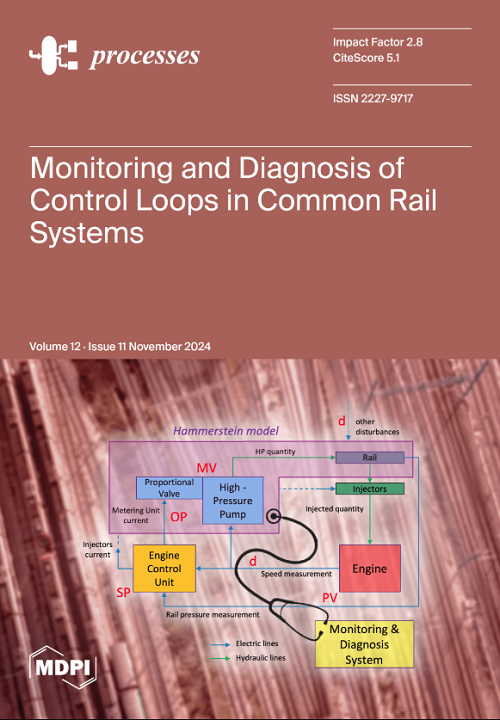
Processes (ISSN 2227-9717) provides an advanced forum for process related research in chemistry, biology and allied engineering fields. The journal publishes regular research papers, communications, letters, short notes and reviews. Our aim is to encourage researchers to publish their experimental, theoretical and computational results in as much detail as necessary. There is no restriction on paper length or number of figures and tables.



 京公网安备 11010802042870号
京ICP备2023020795号-1
京公网安备 11010802042870号
京ICP备2023020795号-1

 分享
分享
 求助内容:
求助内容: 应助结果提醒方式:
 扫码关注我们
