Vanessa Lobue, E. Bonawitz, L. Leotti, N. Fefferman
{"title":"How Children Develop Healthy Behavioral Choices to Promote Illness Prevention","authors":"Vanessa Lobue, E. Bonawitz, L. Leotti, N. Fefferman","doi":"10.1177/09637214221141847","DOIUrl":null,"url":null,"abstract":"Children’s understanding of contagion has been a fruitful area for studying children’s learning. However, despite a large literature on children’s conceptual understanding of illness, there is very little research on the impact of children’s knowledge about illness transmission on adaptive behavior. This is important because how children behave when faced with a sick individual or a contaminated object is what is most relevant to whether children get sick and pass along that illness to other people. Here, we will bring together various theories of how children learn to behave adaptively when faced with the possibility of getting sick (a) to better illuminate the different ways by which children might acquire health-related behaviors and (b) to help develop recommendations for designing interventions aimed at teaching children about contagion and illness prevention in a way that produces the most adaptive health behaviors.","PeriodicalId":10802,"journal":{"name":"Current Directions in Psychological Science","volume":"32 1","pages":"3 - 9"},"PeriodicalIF":5.8000,"publicationDate":"2023-02-01","publicationTypes":"Journal Article","fieldsOfStudy":null,"isOpenAccess":false,"openAccessPdf":"","citationCount":"0","resultStr":null,"platform":"Semanticscholar","paperid":null,"PeriodicalName":"Current Directions in Psychological Science","FirstCategoryId":"102","ListUrlMain":"https://doi.org/10.1177/09637214221141847","RegionNum":1,"RegionCategory":"心理学","ArticlePicture":[],"TitleCN":null,"AbstractTextCN":null,"PMCID":null,"EPubDate":"","PubModel":"","JCR":"Q1","JCRName":"PSYCHOLOGY, MULTIDISCIPLINARY","Score":null,"Total":0}
引用次数: 0
Abstract
Children’s understanding of contagion has been a fruitful area for studying children’s learning. However, despite a large literature on children’s conceptual understanding of illness, there is very little research on the impact of children’s knowledge about illness transmission on adaptive behavior. This is important because how children behave when faced with a sick individual or a contaminated object is what is most relevant to whether children get sick and pass along that illness to other people. Here, we will bring together various theories of how children learn to behave adaptively when faced with the possibility of getting sick (a) to better illuminate the different ways by which children might acquire health-related behaviors and (b) to help develop recommendations for designing interventions aimed at teaching children about contagion and illness prevention in a way that produces the most adaptive health behaviors.
期刊介绍:
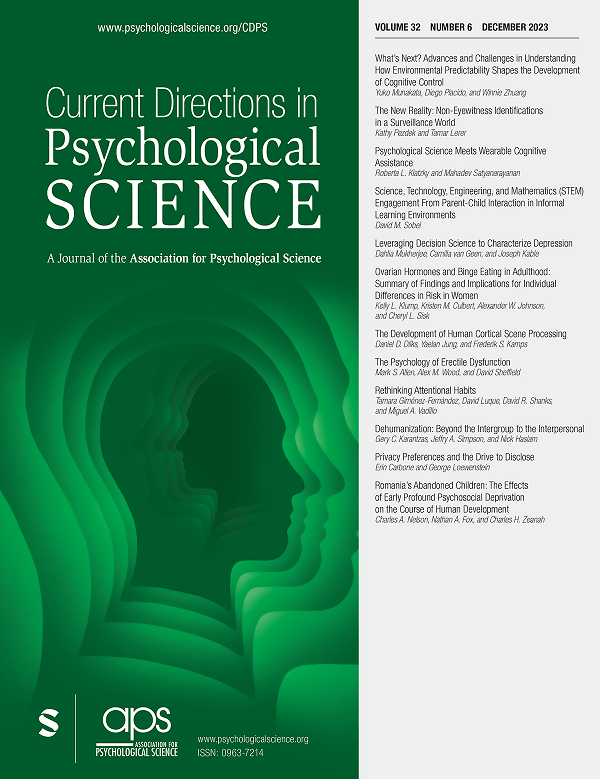
Current Directions in Psychological Science publishes reviews by leading experts covering all of scientific psychology and its applications. Each issue of Current Directions features a diverse mix of reports on various topics such as language, memory and cognition, development, the neural basis of behavior and emotions, various aspects of psychopathology, and theory of mind. These articles allow readers to stay apprised of important developments across subfields beyond their areas of expertise and bodies of research they might not otherwise be aware of. The articles in Current Directions are also written to be accessible to non-experts, making them ideally suited for use in the classroom as teaching supplements.



 京公网安备 11010802042870号
京ICP备2023020795号-1
京公网安备 11010802042870号
京ICP备2023020795号-1

 分享
分享
 求助内容:
求助内容: 应助结果提醒方式:
 扫码关注我们
