Yangcheng Dou , Xuecheng Dong , Yichang Ma , Peng Ge , Chong Li , Aimei Zhu , Qinglin Liu , Qiugen Zhang
{"title":"Hollow fiber ultrafiltration membranes of poly(biphenyl-trifluoroacetone)","authors":"Yangcheng Dou , Xuecheng Dong , Yichang Ma , Peng Ge , Chong Li , Aimei Zhu , Qinglin Liu , Qiugen Zhang","doi":"10.1016/j.memsci.2022.120779","DOIUrl":null,"url":null,"abstract":"<div><p><span><span>This paper reports a kind of fluorinated aromatic polymers for preparing high-performance hollow fiber </span>ultrafiltration membranes. Poly(biphenyl-trifluoroacetone) (PBT) with all-carbon backbone and a high molecular weight is synthesized </span><em>via</em><span> a superacid-catalyzed Friedel-Crafts reaction between biphenyl and trifluoromethyl ketone, and applied to prepare hollow fiber membranes (HFMs) with a typical self-supporting structure. The concentrations of PBT and polyethylene glycol (PEG) in dope solutions are investigated in detail to reveal the HFMs’ structure-performance relationship. The resulting PBT HFMs show an excellent scale-up, a membrane-forming ability and separation performance. Typically, the M-16/10 membrane has a BSA rejection up to 99.7% with a high pure water permeance of 353.3 L m</span><sup>−2</sup> h<sup>−1</sup> bar<sup>−1</sup><span>. Meanwhile, with strong mechanical properties<span> these HFMs can operate at a high pressure of 4.0 bar. In addition, the permeance and the rejection almost do not change during a long-term filtration of a 500 ppm BSA solution, showing an excellent long-term stability of the HFMs. As a novel membrane material, the newly developed PBT should have a great potential in the preparation of separation membranes, particularly in the HFMs.</span></span></p></div>","PeriodicalId":368,"journal":{"name":"Journal of Membrane Science","volume":"659 ","pages":"Article 120779"},"PeriodicalIF":9.0000,"publicationDate":"2022-10-05","publicationTypes":"Journal Article","fieldsOfStudy":null,"isOpenAccess":false,"openAccessPdf":"","citationCount":"3","resultStr":null,"platform":"Semanticscholar","paperid":null,"PeriodicalName":"Journal of Membrane Science","FirstCategoryId":"5","ListUrlMain":"https://www.sciencedirect.com/science/article/pii/S0376738822005245","RegionNum":1,"RegionCategory":"工程技术","ArticlePicture":[],"TitleCN":null,"AbstractTextCN":null,"PMCID":null,"EPubDate":"2022/6/28 0:00:00","PubModel":"Epub","JCR":"Q1","JCRName":"ENGINEERING, CHEMICAL","Score":null,"Total":0}
引用次数: 3
Abstract
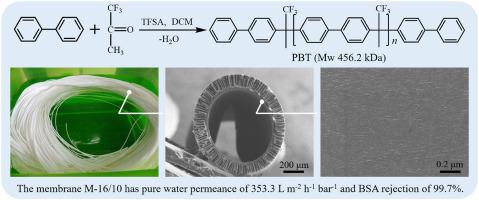
This paper reports a kind of fluorinated aromatic polymers for preparing high-performance hollow fiber ultrafiltration membranes. Poly(biphenyl-trifluoroacetone) (PBT) with all-carbon backbone and a high molecular weight is synthesized via a superacid-catalyzed Friedel-Crafts reaction between biphenyl and trifluoromethyl ketone, and applied to prepare hollow fiber membranes (HFMs) with a typical self-supporting structure. The concentrations of PBT and polyethylene glycol (PEG) in dope solutions are investigated in detail to reveal the HFMs’ structure-performance relationship. The resulting PBT HFMs show an excellent scale-up, a membrane-forming ability and separation performance. Typically, the M-16/10 membrane has a BSA rejection up to 99.7% with a high pure water permeance of 353.3 L m−2 h−1 bar−1. Meanwhile, with strong mechanical properties these HFMs can operate at a high pressure of 4.0 bar. In addition, the permeance and the rejection almost do not change during a long-term filtration of a 500 ppm BSA solution, showing an excellent long-term stability of the HFMs. As a novel membrane material, the newly developed PBT should have a great potential in the preparation of separation membranes, particularly in the HFMs.
期刊介绍:
The Journal of Membrane Science is a publication that focuses on membrane systems and is aimed at academic and industrial chemists, chemical engineers, materials scientists, and membranologists. It publishes original research and reviews on various aspects of membrane transport, membrane formation/structure, fouling, module/process design, and processes/applications. The journal primarily focuses on the structure, function, and performance of non-biological membranes but also includes papers that relate to biological membranes. The Journal of Membrane Science publishes Full Text Papers, State-of-the-Art Reviews, Letters to the Editor, and Perspectives.



 京公网安备 11010802042870号
京ICP备2023020795号-1
京公网安备 11010802042870号
京ICP备2023020795号-1

 分享
分享
 求助内容:
求助内容: 应助结果提醒方式:
 扫码关注我们
