{"title":"Vps501 links sorting nexins to TORC1 regulation in budding yeast.","authors":"Jacob H Brock, Muhammad A Rahman, Richard J Chi","doi":"10.1080/27694127.2022.2111151","DOIUrl":null,"url":null,"abstract":"<p><p>The lysosome in animal cells or the vacuole in plant and yeast cells serve as storage and/or recycling depots and their delimiting membranes host signaling events critical for starvation-induced cellular self-eating or macroautophagy/autophagy. Initiation of autophagy occurs when the Atg1 complex is formed and this process requires the inactivation of the target of rapamycin complex 1 (TORC1), a master regulator of cell growth and metabolism in all eukaryotes. In budding yeast, TORC1 localizes to two independent pools around the vacuolar membrane and in signaling endosomes juxtaposed to the vacuole. These pools are thought to exist independently of nutrient availability and target unique substrates using regulatory elements that are not well understood. One key upstream regulator of TORC1 is the SEA complex (GATOR complex in humans). The SEA complex is a multimeric eight-protein complex (Iml1/Sea1, Rtc1/Sea2, Mtc5/Sea3, Sea4, Seh1, Sec13, Npr2, Npr3) with both inhibiting and activating TORC1 domains, that resides on the vacuolar membrane. However, despite the discovery of the SEA complex over a decade ago, it is still not well understood. In our recent manuscript, we identified a genetic and functional connection between a novel yeast sorting nexin, Vps501, and the SEA complex.</p><p><strong>Abbreviations: </strong>ORF: open reading frame; PX: Phox homology; SEACIT: sea complex inhibitory domain; SNX: Sorting nexin; TORC1: target of rapamycin complex 1.</p>","PeriodicalId":72341,"journal":{"name":"Autophagy reports","volume":" ","pages":"377-380"},"PeriodicalIF":0.0000,"publicationDate":"2022-10-12","publicationTypes":"Journal Article","fieldsOfStudy":null,"isOpenAccess":false,"openAccessPdf":"https://www.ncbi.nlm.nih.gov/pmc/articles/PMC11864680/pdf/","citationCount":"0","resultStr":null,"platform":"Semanticscholar","paperid":null,"PeriodicalName":"Autophagy reports","FirstCategoryId":"1085","ListUrlMain":"https://doi.org/10.1080/27694127.2022.2111151","RegionNum":0,"RegionCategory":null,"ArticlePicture":[],"TitleCN":null,"AbstractTextCN":null,"PMCID":null,"EPubDate":"2022/1/1 0:00:00","PubModel":"eCollection","JCR":"","JCRName":"","Score":null,"Total":0}
引用次数: 0
Abstract
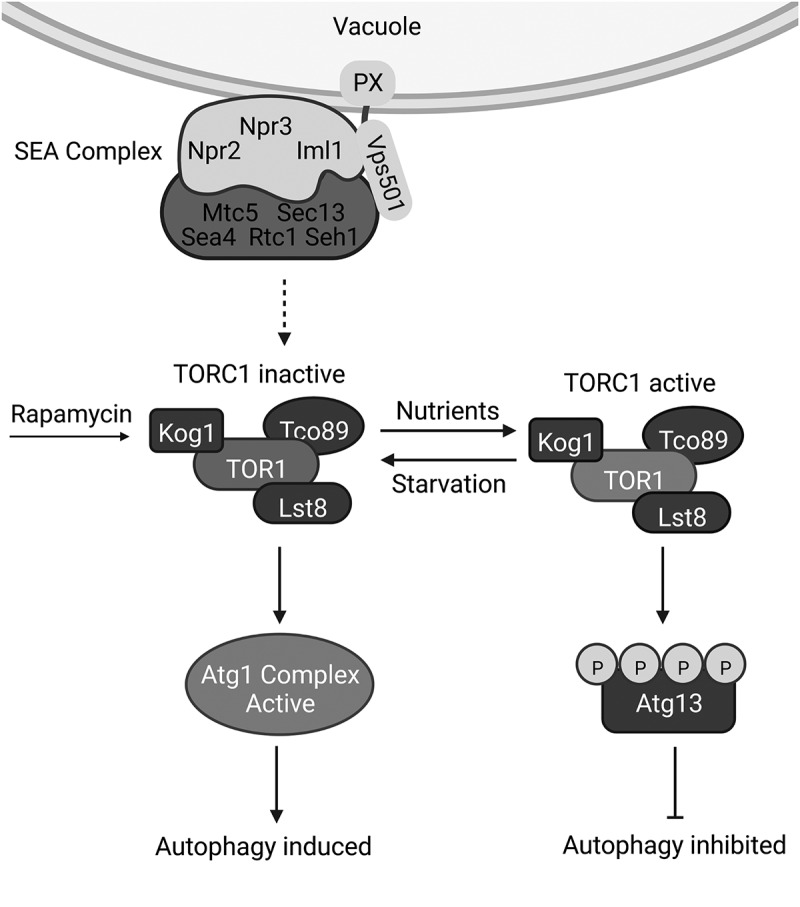
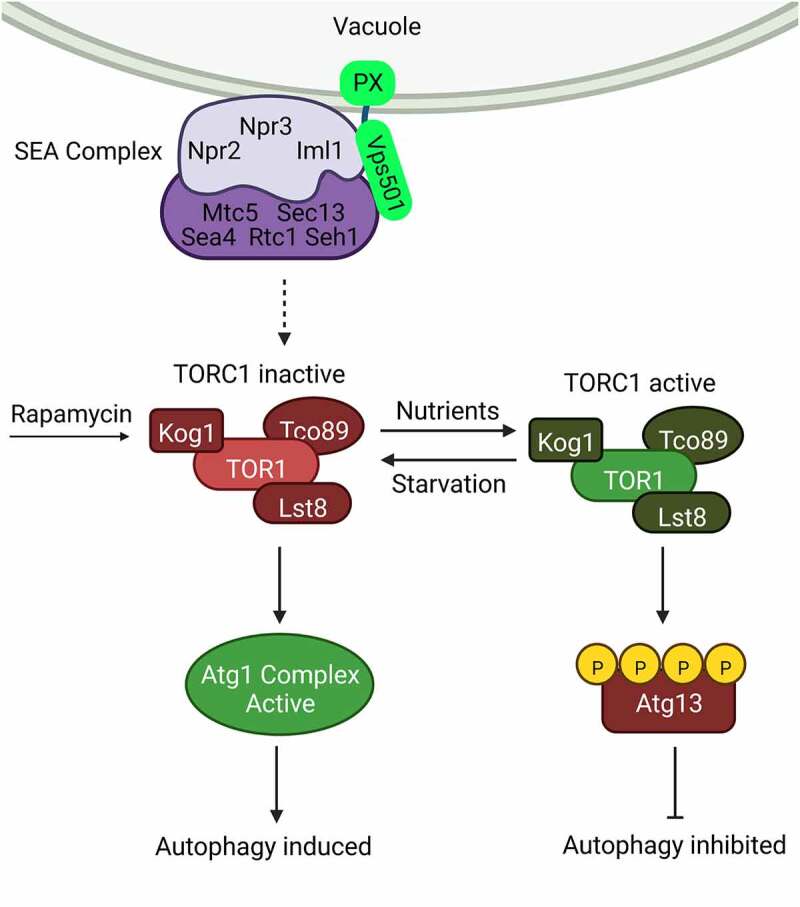
The lysosome in animal cells or the vacuole in plant and yeast cells serve as storage and/or recycling depots and their delimiting membranes host signaling events critical for starvation-induced cellular self-eating or macroautophagy/autophagy. Initiation of autophagy occurs when the Atg1 complex is formed and this process requires the inactivation of the target of rapamycin complex 1 (TORC1), a master regulator of cell growth and metabolism in all eukaryotes. In budding yeast, TORC1 localizes to two independent pools around the vacuolar membrane and in signaling endosomes juxtaposed to the vacuole. These pools are thought to exist independently of nutrient availability and target unique substrates using regulatory elements that are not well understood. One key upstream regulator of TORC1 is the SEA complex (GATOR complex in humans). The SEA complex is a multimeric eight-protein complex (Iml1/Sea1, Rtc1/Sea2, Mtc5/Sea3, Sea4, Seh1, Sec13, Npr2, Npr3) with both inhibiting and activating TORC1 domains, that resides on the vacuolar membrane. However, despite the discovery of the SEA complex over a decade ago, it is still not well understood. In our recent manuscript, we identified a genetic and functional connection between a novel yeast sorting nexin, Vps501, and the SEA complex.




 京公网安备 11010802042870号
京ICP备2023020795号-1
京公网安备 11010802042870号
京ICP备2023020795号-1

 分享
分享

 求助内容:
求助内容: 应助结果提醒方式:
 扫码关注我们
