{"title":"Microgels-on-macrogel: A simple cytophilic surface makeover of soft agarose substrates","authors":"Xueying Yu , Fang Cheng , Wei He","doi":"10.1016/j.jciso.2022.100056","DOIUrl":null,"url":null,"abstract":"<div><p>Microgel-mediated surface modification has shown great promises for a variety of metallic and non-metallic substrates. Yet, despite its compelling merits, this approach is less implemented on soft hydrogel substrates. Here, using the well-known bioinert agarose hydrogel as an example, we highlight a microgels-on-macrogel strategy that readily confers cytophilicity to the agarose surface toward anchorage-dependent cells. Specifically, we selected glycerol diglycidyl ether to tailor design polyetheramine-bisepoxide-based cationic microgels with more prominent ether alcohol features for enhanced chemical compatibility with agarose. Through a simple drop casting method, concurrent modifications of chemical, morphological and mechanical properties of the surface of agarose gel were then achieved with these microgels bound to the surface in a non-covalent yet robust manner. With the mere introduction of the cationic microgels, not only was the non-adhesive agarose surface effectively transformed to be cytophilic shown by the favorable responses from the in vitro culture of MC3T3-E1 cells, but also was hydrophobic reservoir function integrated conveniently. The demonstration of its feasibility and versatility warrants continued research of this straightforward microgels-on-macrogel strategy, which could be of value particularly for the development of novel biointerfaces.</p></div>","PeriodicalId":73541,"journal":{"name":"JCIS open","volume":"7 ","pages":"Article 100056"},"PeriodicalIF":0.0000,"publicationDate":"2022-10-01","publicationTypes":"Journal Article","fieldsOfStudy":null,"isOpenAccess":false,"openAccessPdf":"https://www.sciencedirect.com/science/article/pii/S2666934X22000149/pdfft?md5=7770595cfb3f696708266799256f07b0&pid=1-s2.0-S2666934X22000149-main.pdf","citationCount":"1","resultStr":null,"platform":"Semanticscholar","paperid":null,"PeriodicalName":"JCIS open","FirstCategoryId":"1085","ListUrlMain":"https://www.sciencedirect.com/science/article/pii/S2666934X22000149","RegionNum":0,"RegionCategory":null,"ArticlePicture":[],"TitleCN":null,"AbstractTextCN":null,"PMCID":null,"EPubDate":"","PubModel":"","JCR":"Q3","JCRName":"Materials Science","Score":null,"Total":0}
引用次数: 1
Abstract
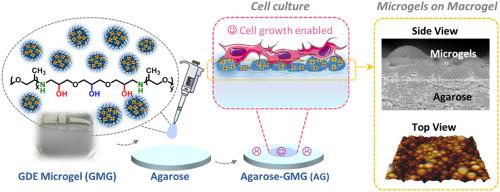
Microgel-mediated surface modification has shown great promises for a variety of metallic and non-metallic substrates. Yet, despite its compelling merits, this approach is less implemented on soft hydrogel substrates. Here, using the well-known bioinert agarose hydrogel as an example, we highlight a microgels-on-macrogel strategy that readily confers cytophilicity to the agarose surface toward anchorage-dependent cells. Specifically, we selected glycerol diglycidyl ether to tailor design polyetheramine-bisepoxide-based cationic microgels with more prominent ether alcohol features for enhanced chemical compatibility with agarose. Through a simple drop casting method, concurrent modifications of chemical, morphological and mechanical properties of the surface of agarose gel were then achieved with these microgels bound to the surface in a non-covalent yet robust manner. With the mere introduction of the cationic microgels, not only was the non-adhesive agarose surface effectively transformed to be cytophilic shown by the favorable responses from the in vitro culture of MC3T3-E1 cells, but also was hydrophobic reservoir function integrated conveniently. The demonstration of its feasibility and versatility warrants continued research of this straightforward microgels-on-macrogel strategy, which could be of value particularly for the development of novel biointerfaces.




 京公网安备 11010802042870号
京ICP备2023020795号-1
京公网安备 11010802042870号
京ICP备2023020795号-1

 分享
分享
 求助内容:
求助内容: 应助结果提醒方式:
 扫码关注我们
