{"title":"<i>DeviceD</i>: Audience-dancer interaction via social media posts and wearable for haptic feedback.","authors":"Manoli Moriaty, Lucie Sykes","doi":"10.1017/wtc.2021.20","DOIUrl":null,"url":null,"abstract":"<p><p>The performative installation <i>DeviceD</i> utilizes a network of systems toward facilitating interaction between dancer, digital media, and audience. Central to the work is a wearable haptic feedback system able to wirelessly deliver vibrotactile stimuli, with the latter initiated by the audience through posting on Twitter social media platform; the system in use searches for specific mentions, hashtags, and keywords, with positive results causing the system to trigger patterns of haptic biofeedback across the wearable's four actuator motors. The system acts as the intermediator between the audience's online actions and the dancer receiving physical stimuli; the dancer interprets these biofeedback signals according to Laban's Effort movement qualities, with the interpretation informing different states of habitual and conscious choreographic performance. In this article, the authors reflect on their collaborative process while developing <i>DeviceD</i> alongside a multidisciplinary team of technologists, detailing their experience of refining the technology and methodology behind the work while presenting it in three different settings. A literature review is used to situate the work among contemporary research on interaction over internet and haptics in performance practice; haptic feedback devices have been widely used within artistic work for the past 25 years, with more recent practice and research outputs suggesting an increased interest for haptics in the field of dance research. The authors detail both technological and performative elements making up the work, and provide a transparent evaluation of the system, as means of providing a foundation for further research on wearable haptic devices.</p>","PeriodicalId":3,"journal":{"name":"ACS Applied Electronic Materials","volume":" ","pages":"e3"},"PeriodicalIF":4.7000,"publicationDate":"2022-02-18","publicationTypes":"Journal Article","fieldsOfStudy":null,"isOpenAccess":false,"openAccessPdf":"https://www.ncbi.nlm.nih.gov/pmc/articles/PMC10936264/pdf/","citationCount":"0","resultStr":null,"platform":"Semanticscholar","paperid":null,"PeriodicalName":"ACS Applied Electronic Materials","FirstCategoryId":"1085","ListUrlMain":"https://doi.org/10.1017/wtc.2021.20","RegionNum":3,"RegionCategory":"材料科学","ArticlePicture":[],"TitleCN":null,"AbstractTextCN":null,"PMCID":null,"EPubDate":"2022/1/1 0:00:00","PubModel":"eCollection","JCR":"Q1","JCRName":"ENGINEERING, ELECTRICAL & ELECTRONIC","Score":null,"Total":0}
引用次数: 0
Abstract
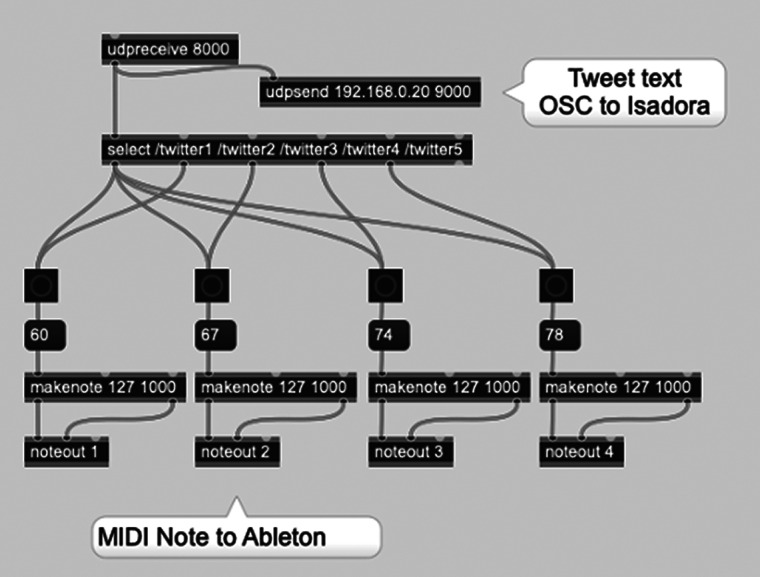
The performative installation DeviceD utilizes a network of systems toward facilitating interaction between dancer, digital media, and audience. Central to the work is a wearable haptic feedback system able to wirelessly deliver vibrotactile stimuli, with the latter initiated by the audience through posting on Twitter social media platform; the system in use searches for specific mentions, hashtags, and keywords, with positive results causing the system to trigger patterns of haptic biofeedback across the wearable's four actuator motors. The system acts as the intermediator between the audience's online actions and the dancer receiving physical stimuli; the dancer interprets these biofeedback signals according to Laban's Effort movement qualities, with the interpretation informing different states of habitual and conscious choreographic performance. In this article, the authors reflect on their collaborative process while developing DeviceD alongside a multidisciplinary team of technologists, detailing their experience of refining the technology and methodology behind the work while presenting it in three different settings. A literature review is used to situate the work among contemporary research on interaction over internet and haptics in performance practice; haptic feedback devices have been widely used within artistic work for the past 25 years, with more recent practice and research outputs suggesting an increased interest for haptics in the field of dance research. The authors detail both technological and performative elements making up the work, and provide a transparent evaluation of the system, as means of providing a foundation for further research on wearable haptic devices.
期刊介绍:
ACS Applied Electronic Materials is an interdisciplinary journal publishing original research covering all aspects of electronic materials. The journal is devoted to reports of new and original experimental and theoretical research of an applied nature that integrate knowledge in the areas of materials science, engineering, optics, physics, and chemistry into important applications of electronic materials. Sample research topics that span the journal's scope are inorganic, organic, ionic and polymeric materials with properties that include conducting, semiconducting, superconducting, insulating, dielectric, magnetic, optoelectronic, piezoelectric, ferroelectric and thermoelectric.
Indexed/Abstracted:
Web of Science SCIE
Scopus
CAS
INSPEC
Portico






 京公网安备 11010802042870号
京ICP备2023020795号-1
京公网安备 11010802042870号
京ICP备2023020795号-1

 分享
分享
 求助内容:
求助内容: 应助结果提醒方式:
 扫码关注我们
