{"title":"Insights into the role of Zn and Ga in the hydrogenation of CO2 to methanol over Pd","authors":"Raydel Manrique , Romel Jiménez , Jhonatan Rodríguez-Pereira , Víctor G. Baldovino-Medrano , Alejandro Karelovic","doi":"10.1016/j.ijhydene.2019.04.206","DOIUrl":null,"url":null,"abstract":"<div><div>The hydrogenation of CO<sub>2</sub> to methanol is a viable alternative for reducing greenhouse gases net emissions as well as a route for hydrogen storage and transportation. In this context, the synthesis of active and selective catalysts is a relevant objective. In this work, we study the promotion of Pd with Ga and Zn in the hydrogenation of CO<sub>2</sub><span> to methanol at 800 kPa and 220–280 °C. Mono and intermetallic catalysts (Pd/SiO</span><sub>2</sub>, Pd<img>Ga/SiO<sub>2</sub> and Pd<img>Zn/SiO<sub>2</sub><span><span>) were synthesized by incipient wetness impregnation with the aid of </span>triethanolamine<span><span> as an organic additive, obtaining similar average metal particle sizes (between 9 and 12 nm). Kinetic analysis reveals that the addition of Ga and Zn increases the </span>turnover frequency for methanol formation by an order of magnitude without significant changes in the reaction rate of the reverse water-gas shift (r-WGS) which is a parallel undesired reaction. The selectivity to methanol (at 220 °C) thus increases from 3% for Pd/SiO</span></span><sub>2</sub> to 12% for Pd<img>Ga/SiO<sub>2</sub> and 30% for Pd<img>Zn/SiO<sub>2</sub><span><span>. XPS studies, Infrared analysis of CO adsorption, and XRD analyses show the presence of </span>intermetallic phases Pd</span><sub>2</sub><span>Ga and PdZn on the surface. The results suggest that Ga and Zn promote Pd, increasing its activity towards the synthesis of methanol, by creating more active sites for this reaction. These sites are likely formed by intermetallic compounds such as Pd</span><sub>2</sub>Ga and PdZn.</div></div>","PeriodicalId":337,"journal":{"name":"International Journal of Hydrogen Energy","volume":"44 31","pages":"Pages 16526-16536"},"PeriodicalIF":8.3000,"publicationDate":"2019-06-21","publicationTypes":"Journal Article","fieldsOfStudy":null,"isOpenAccess":false,"openAccessPdf":"","citationCount":"0","resultStr":null,"platform":"Semanticscholar","paperid":null,"PeriodicalName":"International Journal of Hydrogen Energy","FirstCategoryId":"5","ListUrlMain":"https://www.sciencedirect.com/science/article/pii/S0360319919316398","RegionNum":2,"RegionCategory":"工程技术","ArticlePicture":[],"TitleCN":null,"AbstractTextCN":null,"PMCID":null,"EPubDate":"2019/5/16 0:00:00","PubModel":"Epub","JCR":"Q1","JCRName":"CHEMISTRY, PHYSICAL","Score":null,"Total":0}
引用次数: 0
Abstract
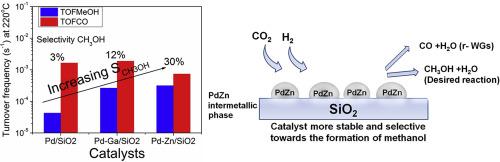
The hydrogenation of CO2 to methanol is a viable alternative for reducing greenhouse gases net emissions as well as a route for hydrogen storage and transportation. In this context, the synthesis of active and selective catalysts is a relevant objective. In this work, we study the promotion of Pd with Ga and Zn in the hydrogenation of CO2 to methanol at 800 kPa and 220–280 °C. Mono and intermetallic catalysts (Pd/SiO2, PdGa/SiO2 and PdZn/SiO2) were synthesized by incipient wetness impregnation with the aid of triethanolamine as an organic additive, obtaining similar average metal particle sizes (between 9 and 12 nm). Kinetic analysis reveals that the addition of Ga and Zn increases the turnover frequency for methanol formation by an order of magnitude without significant changes in the reaction rate of the reverse water-gas shift (r-WGS) which is a parallel undesired reaction. The selectivity to methanol (at 220 °C) thus increases from 3% for Pd/SiO2 to 12% for PdGa/SiO2 and 30% for PdZn/SiO2. XPS studies, Infrared analysis of CO adsorption, and XRD analyses show the presence of intermetallic phases Pd2Ga and PdZn on the surface. The results suggest that Ga and Zn promote Pd, increasing its activity towards the synthesis of methanol, by creating more active sites for this reaction. These sites are likely formed by intermetallic compounds such as Pd2Ga and PdZn.
期刊介绍:
The objective of the International Journal of Hydrogen Energy is to facilitate the exchange of new ideas, technological advancements, and research findings in the field of Hydrogen Energy among scientists and engineers worldwide. This journal showcases original research, both analytical and experimental, covering various aspects of Hydrogen Energy. These include production, storage, transmission, utilization, enabling technologies, environmental impact, economic considerations, and global perspectives on hydrogen and its carriers such as NH3, CH4, alcohols, etc.
The utilization aspect encompasses various methods such as thermochemical (combustion), photochemical, electrochemical (fuel cells), and nuclear conversion of hydrogen, hydrogen isotopes, and hydrogen carriers into thermal, mechanical, and electrical energies. The applications of these energies can be found in transportation (including aerospace), industrial, commercial, and residential sectors.



 京公网安备 11010802042870号
京ICP备2023020795号-1
京公网安备 11010802042870号
京ICP备2023020795号-1

 分享
分享
 求助内容:
求助内容: 应助结果提醒方式:
 扫码关注我们
