Xuemin Yin, Hejun Li, Ruimei Yuan, Yameng Jiao, Jinhua Lu
{"title":"Templated synthesis of spinel cobaltite MCo2O4 (M=Ni, Co and Mn) hierarchical nanofibers for high performance supercapacitors","authors":"Xuemin Yin, Hejun Li, Ruimei Yuan, Yameng Jiao, Jinhua Lu","doi":"10.1016/j.jmat.2020.12.007","DOIUrl":null,"url":null,"abstract":"<div><p>Rational construction of transitional metal oxides electrode materials with suitable structure and composition is an effective strategy of improving their electrochemical performance. Herein, novel MCo<sub>2</sub>O<sub>4</sub> hierarchical nanofibers (H-MCo<sub>2</sub>O<sub>4</sub>NFs, M = Ni, Co and Mn) were fabricated by a multi-step self-templating method using electrospun nanofibers as precursors. Benefiting from the unique structure, such as numerous of vertically interlinked nanosheets on the surface and 1D interwoven nanofibers networks, the obtained H<img>NiCo<sub>2</sub>O<sub>4</sub>NFs electrode exhibits a high specific capacitance of 1750 F g<sup>−1</sup> (At a current density of 0.5 A g<sup>−1</sup>), good rate capability (Capacitance retention of 70% at 20 A g<sup>−1</sup>), and outstanding cycling stability (Capacitance retention of 92% after 6000 cycles). Moreover, the solid-state hybrid supercapacitor assembled by H<img>NiCo<sub>2</sub>O<sub>4</sub>NFs and activated carbon (AC), delivers a high energy density of 38.4 Wh kg<sup>−1</sup> at a power density of 800 W kg<sup>−1</sup>, and excellent cycling stability. Thus, the H<img>NiCo<sub>2</sub>O<sub>4</sub>NFs is a promising candidate material for supercapacitors electrode and this self-templating method in this work also provides a new path for the preparation of one-dimensional hierarchical metallic oxides.</p></div>","PeriodicalId":16173,"journal":{"name":"Journal of Materiomics","volume":"7 4","pages":"Pages 858-868"},"PeriodicalIF":9.6000,"publicationDate":"2021-07-01","publicationTypes":"Journal Article","fieldsOfStudy":null,"isOpenAccess":false,"openAccessPdf":"https://sci-hub-pdf.com/10.1016/j.jmat.2020.12.007","citationCount":"14","resultStr":null,"platform":"Semanticscholar","paperid":null,"PeriodicalName":"Journal of Materiomics","FirstCategoryId":"88","ListUrlMain":"https://www.sciencedirect.com/science/article/pii/S2352847820305311","RegionNum":1,"RegionCategory":"材料科学","ArticlePicture":[],"TitleCN":null,"AbstractTextCN":null,"PMCID":null,"EPubDate":"","PubModel":"","JCR":"Q1","JCRName":"CHEMISTRY, PHYSICAL","Score":null,"Total":0}
引用次数: 14
Abstract
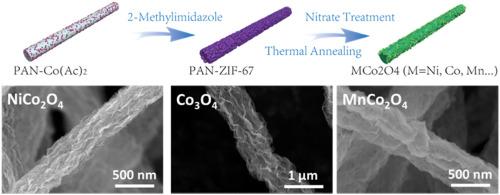
Rational construction of transitional metal oxides electrode materials with suitable structure and composition is an effective strategy of improving their electrochemical performance. Herein, novel MCo2O4 hierarchical nanofibers (H-MCo2O4NFs, M = Ni, Co and Mn) were fabricated by a multi-step self-templating method using electrospun nanofibers as precursors. Benefiting from the unique structure, such as numerous of vertically interlinked nanosheets on the surface and 1D interwoven nanofibers networks, the obtained HNiCo2O4NFs electrode exhibits a high specific capacitance of 1750 F g−1 (At a current density of 0.5 A g−1), good rate capability (Capacitance retention of 70% at 20 A g−1), and outstanding cycling stability (Capacitance retention of 92% after 6000 cycles). Moreover, the solid-state hybrid supercapacitor assembled by HNiCo2O4NFs and activated carbon (AC), delivers a high energy density of 38.4 Wh kg−1 at a power density of 800 W kg−1, and excellent cycling stability. Thus, the HNiCo2O4NFs is a promising candidate material for supercapacitors electrode and this self-templating method in this work also provides a new path for the preparation of one-dimensional hierarchical metallic oxides.
合理构建结构和成分合适的过渡金属氧化物电极材料是提高其电化学性能的有效策略。本文以电纺丝纳米纤维为前驱体,采用多步自模板法制备了H-MCo2O4NFs、M = Ni、Co和Mn的多层MCo2O4纳米纤维。由于其独特的结构,如表面有大量垂直互连的纳米片和一维相互编织的纳米纤维网络,所得的HNiCo2O4NFs电极具有1750 F g−1(电流密度为0.5 a g−1)的高比电容,良好的倍率能力(20 a g−1时电容保持率为70%),以及出色的循环稳定性(循环6000次后电容保持率为92%)。此外,由HNiCo2O4NFs和活性炭(AC)组装的固态混合超级电容器在功率密度为800 W kg - 1时具有38.4 Wh kg - 1的高能量密度,并且具有良好的循环稳定性。因此,HNiCo2O4NFs是一种很有前途的超级电容器电极候选材料,本研究的自模板方法也为一维分层金属氧化物的制备提供了新的途径。
期刊介绍:
The Journal of Materiomics is a peer-reviewed open-access journal that aims to serve as a forum for the continuous dissemination of research within the field of materials science. It particularly emphasizes systematic studies on the relationships between composition, processing, structure, property, and performance of advanced materials. The journal is supported by the Chinese Ceramic Society and is indexed in SCIE and Scopus. It is commonly referred to as J Materiomics.



 京公网安备 11010802042870号
京ICP备2023020795号-1
京公网安备 11010802042870号
京ICP备2023020795号-1

 分享
分享
 求助内容:
求助内容: 应助结果提醒方式:
 扫码关注我们
