Clinical significance of mechanistic target of rapamycin expression in vessels that encapsulate tumor cluster-positive hepatocellular carcinoma patients who have undergone living donor liver transplantation
{"title":"Clinical significance of mechanistic target of rapamycin expression in vessels that encapsulate tumor cluster-positive hepatocellular carcinoma patients who have undergone living donor liver transplantation","authors":"Katsuya Toshida, Shinji Itoh, Takeo Toshima, Shohei Yoshiya, Ryoichi Goto, Atsuyoshi Mita, Noboru Harada, Kenichi Kohashi, Yoshinao Oda, Tomoharu Yoshizumi","doi":"10.1002/ags3.12735","DOIUrl":null,"url":null,"abstract":"<div>\n \n \n <section>\n \n <h3> Background</h3>\n \n <p>There is limited published information regarding the expression of mechanistic target of rapamycin (mTOR) in vessels that encapsulate tumor cluster (VETC)-positive hepatocellular carcinoma (HCC). The mTOR inhibitor, everolimus, has been approved as an immunosuppressant for use in HCC patients after living donor liver transplantation (LDLT).</p>\n </section>\n \n <section>\n \n <h3> Methods</h3>\n \n <p>Using a database of 214 patients who underwent LDLT for HCC, we examined the mTOR protein and angiopoietin-2 (Ang-2) in VETC-positive HCC by immunohistochemical staining. The presence of VETC and mTOR expression were evaluated in both primary and recurrent HCC lesions.</p>\n </section>\n \n <section>\n \n <h3> Results</h3>\n \n <p>Forty-three of the 214 patients (20.1%) were VETC-positive, and 29 of these 43 patients (67.4%) expressed mTOR. Relative Ang-2 expression was significantly higher in the mTOR-positive than in the mTOR-negative group (<i>p</i> = 0.037). Thirty-four of the 214 patients experienced HCC recurrence after LDLT; 20 of these were operable. The primary lesions of six of these 20 patients were VETC-positive; five of these six patients also had VETC-positive recurrent lesions (<i>p</i> < 0.001). The expression of mTOR was significantly higher in the VETC-positive lesions (<i>p</i> = 0.0018).</p>\n </section>\n \n <section>\n \n <h3> Conclusions</h3>\n \n <p>We showed that mTOR expression was higher in the VETC-positive primary and recurrent lesions than in the VETC-negative ones.</p>\n </section>\n </div>","PeriodicalId":8030,"journal":{"name":"Annals of Gastroenterological Surgery","volume":"8 1","pages":"163-171"},"PeriodicalIF":3.3000,"publicationDate":"2023-08-28","publicationTypes":"Journal Article","fieldsOfStudy":null,"isOpenAccess":false,"openAccessPdf":"https://onlinelibrary.wiley.com/doi/epdf/10.1002/ags3.12735","citationCount":"0","resultStr":null,"platform":"Semanticscholar","paperid":null,"PeriodicalName":"Annals of Gastroenterological Surgery","FirstCategoryId":"3","ListUrlMain":"https://onlinelibrary.wiley.com/doi/10.1002/ags3.12735","RegionNum":4,"RegionCategory":"医学","ArticlePicture":[],"TitleCN":null,"AbstractTextCN":null,"PMCID":null,"EPubDate":"","PubModel":"","JCR":"Q2","JCRName":"GASTROENTEROLOGY & HEPATOLOGY","Score":null,"Total":0}
引用次数: 0
Abstract
Background
There is limited published information regarding the expression of mechanistic target of rapamycin (mTOR) in vessels that encapsulate tumor cluster (VETC)-positive hepatocellular carcinoma (HCC). The mTOR inhibitor, everolimus, has been approved as an immunosuppressant for use in HCC patients after living donor liver transplantation (LDLT).
Methods
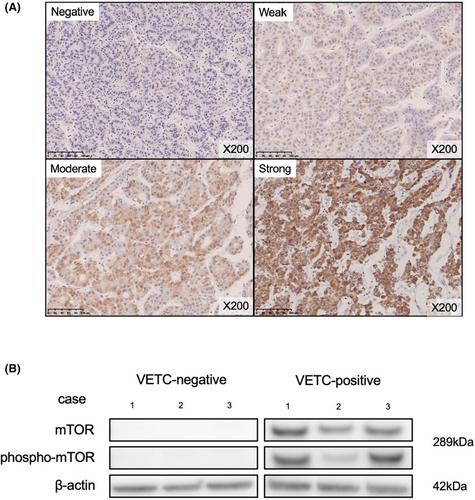
Using a database of 214 patients who underwent LDLT for HCC, we examined the mTOR protein and angiopoietin-2 (Ang-2) in VETC-positive HCC by immunohistochemical staining. The presence of VETC and mTOR expression were evaluated in both primary and recurrent HCC lesions.
Results
Forty-three of the 214 patients (20.1%) were VETC-positive, and 29 of these 43 patients (67.4%) expressed mTOR. Relative Ang-2 expression was significantly higher in the mTOR-positive than in the mTOR-negative group (p = 0.037). Thirty-four of the 214 patients experienced HCC recurrence after LDLT; 20 of these were operable. The primary lesions of six of these 20 patients were VETC-positive; five of these six patients also had VETC-positive recurrent lesions (p < 0.001). The expression of mTOR was significantly higher in the VETC-positive lesions (p = 0.0018).
Conclusions
We showed that mTOR expression was higher in the VETC-positive primary and recurrent lesions than in the VETC-negative ones.



 京公网安备 11010802042870号
京ICP备2023020795号-1
京公网安备 11010802042870号
京ICP备2023020795号-1

 分享
分享
 求助内容:
求助内容: 应助结果提醒方式:
 扫码关注我们
