Integrated mRNA and microRNA Transcriptome Sequencing Characterizes Sequence Variants and mRNA-microRNA Regulatory Networks in Grass Carp Fibroblasts Infected with Virulent and Attenuated GCRV
Qiucheng Yao, Mengdi Zhang, Shaopo Zu, Hong Yang, Weitian Xie, Jinjun Chen, Zhibao Chen, Ye Ge, Weiwei Zeng, Zhihui Zhao
{"title":"Integrated mRNA and microRNA Transcriptome Sequencing Characterizes Sequence Variants and mRNA-microRNA Regulatory Networks in Grass Carp Fibroblasts Infected with Virulent and Attenuated GCRV","authors":"Qiucheng Yao, Mengdi Zhang, Shaopo Zu, Hong Yang, Weitian Xie, Jinjun Chen, Zhibao Chen, Ye Ge, Weiwei Zeng, Zhihui Zhao","doi":"10.1007/s10126-021-10029-4","DOIUrl":null,"url":null,"abstract":"<p>Grass carp hemorrhagic disease is a fatal disease caused by the grass carp reovirus (GCRV). The aberrant regulation of transcripts has been implicated in many types of diseases. In the present study, we characterized mRNA and miRNA transcriptomes of different virulent GCRVs using RNA sequencing (RNA-Seq). One hundred eighteen miRNAs were identified as being differentially expressed between different virulent viruses in grass carp fibroblasts. Eight miRNAs were selected to verify the RNA-Seq results using RT-PCR and mRNA methods. In total, 996 differentially expressed mRNA genes were identified in grass carp fibroblasts, while 901 miRNA-mRNA target pairs were observed to be inversely regulated in grass carp fibroblasts. Integrated mRNA/miRNA expression profiling analysis results showed that the most influenced processes were the immune response and cell death. Three miRNAs were shown to exhibit the same expression patterns when two different methods were used and had important functions during viral infection. These results provide insights into the miRNA-mediated regulation of mRNA and valuable resources on transcript variation and regulation during GCRV infection, which are potentially useful for mechanistic and drug studies.</p>","PeriodicalId":690,"journal":{"name":"Marine Biotechnology","volume":"23 2","pages":"342 - 355"},"PeriodicalIF":2.8000,"publicationDate":"2021-03-22","publicationTypes":"Journal Article","fieldsOfStudy":null,"isOpenAccess":false,"openAccessPdf":"https://sci-hub-pdf.com/10.1007/s10126-021-10029-4","citationCount":"4","resultStr":null,"platform":"Semanticscholar","paperid":null,"PeriodicalName":"Marine Biotechnology","FirstCategoryId":"99","ListUrlMain":"https://link.springer.com/article/10.1007/s10126-021-10029-4","RegionNum":3,"RegionCategory":"生物学","ArticlePicture":[],"TitleCN":null,"AbstractTextCN":null,"PMCID":null,"EPubDate":"","PubModel":"","JCR":"Q3","JCRName":"BIOTECHNOLOGY & APPLIED MICROBIOLOGY","Score":null,"Total":0}
引用次数: 4
Abstract
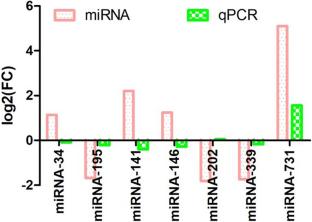
Grass carp hemorrhagic disease is a fatal disease caused by the grass carp reovirus (GCRV). The aberrant regulation of transcripts has been implicated in many types of diseases. In the present study, we characterized mRNA and miRNA transcriptomes of different virulent GCRVs using RNA sequencing (RNA-Seq). One hundred eighteen miRNAs were identified as being differentially expressed between different virulent viruses in grass carp fibroblasts. Eight miRNAs were selected to verify the RNA-Seq results using RT-PCR and mRNA methods. In total, 996 differentially expressed mRNA genes were identified in grass carp fibroblasts, while 901 miRNA-mRNA target pairs were observed to be inversely regulated in grass carp fibroblasts. Integrated mRNA/miRNA expression profiling analysis results showed that the most influenced processes were the immune response and cell death. Three miRNAs were shown to exhibit the same expression patterns when two different methods were used and had important functions during viral infection. These results provide insights into the miRNA-mediated regulation of mRNA and valuable resources on transcript variation and regulation during GCRV infection, which are potentially useful for mechanistic and drug studies.
期刊介绍:
Marine Biotechnology welcomes high-quality research papers presenting novel data on the biotechnology of aquatic organisms. The journal publishes high quality papers in the areas of molecular biology, genomics, proteomics, cell biology, and biochemistry, and particularly encourages submissions of papers related to genome biology such as linkage mapping, large-scale gene discoveries, QTL analysis, physical mapping, and comparative and functional genome analysis. Papers on technological development and marine natural products should demonstrate innovation and novel applications.




 京公网安备 11010802042870号
京ICP备2023020795号-1
京公网安备 11010802042870号
京ICP备2023020795号-1

 分享
分享
 求助内容:
求助内容: 应助结果提醒方式:
 扫码关注我们
