{"title":"Elasto-thermodiffusive nonlocal responses for a spherical cavity due to memory effect","authors":"Abhik Sur","doi":"10.1007/s11043-023-09626-8","DOIUrl":null,"url":null,"abstract":"<div><p>The present work is devoted to the derivation of fundamental equations in generalized thermoelastic diffusion theory. The main aim is to establish a size-dependent model with the consideration of spatial nonlocal effects of concentration and strain fields. The heat transport equation for the present problem is considered in the context of Moore–Gibson–Thompson (MGT) generalized thermoelasticity theory involving linear and nonlinear kernel functions in a delayed interval in terms of the memory-dependent derivative. The medium is considered to be one-dimensional having a spherical cavity where the boundary of the cavity is traction-free and is subjected to prescribed thermal and chemical shocks. The Laplace transform technique is incorporated for the solution of the basic equations. For numerical evaluation, the analytical expressions have been inverted in the space-time domain using the method of Zakian. From numerical results, the effects of the nonlocality parameters in the heat transport law and the nonlocality of mass-flux have been discussed. The effect of different kernel functions, the delay time, and the effect of thermodiffusion are also reported. A comparative study between the MGT theory and the hyperbolic Lord–Shulman theory is also explained.</p></div>","PeriodicalId":698,"journal":{"name":"Mechanics of Time-Dependent Materials","volume":"28 3","pages":"1395 - 1419"},"PeriodicalIF":2.3000,"publicationDate":"2023-07-25","publicationTypes":"Journal Article","fieldsOfStudy":null,"isOpenAccess":false,"openAccessPdf":"","citationCount":"0","resultStr":null,"platform":"Semanticscholar","paperid":null,"PeriodicalName":"Mechanics of Time-Dependent Materials","FirstCategoryId":"88","ListUrlMain":"https://link.springer.com/article/10.1007/s11043-023-09626-8","RegionNum":4,"RegionCategory":"材料科学","ArticlePicture":[],"TitleCN":null,"AbstractTextCN":null,"PMCID":null,"EPubDate":"","PubModel":"","JCR":"Q2","JCRName":"MATERIALS SCIENCE, CHARACTERIZATION & TESTING","Score":null,"Total":0}
引用次数: 0
Abstract
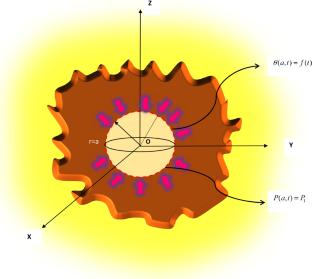
The present work is devoted to the derivation of fundamental equations in generalized thermoelastic diffusion theory. The main aim is to establish a size-dependent model with the consideration of spatial nonlocal effects of concentration and strain fields. The heat transport equation for the present problem is considered in the context of Moore–Gibson–Thompson (MGT) generalized thermoelasticity theory involving linear and nonlinear kernel functions in a delayed interval in terms of the memory-dependent derivative. The medium is considered to be one-dimensional having a spherical cavity where the boundary of the cavity is traction-free and is subjected to prescribed thermal and chemical shocks. The Laplace transform technique is incorporated for the solution of the basic equations. For numerical evaluation, the analytical expressions have been inverted in the space-time domain using the method of Zakian. From numerical results, the effects of the nonlocality parameters in the heat transport law and the nonlocality of mass-flux have been discussed. The effect of different kernel functions, the delay time, and the effect of thermodiffusion are also reported. A comparative study between the MGT theory and the hyperbolic Lord–Shulman theory is also explained.
期刊介绍:
Mechanics of Time-Dependent Materials accepts contributions dealing with the time-dependent mechanical properties of solid polymers, metals, ceramics, concrete, wood, or their composites. It is recognized that certain materials can be in the melt state as function of temperature and/or pressure. Contributions concerned with fundamental issues relating to processing and melt-to-solid transition behaviour are welcome, as are contributions addressing time-dependent failure and fracture phenomena. Manuscripts addressing environmental issues will be considered if they relate to time-dependent mechanical properties.
The journal promotes the transfer of knowledge between various disciplines that deal with the properties of time-dependent solid materials but approach these from different angles. Among these disciplines are: Mechanical Engineering, Aerospace Engineering, Chemical Engineering, Rheology, Materials Science, Polymer Physics, Design, and others.