Peng Zhang, Xingguo Wang, Huaning Jiang, Yiwei Zhang, Qianqian He, Kunpeng Si, Bixuan Li, Feifei Zhao, Anyang Cui, Yi Wei, Lixuan Liu, Haifeng Que, Peizhe Tang, Zhigao Hu, Wu Zhou, Kai Wu, Yongji Gong
{"title":"Flux-assisted growth of atomically thin materials","authors":"Peng Zhang, Xingguo Wang, Huaning Jiang, Yiwei Zhang, Qianqian He, Kunpeng Si, Bixuan Li, Feifei Zhao, Anyang Cui, Yi Wei, Lixuan Liu, Haifeng Que, Peizhe Tang, Zhigao Hu, Wu Zhou, Kai Wu, Yongji Gong","doi":"10.1038/s44160-022-00165-7","DOIUrl":null,"url":null,"abstract":"The desirable properties of atomically thin materials (ATMs) have encouraged development of preparation methods. However, many multi-element layered and non-layered ATMs are still difficult to be fabricated in a controlled manner. Here we design a flux-assisted growth approach to overcome these limitations that can reproducibly prepare high-quality ATMs, such as metal chalcogenides, oxides, oxyhalides and phosphorous trichalcogenides, and is tolerant to growth parameters such as temperature and flow rate. In this approach, target materials nucleate and crystallize following a flux-crystallization mechanism, enabling precise control of their stoichiometry. ATMs are guaranteed by the confined synthetic space and kinetically driven growth. Eighty atomically thin composite flakes, including 48 ternary or quaternary compounds and 23 non-layered materials, have been successfully prepared by this approach. Furthermore, large single crystals or continuous films of ATMs can be prepared by the same method. This proposed flux-crystallization mechanism offers great possibilities to fabricate ATMs with good stoichiometry control and non-layered structures that possess interesting physical and chemical properties. Two-dimensional materials have many desirable properties but controllable synthesis is difficult. Now, a flux-assisted growth approach has been designed to reproducibly prepare high-quality, atomically thin materials. Eighty atomically thin composite flakes have been prepared by this approach.","PeriodicalId":74251,"journal":{"name":"Nature synthesis","volume":"1 11","pages":"864-872"},"PeriodicalIF":20.0000,"publicationDate":"2022-09-29","publicationTypes":"Journal Article","fieldsOfStudy":null,"isOpenAccess":false,"openAccessPdf":"","citationCount":"5","resultStr":null,"platform":"Semanticscholar","paperid":null,"PeriodicalName":"Nature synthesis","FirstCategoryId":"1085","ListUrlMain":"https://www.nature.com/articles/s44160-022-00165-7","RegionNum":0,"RegionCategory":null,"ArticlePicture":[],"TitleCN":null,"AbstractTextCN":null,"PMCID":null,"EPubDate":"","PubModel":"","JCR":"0","JCRName":"CHEMISTRY, MULTIDISCIPLINARY","Score":null,"Total":0}
引用次数: 5
Abstract
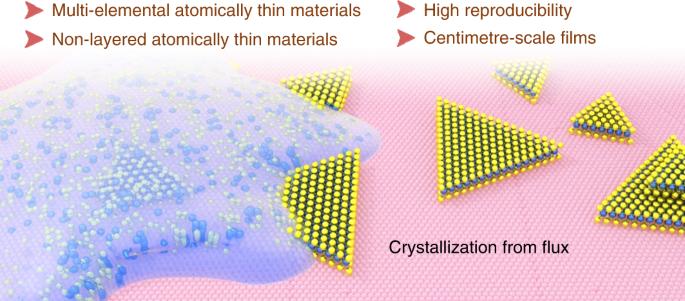
The desirable properties of atomically thin materials (ATMs) have encouraged development of preparation methods. However, many multi-element layered and non-layered ATMs are still difficult to be fabricated in a controlled manner. Here we design a flux-assisted growth approach to overcome these limitations that can reproducibly prepare high-quality ATMs, such as metal chalcogenides, oxides, oxyhalides and phosphorous trichalcogenides, and is tolerant to growth parameters such as temperature and flow rate. In this approach, target materials nucleate and crystallize following a flux-crystallization mechanism, enabling precise control of their stoichiometry. ATMs are guaranteed by the confined synthetic space and kinetically driven growth. Eighty atomically thin composite flakes, including 48 ternary or quaternary compounds and 23 non-layered materials, have been successfully prepared by this approach. Furthermore, large single crystals or continuous films of ATMs can be prepared by the same method. This proposed flux-crystallization mechanism offers great possibilities to fabricate ATMs with good stoichiometry control and non-layered structures that possess interesting physical and chemical properties. Two-dimensional materials have many desirable properties but controllable synthesis is difficult. Now, a flux-assisted growth approach has been designed to reproducibly prepare high-quality, atomically thin materials. Eighty atomically thin composite flakes have been prepared by this approach.



 京公网安备 11010802042870号
京ICP备2023020795号-1
京公网安备 11010802042870号
京ICP备2023020795号-1

 分享
分享

 求助内容:
求助内容: 应助结果提醒方式:
 扫码关注我们
