Xinkun Zhao, Yuqin Xiong, Wanlin Wang, Wang Zhang, Di Zhang
{"title":"Achieving structural white inspired by quasiordered microstructures in Morpho theseus","authors":"Xinkun Zhao, Yuqin Xiong, Wanlin Wang, Wang Zhang, Di Zhang","doi":"10.1038/s41427-023-00463-2","DOIUrl":null,"url":null,"abstract":"As one of the most fascinating phenomena, structural whiteness in natural organisms serves important functions in thermoregulation and mating. However, the architectures that cause visible broadband reflection are often in quasiordered distributions, which hinders systematic research on their color formation mechanisms. Here, through numerical analysis, the architectures in Morpho theseus scales are shown to be distributed in various tubular morphologies between tubular and gyroid structures. Then, the mechanism of structural white is discussed using the numerical model built with the combination of a periodic numerical framework and random elements. Thermodynamic experiments indicate that the white scales can efficiently help reduce the temperature of butterfly wings under a direct light beam. Our work provides a concise method for analyzing quasiordered structures. The methodology developed by this numerical model can facilitate a deep understanding of the performance improvement facilitated by these structural characteristics. Corresponding solutions can guide the design of nano-optical materials to achieve an efficient cooling, camouflage, and photothermal conversion system. Microstructures in organisms are often in quasiordered distribution, which brings specific functions and performance stability. Here, a numerical model was built to demonstrate the structural whiteness caused by the quasiordered state of the tubular architectures in Morpho theseus wing scales. The method is beneficial to tailored disorder in periodic structures to achieve better properties.","PeriodicalId":19382,"journal":{"name":"Npg Asia Materials","volume":"15 1","pages":"1-11"},"PeriodicalIF":8.3000,"publicationDate":"2023-03-31","publicationTypes":"Journal Article","fieldsOfStudy":null,"isOpenAccess":false,"openAccessPdf":"https://www.nature.com/articles/s41427-023-00463-2.pdf","citationCount":"0","resultStr":null,"platform":"Semanticscholar","paperid":null,"PeriodicalName":"Npg Asia Materials","FirstCategoryId":"88","ListUrlMain":"https://www.nature.com/articles/s41427-023-00463-2","RegionNum":2,"RegionCategory":"材料科学","ArticlePicture":[],"TitleCN":null,"AbstractTextCN":null,"PMCID":null,"EPubDate":"","PubModel":"","JCR":"Q1","JCRName":"MATERIALS SCIENCE, MULTIDISCIPLINARY","Score":null,"Total":0}
引用次数: 0
Abstract
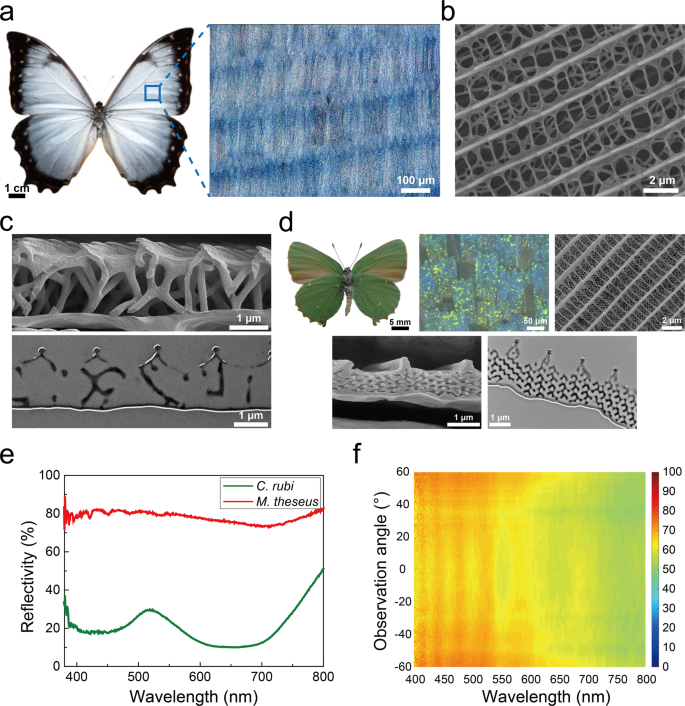
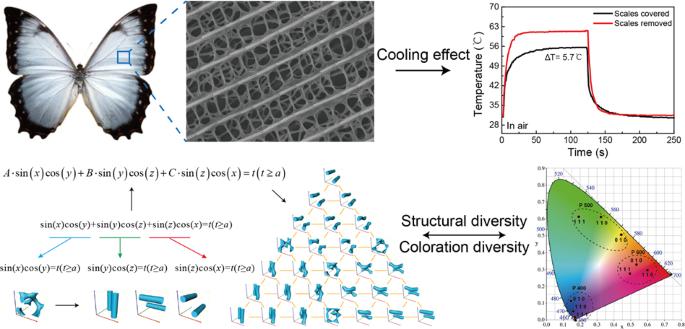
As one of the most fascinating phenomena, structural whiteness in natural organisms serves important functions in thermoregulation and mating. However, the architectures that cause visible broadband reflection are often in quasiordered distributions, which hinders systematic research on their color formation mechanisms. Here, through numerical analysis, the architectures in Morpho theseus scales are shown to be distributed in various tubular morphologies between tubular and gyroid structures. Then, the mechanism of structural white is discussed using the numerical model built with the combination of a periodic numerical framework and random elements. Thermodynamic experiments indicate that the white scales can efficiently help reduce the temperature of butterfly wings under a direct light beam. Our work provides a concise method for analyzing quasiordered structures. The methodology developed by this numerical model can facilitate a deep understanding of the performance improvement facilitated by these structural characteristics. Corresponding solutions can guide the design of nano-optical materials to achieve an efficient cooling, camouflage, and photothermal conversion system. Microstructures in organisms are often in quasiordered distribution, which brings specific functions and performance stability. Here, a numerical model was built to demonstrate the structural whiteness caused by the quasiordered state of the tubular architectures in Morpho theseus wing scales. The method is beneficial to tailored disorder in periodic structures to achieve better properties.
期刊介绍:
NPG Asia Materials is an open access, international journal that publishes peer-reviewed review and primary research articles in the field of materials sciences. The journal has a global outlook and reach, with a base in the Asia-Pacific region to reflect the significant and growing output of materials research from this area. The target audience for NPG Asia Materials is scientists and researchers involved in materials research, covering a wide range of disciplines including physical and chemical sciences, biotechnology, and nanotechnology. The journal particularly welcomes high-quality articles from rapidly advancing areas that bridge the gap between materials science and engineering, as well as the classical disciplines of physics, chemistry, and biology. NPG Asia Materials is abstracted/indexed in Journal Citation Reports/Science Edition Web of Knowledge, Google Scholar, Chemical Abstract Services, Scopus, Ulrichsweb (ProQuest), and Scirus.



 京公网安备 11010802042870号
京ICP备2023020795号-1
京公网安备 11010802042870号
京ICP备2023020795号-1

 分享
分享
 求助内容:
求助内容: 应助结果提醒方式:
 扫码关注我们
