{"title":"Nano-silicon/polyaniline composites with an enhanced reversible capacity as anode materials for lithium ion batteries","authors":"Mingyan Feng, Jianhua Tian, Haimei Xie, Yilan Kang, Zhongqiang Shan","doi":"10.1007/s10008-015-2807-x","DOIUrl":null,"url":null,"abstract":"<p>Silicon nanoparticles are coated with the conductive polyaniline (PANI) using in situ polymerization method as anode materials to improve the electrochemical performance for lithium ion batteries. At first, the physicochemical and electrochemical properties of the doped polyaniline in the lithium ion electrolyte are investigated. After that, the effect of different contents of PANI for preparing Si/PANI composites on the composition and structure and thus the electrochemical performance are investigated. The structure and morphology of as-prepared materials are characterized systematically by scanning electron microscopy (SEM), transmission electron microscopy (TEM), and X-ray diffraction (XRD). It is demonstrated that the silicon/polyaniline composite presents the core/shell structure. The Si/PANI composite with 12.3?wt% PANI exhibits the optimum electrochemical performance. The electrode still maintains better reversible capacity of 766.6?mAh?g<sup>?1</sup>, and the capacity retention of 72?% is retained after 50?cycles at current density of 2?A?g<sup>?1</sup>. The good electrochemical properties can be attributed to the PANI-coating layer, which can improve the electrical conductivity of the Si-based anode materials for lithium ion batteries and accommodate the volume change of silicon during the charge-discharge processes.</p>","PeriodicalId":665,"journal":{"name":"Journal of Solid State Electrochemistry","volume":"19 6","pages":"1773 - 1782"},"PeriodicalIF":2.6000,"publicationDate":"2015-03-15","publicationTypes":"Journal Article","fieldsOfStudy":null,"isOpenAccess":false,"openAccessPdf":"https://sci-hub-pdf.com/10.1007/s10008-015-2807-x","citationCount":"33","resultStr":null,"platform":"Semanticscholar","paperid":null,"PeriodicalName":"Journal of Solid State Electrochemistry","FirstCategoryId":"5","ListUrlMain":"https://link.springer.com/article/10.1007/s10008-015-2807-x","RegionNum":4,"RegionCategory":"化学","ArticlePicture":[],"TitleCN":null,"AbstractTextCN":null,"PMCID":null,"EPubDate":"","PubModel":"","JCR":"Q3","JCRName":"ELECTROCHEMISTRY","Score":null,"Total":0}
引用次数: 33
Abstract
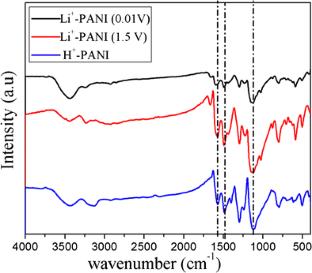
Silicon nanoparticles are coated with the conductive polyaniline (PANI) using in situ polymerization method as anode materials to improve the electrochemical performance for lithium ion batteries. At first, the physicochemical and electrochemical properties of the doped polyaniline in the lithium ion electrolyte are investigated. After that, the effect of different contents of PANI for preparing Si/PANI composites on the composition and structure and thus the electrochemical performance are investigated. The structure and morphology of as-prepared materials are characterized systematically by scanning electron microscopy (SEM), transmission electron microscopy (TEM), and X-ray diffraction (XRD). It is demonstrated that the silicon/polyaniline composite presents the core/shell structure. The Si/PANI composite with 12.3?wt% PANI exhibits the optimum electrochemical performance. The electrode still maintains better reversible capacity of 766.6?mAh?g?1, and the capacity retention of 72?% is retained after 50?cycles at current density of 2?A?g?1. The good electrochemical properties can be attributed to the PANI-coating layer, which can improve the electrical conductivity of the Si-based anode materials for lithium ion batteries and accommodate the volume change of silicon during the charge-discharge processes.
期刊介绍:
The Journal of Solid State Electrochemistry is devoted to all aspects of solid-state chemistry and solid-state physics in electrochemistry.
The Journal of Solid State Electrochemistry publishes papers on all aspects of electrochemistry of solid compounds, including experimental and theoretical, basic and applied work. It equally publishes papers on the thermodynamics and kinetics of electrochemical reactions if at least one actively participating phase is solid. Also of interest are articles on the transport of ions and electrons in solids whenever these processes are relevant to electrochemical reactions and on the use of solid-state electrochemical reactions in the analysis of solids and their surfaces.
The journal covers solid-state electrochemistry and focusses on the following fields: mechanisms of solid-state electrochemical reactions, semiconductor electrochemistry, electrochemical batteries, accumulators and fuel cells, electrochemical mineral leaching, galvanic metal plating, electrochemical potential memory devices, solid-state electrochemical sensors, ion and electron transport in solid materials and polymers, electrocatalysis, photoelectrochemistry, corrosion of solid materials, solid-state electroanalysis, electrochemical machining of materials, electrochromism and electrochromic devices, new electrochemical solid-state synthesis.
The Journal of Solid State Electrochemistry makes the professional in research and industry aware of this swift progress and its importance for future developments and success in the above-mentioned fields.



 京公网安备 11010802042870号
京ICP备2023020795号-1
京公网安备 11010802042870号
京ICP备2023020795号-1

 分享
分享
 求助内容:
求助内容: 应助结果提醒方式:
 扫码关注我们
