Xuanxia Mao, Xiuhua Shen, Wenjing Tang, Kefeng Yang
{"title":"An analysis on the candidate profile and pass rate of the pilot qualification examination for registered dietitians in Shanghai","authors":"Xuanxia Mao, Xiuhua Shen, Wenjing Tang, Kefeng Yang","doi":"10.3760/CMA.J.ISSN.1674-635X.2017.06.009","DOIUrl":null,"url":null,"abstract":"Objective \nTo investigate the candidate profile and pass rate of the 2016 pilot qualification examination for registered dietitians in Shanghai, and attempt to inform the improvement of the examination. \n \n \nMethods \nAn analysis was conducted on the profiles of all the 193 qualified candidates in the signing-up system of the 2016 pilot examination. Questionnaire surveys were carried out to collect feedback from the candidates on the enrollment requirements of the examination. The pass rates were compared between subgroups divided by age, gender, education, major, workplace (as employee or intern), working years and academic rank. \n \n \nResults \n81.3% of the candidates were aged between 20 and 29. Females accounted for 80.3%. The candidates had all received bachelor's degree, 75.6% from full-time undergraduate programs and 96.4% from programs of nutrition. 78.3% of the candidates rated the enrollment requirements of the examination as \"reasonable\" or \"relatively reasonable\" . The overall pass rate of the examination was 38.3%. The pass rate of the examinees working or doing internship in hospitals (45%) was significantly higher than that of others (24.5%)(P=0.012). \n \n \nConclusions \nThe overall pass rate is reasonable. Examinees working or doing internship in hospitals had a higher pass rate than those working in other places. The majority of the candidates had bachelor's degree of nutrition, which is in accordance with the requirement of similar exams in other parts of the world. \n \n \nKey words: \nRegistered dietitian; Examination; Pass rate","PeriodicalId":9877,"journal":{"name":"中华临床营养杂志","volume":"25 1","pages":"383-386"},"PeriodicalIF":0.0000,"publicationDate":"2017-12-30","publicationTypes":"Journal Article","fieldsOfStudy":null,"isOpenAccess":false,"openAccessPdf":"","citationCount":"0","resultStr":null,"platform":"Semanticscholar","paperid":null,"PeriodicalName":"中华临床营养杂志","FirstCategoryId":"3","ListUrlMain":"https://doi.org/10.3760/CMA.J.ISSN.1674-635X.2017.06.009","RegionNum":0,"RegionCategory":null,"ArticlePicture":[],"TitleCN":null,"AbstractTextCN":null,"PMCID":null,"EPubDate":"","PubModel":"","JCR":"Q4","JCRName":"Nursing","Score":null,"Total":0}
引用次数: 0
Abstract
Objective
To investigate the candidate profile and pass rate of the 2016 pilot qualification examination for registered dietitians in Shanghai, and attempt to inform the improvement of the examination.
Methods
An analysis was conducted on the profiles of all the 193 qualified candidates in the signing-up system of the 2016 pilot examination. Questionnaire surveys were carried out to collect feedback from the candidates on the enrollment requirements of the examination. The pass rates were compared between subgroups divided by age, gender, education, major, workplace (as employee or intern), working years and academic rank.
Results
81.3% of the candidates were aged between 20 and 29. Females accounted for 80.3%. The candidates had all received bachelor's degree, 75.6% from full-time undergraduate programs and 96.4% from programs of nutrition. 78.3% of the candidates rated the enrollment requirements of the examination as "reasonable" or "relatively reasonable" . The overall pass rate of the examination was 38.3%. The pass rate of the examinees working or doing internship in hospitals (45%) was significantly higher than that of others (24.5%)(P=0.012).
Conclusions
The overall pass rate is reasonable. Examinees working or doing internship in hospitals had a higher pass rate than those working in other places. The majority of the candidates had bachelor's degree of nutrition, which is in accordance with the requirement of similar exams in other parts of the world.
Key words:
Registered dietitian; Examination; Pass rate
期刊介绍:
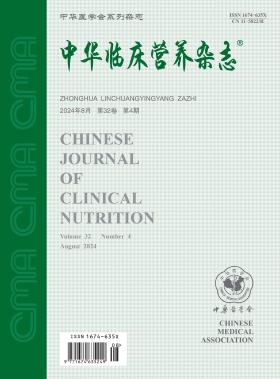
The Chinese Journal of Clinical Nutrition was founded in 1993. It is the first professional academic journal (bimonthly) in my country co-sponsored by the Chinese Medical Association and the Chinese Academy of Medical Sciences to disseminate information on clinical nutrition support, nutrient metabolism, the impact of nutrition support on outcomes and "cost-effectiveness", as well as translational medicine and nutrition research. It is also a professional journal of the Chinese Medical Association's Parenteral and Enteral Nutrition Branch.
The purpose of the Chinese Journal of Clinical Nutrition is to promote the rapid dissemination of knowledge on nutrient metabolism and the rational application of parenteral and enteral nutrition, focusing on the combination of multidisciplinary and multi-regional field investigations and clinical research. It mainly reports on nutritional risk screening related to the indications of parenteral and enteral nutrition support, "cost-effectiveness" research on nutritional drugs, consensus on clinical nutrition, guidelines, expert reviews, randomized controlled studies, cohort studies, glycoprotein and other nutrient metabolism research, systematic evaluation of clinical research, evidence-based case reports, special reviews, case reports and clinical experience exchanges, etc., and has a special column on new technologies related to the field of clinical nutrition and their clinical applications.



 京公网安备 11010802042870号
京ICP备2023020795号-1
京公网安备 11010802042870号
京ICP备2023020795号-1

 分享
分享
 求助内容:
求助内容: 应助结果提醒方式:
 扫码关注我们
