{"title":"The use of virtual patients for breaking bad news: A rapid review","authors":"Woohyun Kang","doi":"10.1111/tct.13681","DOIUrl":null,"url":null,"abstract":"<div>\n \n \n <section>\n \n <h3> Background</h3>\n \n <p>Breaking bad news is an imperative skill for clinical practice that health care professionals struggle with. Virtual patients have been adopted as a new teaching aide in medical education and have shown efficacy in teaching clinical skills; however, there is limited research for use in communication skills. Virtual patients are especially well-suited for difficult communication skills, as students can practice without risk to patients. This rapid review aimed to review literature observing the potential of virtual patients as an effective means to teach breaking bad news.</p>\n </section>\n \n <section>\n \n <h3> Method</h3>\n \n <p>A systematic search strategy was applied for papers published between November 2012 and November 2022 on Medline and Embase databases. Following the application of inclusion criteria, three studies were included. The Medical Education Research Study Quality Instrument and Critical Appraisal Skills Programme checklist were used for quality appraisal of the studies. Tabular and narrative synthesis was used to present the findings.</p>\n </section>\n \n <section>\n \n <h3> Findings</h3>\n \n <p>The findings of the studies suggest that when teaching breaking bad news, virtual patients are valuable compared with no intervention and are not inferior compared with simulated patients. An unexpected benefit of virtual patients was videotaping. A barrier to learning was the lack of affect and interaction. More research into the design of virtual simulations and its integration into existing curricula is required.</p>\n </section>\n \n <section>\n \n <h3> Conclusion</h3>\n \n <p>Virtual patients are a valuable educational tool for breaking bad news; however, they are yet to replace existing educational approaches. There is a need for more large-scale, homogeneous studies to inform instructional design and curriculum integration.</p>\n </section>\n </div>","PeriodicalId":47324,"journal":{"name":"Clinical Teacher","volume":"21 2","pages":""},"PeriodicalIF":1.2000,"publicationDate":"2023-10-20","publicationTypes":"Journal Article","fieldsOfStudy":null,"isOpenAccess":false,"openAccessPdf":"https://onlinelibrary.wiley.com/doi/epdf/10.1111/tct.13681","citationCount":"0","resultStr":null,"platform":"Semanticscholar","paperid":null,"PeriodicalName":"Clinical Teacher","FirstCategoryId":"1085","ListUrlMain":"https://asmepublications.onlinelibrary.wiley.com/doi/10.1111/tct.13681","RegionNum":0,"RegionCategory":null,"ArticlePicture":[],"TitleCN":null,"AbstractTextCN":null,"PMCID":null,"EPubDate":"","PubModel":"","JCR":"Q4","JCRName":"MEDICINE, RESEARCH & EXPERIMENTAL","Score":null,"Total":0}
引用次数: 0
Abstract
Background
Breaking bad news is an imperative skill for clinical practice that health care professionals struggle with. Virtual patients have been adopted as a new teaching aide in medical education and have shown efficacy in teaching clinical skills; however, there is limited research for use in communication skills. Virtual patients are especially well-suited for difficult communication skills, as students can practice without risk to patients. This rapid review aimed to review literature observing the potential of virtual patients as an effective means to teach breaking bad news.
Method
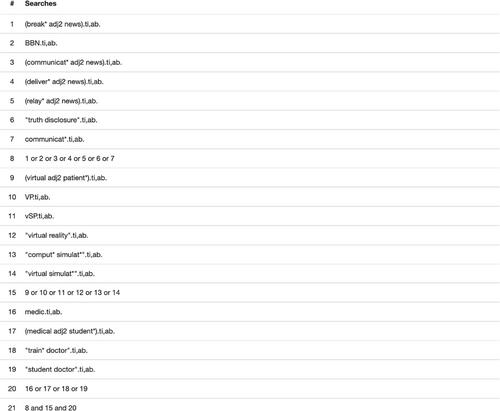
A systematic search strategy was applied for papers published between November 2012 and November 2022 on Medline and Embase databases. Following the application of inclusion criteria, three studies were included. The Medical Education Research Study Quality Instrument and Critical Appraisal Skills Programme checklist were used for quality appraisal of the studies. Tabular and narrative synthesis was used to present the findings.
Findings
The findings of the studies suggest that when teaching breaking bad news, virtual patients are valuable compared with no intervention and are not inferior compared with simulated patients. An unexpected benefit of virtual patients was videotaping. A barrier to learning was the lack of affect and interaction. More research into the design of virtual simulations and its integration into existing curricula is required.
Conclusion
Virtual patients are a valuable educational tool for breaking bad news; however, they are yet to replace existing educational approaches. There is a need for more large-scale, homogeneous studies to inform instructional design and curriculum integration.
期刊介绍:
The Clinical Teacher has been designed with the active, practising clinician in mind. It aims to provide a digest of current research, practice and thinking in medical education presented in a readable, stimulating and practical style. The journal includes sections for reviews of the literature relating to clinical teaching bringing authoritative views on the latest thinking about modern teaching. There are also sections on specific teaching approaches, a digest of the latest research published in Medical Education and other teaching journals, reports of initiatives and advances in thinking and practical teaching from around the world, and expert community and discussion on challenging and controversial issues in today"s clinical education.