Xuelian Wang*, Daman J. Adlam, Ran Wang, Amal Altujjar, Zhenyu Jia, Jennifer M. Saunders, Judith A. Hoyland, Nischal Rai and Brian R. Saunders*,
{"title":"Injectable Colloidal Hydrogels of N-Vinylformamide Microgels Dispersed in Covalently Interlinked pH-Responsive Methacrylic Acid-Based Microgels","authors":"Xuelian Wang*, Daman J. Adlam, Ran Wang, Amal Altujjar, Zhenyu Jia, Jennifer M. Saunders, Judith A. Hoyland, Nischal Rai and Brian R. Saunders*, ","doi":"10.1021/acs.biomac.3c00058","DOIUrl":null,"url":null,"abstract":"<p >Injectable hydrogels offer great potential to augment damaged or degenerated soft tissues. A key criterion for such gels is that their modulus is as close as possible to that of the target tissue. The majority of synthetic hydrogels have used low molecular weight polymer chains which may cause problems if they diffuse away from the injection site and/or increase the local osmotic pressure. We previously introduced a different approach of injecting preformed ultra-high molecular weight pH-responsive microgels (MGs) that interlink to form hydrogels. MGs are crosslinked polymer colloid particles that swell when the pH approaches the particle p<i>K</i><sub>a</sub>. These colloidal hydrogels are termed doubly crosslinked microgels (DX MGs). The gel moduli of previous DX MGs were much greater than that reported for human nucleus pulposus (NP) tissue of the spinal intervertebral disk. Here, we replace some of the pH-responsive poly(ethyl acrylate-<i>co</i>-methacrylic acid) (PEA-MAA) MGs with hydrophilic non-ionic MGs based on poly(<i>N</i>-vinylformamide) (NVF). We investigate the morphology and mechanical properties of these new injectable composite DX MGs and show that the mechanical properties can be tuned by systematically varying the NVF MG content. Using this approach, the gel moduli close to that for NP tissue are achieved. These injectable new pH-responsive gels exhibit low cytotoxicity. Our work provides a potential new system for minimally invasive intervertebral disk augmentation.</p>","PeriodicalId":30,"journal":{"name":"Biomacromolecules","volume":"24 5","pages":"2173–2183"},"PeriodicalIF":5.4000,"publicationDate":"2023-04-07","publicationTypes":"Journal Article","fieldsOfStudy":null,"isOpenAccess":false,"openAccessPdf":"https://pubs.acs.org/doi/epdf/10.1021/acs.biomac.3c00058","citationCount":"0","resultStr":null,"platform":"Semanticscholar","paperid":null,"PeriodicalName":"Biomacromolecules","FirstCategoryId":"92","ListUrlMain":"https://pubs.acs.org/doi/10.1021/acs.biomac.3c00058","RegionNum":2,"RegionCategory":"化学","ArticlePicture":[],"TitleCN":null,"AbstractTextCN":null,"PMCID":null,"EPubDate":"","PubModel":"","JCR":"Q1","JCRName":"BIOCHEMISTRY & MOLECULAR BIOLOGY","Score":null,"Total":0}
引用次数: 0
Abstract
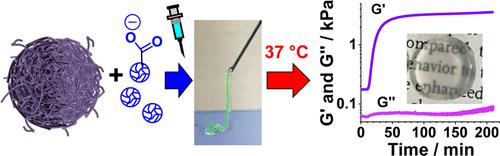
Injectable hydrogels offer great potential to augment damaged or degenerated soft tissues. A key criterion for such gels is that their modulus is as close as possible to that of the target tissue. The majority of synthetic hydrogels have used low molecular weight polymer chains which may cause problems if they diffuse away from the injection site and/or increase the local osmotic pressure. We previously introduced a different approach of injecting preformed ultra-high molecular weight pH-responsive microgels (MGs) that interlink to form hydrogels. MGs are crosslinked polymer colloid particles that swell when the pH approaches the particle pKa. These colloidal hydrogels are termed doubly crosslinked microgels (DX MGs). The gel moduli of previous DX MGs were much greater than that reported for human nucleus pulposus (NP) tissue of the spinal intervertebral disk. Here, we replace some of the pH-responsive poly(ethyl acrylate-co-methacrylic acid) (PEA-MAA) MGs with hydrophilic non-ionic MGs based on poly(N-vinylformamide) (NVF). We investigate the morphology and mechanical properties of these new injectable composite DX MGs and show that the mechanical properties can be tuned by systematically varying the NVF MG content. Using this approach, the gel moduli close to that for NP tissue are achieved. These injectable new pH-responsive gels exhibit low cytotoxicity. Our work provides a potential new system for minimally invasive intervertebral disk augmentation.
期刊介绍:
Biomacromolecules is a leading forum for the dissemination of cutting-edge research at the interface of polymer science and biology. Submissions to Biomacromolecules should contain strong elements of innovation in terms of macromolecular design, synthesis and characterization, or in the application of polymer materials to biology and medicine.
Topics covered by Biomacromolecules include, but are not exclusively limited to: sustainable polymers, polymers based on natural and renewable resources, degradable polymers, polymer conjugates, polymeric drugs, polymers in biocatalysis, biomacromolecular assembly, biomimetic polymers, polymer-biomineral hybrids, biomimetic-polymer processing, polymer recycling, bioactive polymer surfaces, original polymer design for biomedical applications such as immunotherapy, drug delivery, gene delivery, antimicrobial applications, diagnostic imaging and biosensing, polymers in tissue engineering and regenerative medicine, polymeric scaffolds and hydrogels for cell culture and delivery.



 京公网安备 11010802042870号
京ICP备2023020795号-1
京公网安备 11010802042870号
京ICP备2023020795号-1

 分享
分享
 求助内容:
求助内容: 应助结果提醒方式:
 扫码关注我们
