Stability of vacancies in β-type Ti-15Mo-5Zr-3Al alloy fabricated via laser powder bed fusion

IF 4.7 Q2 ENGINEERING, MANUFACTURING Additive manufacturing letters Pub Date : 2023-07-13 DOI:10.1016/j.addlet.2023.100162
Masataka Mizuno , Kazuki Sugita , Kousuke Do , Takuya Ishimoto , Takayoshi Nakano , Hideki Araki
{"title":"Stability of vacancies in β-type Ti-15Mo-5Zr-3Al alloy fabricated via laser powder bed fusion","authors":"Masataka Mizuno ,&nbsp;Kazuki Sugita ,&nbsp;Kousuke Do ,&nbsp;Takuya Ishimoto ,&nbsp;Takayoshi Nakano ,&nbsp;Hideki Araki","doi":"10.1016/j.addlet.2023.100162","DOIUrl":null,"url":null,"abstract":"<div><p>The structural instability in the β-type titanium alloys could affect the stability of vacancies. The stability of vacancies in a β-type Ti-15Mo-5Zr-3Al alloy, fabricated via laser powder bed fusion (LPBF), was investigated using positron annihilation spectroscopy and first-principles calculations. The observed positron lifetimes were close to the experimental and calculated bulk lifetime of Ti-15Mo-5Zr-3Al, which indicates that vacancies were not detected in Ti-15Mo-5Zr-3Al by positron lifetime measurements. Therefore, for the first time, it has been confirmed that quenched-in vacancies are not introduced in the LPBF-manufactured β-type Ti-15Mo-5Zr-3Al despite the fast cooling rate in LPBF process. This feature is preferable for the structural stability in biomedical and industrial applications. The calculated atomic displacement from the ideal bcc lattice positions decreased in β-type Ti-Mo alloys with increasing Mo concentration, indicating that the bcc structure was stabilized by the added Mo. The calculated vacancy formation energies of Ti atoms in β-type Ti-14.5Mo and Ti-27.0Mo alloys exhibited an increasing trend with an increasing number of neighboring Mo atoms. Mo atoms also increased the migration energies of the neighboring paths of vacancies. The calculated results for Ti-15Mo-5Zr-3Al suggest that, while the bcc structure was stabilized by the Mo atoms in Ti-15Mo-5Zr-3Al, the migration and formation energies were still low enough for the diffusion of vacancies.</p></div>","PeriodicalId":72068,"journal":{"name":"Additive manufacturing letters","volume":"7 ","pages":"Article 100162"},"PeriodicalIF":4.7000,"publicationDate":"2023-07-13","publicationTypes":"Journal Article","fieldsOfStudy":null,"isOpenAccess":false,"openAccessPdf":"","citationCount":"0","resultStr":null,"platform":"Semanticscholar","paperid":null,"PeriodicalName":"Additive manufacturing letters","FirstCategoryId":"1085","ListUrlMain":"https://www.sciencedirect.com/science/article/pii/S2772369023000439","RegionNum":0,"RegionCategory":null,"ArticlePicture":[],"TitleCN":null,"AbstractTextCN":null,"PMCID":null,"EPubDate":"","PubModel":"","JCR":"Q2","JCRName":"ENGINEERING, MANUFACTURING","Score":null,"Total":0}
引用次数: 0

Abstract

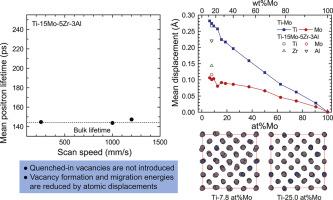
The structural instability in the β-type titanium alloys could affect the stability of vacancies. The stability of vacancies in a β-type Ti-15Mo-5Zr-3Al alloy, fabricated via laser powder bed fusion (LPBF), was investigated using positron annihilation spectroscopy and first-principles calculations. The observed positron lifetimes were close to the experimental and calculated bulk lifetime of Ti-15Mo-5Zr-3Al, which indicates that vacancies were not detected in Ti-15Mo-5Zr-3Al by positron lifetime measurements. Therefore, for the first time, it has been confirmed that quenched-in vacancies are not introduced in the LPBF-manufactured β-type Ti-15Mo-5Zr-3Al despite the fast cooling rate in LPBF process. This feature is preferable for the structural stability in biomedical and industrial applications. The calculated atomic displacement from the ideal bcc lattice positions decreased in β-type Ti-Mo alloys with increasing Mo concentration, indicating that the bcc structure was stabilized by the added Mo. The calculated vacancy formation energies of Ti atoms in β-type Ti-14.5Mo and Ti-27.0Mo alloys exhibited an increasing trend with an increasing number of neighboring Mo atoms. Mo atoms also increased the migration energies of the neighboring paths of vacancies. The calculated results for Ti-15Mo-5Zr-3Al suggest that, while the bcc structure was stabilized by the Mo atoms in Ti-15Mo-5Zr-3Al, the migration and formation energies were still low enough for the diffusion of vacancies.

Abstract Image

查看原文
分享 分享
微信好友 朋友圈 QQ好友 复制链接
本刊更多论文
激光粉末床熔合β型Ti-15Mo-5Zr-3Al合金中空位的稳定性
β型钛合金的结构不稳定性会影响空位的稳定性。利用正电子湮没谱和第一性原理计算研究了激光粉末床聚变(LPBF)制备的β型Ti-15Mo-5Zr-3Al合金中空位的稳定性。观察到的正电子寿命接近Ti-15Mo-5Zr-3Al的实验和计算体寿命,这表明通过正电子寿命测量在Ti-15Mo-54Zr-3Al中没有检测到空位。因此,首次证实,尽管在LPBF工艺中冷却速度很快,但在LPBF制造的β型Ti-15Mo-5Zr-3Al中没有引入空位淬火。该特征对于生物医学和工业应用中的结构稳定性是优选的。β型Ti-Mo合金中理想bcc晶格位置的原子位移随着Mo浓度的增加而减少,表明添加Mo使bcc结构稳定。β型Ti-14.5Mo和Ti-27.0Mo合金中Ti原子的空位形成能随着相邻Mo原子数的增加而呈增加趋势。Mo原子还增加了空位相邻路径的迁移能。Ti-15Mo-5Zr-3Al的计算结果表明,尽管Ti-15Mo-54Zr-3Al中的Mo原子稳定了bcc结构,但迁移能和形成能仍然足够低,足以使空位扩散。
本文章由计算机程序翻译,如有差异,请以英文原文为准。
求助全文
约1分钟内获得全文 去求助
来源期刊
Additive manufacturing letters
Additive manufacturing letters Materials Science (General), Industrial and Manufacturing Engineering, Mechanics of Materials
CiteScore
3.70
自引率
0.00%
发文量
0
审稿时长
37 days
期刊最新文献
Agentic additive manufacturing alloy evaluation Effect of TiN nanoparticle on shape memory properties of additively manufactured ferrous high entropy shape memory alloy Approximation of absorptivity conditions for Inconel 625 from in situ radiation thermometry measurements in electron beam powder bed fusion Friction-induced distortion in binder jetted 316 L stainless steel: Experimental analysis, simulation, and compensation strategy Mechanical properties and strain localization of WA-DED printed P91 steel
×
引用
GB/T 7714-2015
复制
MLA
复制
APA
复制
导出至
BibTeX EndNote RefMan NoteFirst NoteExpress
×
×
提示
您的信息不完整,为了账户安全,请先补充。
现在去补充
×
提示
您因"违规操作"
具体请查看互助需知
我知道了
×
提示
现在去查看 取消
×
提示
确定
0
微信
客服QQ
Book学术公众号 扫码关注我们
反馈
×
意见反馈
请填写您的意见或建议
请填写您的手机或邮箱
已复制链接
已复制链接
快去分享给好友吧!
我知道了
×
扫码分享
扫码分享
Book学术官方微信
Book学术文献互助
Book学术文献互助群
群 号:604180095
Book学术
文献互助 智能选刊 最新文献 互助须知 联系我们:info@booksci.cn
Book学术提供免费学术资源搜索服务,方便国内外学者检索中英文文献。致力于提供最便捷和优质的服务体验。
Copyright © 2023 Book学术 All rights reserved.
ghs 京公网安备 11010802042870号 京ICP备2023020795号-1





