Facilitating direct interspecies electron transfer in anaerobic digestion via speeding up transmembrane transport of electrons and CO2 reduction in methanogens by Na+ adjustment
Zhipeng Ao , Yuan Li , Yang Li , Zhiqiang Zhao , Yaobin Zhang
{"title":"Facilitating direct interspecies electron transfer in anaerobic digestion via speeding up transmembrane transport of electrons and CO2 reduction in methanogens by Na+ adjustment","authors":"Zhipeng Ao , Yuan Li , Yang Li , Zhiqiang Zhao , Yaobin Zhang","doi":"10.1016/j.wasman.2023.09.017","DOIUrl":null,"url":null,"abstract":"<div><p>The possibility of facilitating direct interspecies electron transfer (DIET) in anaerobic digestion with different concentrations of NaCl was explored. Additional NaCl at 2 or 4 g/L strengthened anaerobic digestion to resist the high-organic loading rate impacts, whereas the higher concentrations of NaCl (6 or 8 g/L) suppressed methanogenesis. Additional MgCl<sub>2</sub> with the same ion strength as NaCl at 2 g/L had no effect on performances. Additional NaCl at 2 or 4 g/L dramatically increased the abundance of <em>Methanosarcina</em> species (20.7%/23.4% vs 8.6%) and stimulated the growth of <em>Sphaerochaeta</em> and <em>Petrimonas</em> species that could transfer electrons to the soluble Fe(III) or elemental sulfur. Electrochemical evidences showed that, additional NaCl at 2 or 4 g/L increased capacitances and decreased charge transfer resistances of <em>Methanosarcina</em>-dominant communities. Metagenomic evidences showed that, additional NaCl at 2 or 4 g/L increased the abundance of genes that encoded the type IV pilus assembly proteins (1.98E-04/1.87E-04 vs 1.85E-04) and cytochrome <em>c</em>-like proteins (5.51E-04/5.60E-04 vs 5.31E-04). In addition, additional NaCl at 2 or 4 g/L increased the abundance of genes for methanophenazine (MP)/MPH<sub>2</sub> transformation (1.04E-05/1.24E-05 vs 8.06E-06) and CO<sub>2</sub> reduction (1.64E-03/1.86E-03 vs 1.06E-03), suggesting a rapid transmembrane transport of electrons and CO<sub>2</sub> reduction in methanogens. Both processes were closely associated with F<sub>420</sub>/F<sub>420</sub>H<sub>2</sub> transformation that required ATP. Additional NaCl at 2 or 4 g/L increased the yield of ATP (256.0/249.3 vs 231.8 nmol/L) that might promote F<sub>420</sub>/F<sub>420</sub>H<sub>2</sub> transformation in methanogens, which overcame the thermodynamic limitations of combining electrons with protons for the reduction of CO<sub>2</sub> to methane and facilitated DIET.</p></div>","PeriodicalId":23969,"journal":{"name":"Waste management","volume":"170 ","pages":"Pages 252-260"},"PeriodicalIF":7.1000,"publicationDate":"2023-10-01","publicationTypes":"Journal Article","fieldsOfStudy":null,"isOpenAccess":false,"openAccessPdf":"","citationCount":"0","resultStr":null,"platform":"Semanticscholar","paperid":null,"PeriodicalName":"Waste management","FirstCategoryId":"93","ListUrlMain":"https://www.sciencedirect.com/science/article/pii/S0956053X23005810","RegionNum":2,"RegionCategory":"环境科学与生态学","ArticlePicture":[],"TitleCN":null,"AbstractTextCN":null,"PMCID":null,"EPubDate":"","PubModel":"","JCR":"Q1","JCRName":"ENGINEERING, ENVIRONMENTAL","Score":null,"Total":0}
引用次数: 0
Abstract
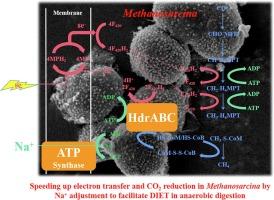
The possibility of facilitating direct interspecies electron transfer (DIET) in anaerobic digestion with different concentrations of NaCl was explored. Additional NaCl at 2 or 4 g/L strengthened anaerobic digestion to resist the high-organic loading rate impacts, whereas the higher concentrations of NaCl (6 or 8 g/L) suppressed methanogenesis. Additional MgCl2 with the same ion strength as NaCl at 2 g/L had no effect on performances. Additional NaCl at 2 or 4 g/L dramatically increased the abundance of Methanosarcina species (20.7%/23.4% vs 8.6%) and stimulated the growth of Sphaerochaeta and Petrimonas species that could transfer electrons to the soluble Fe(III) or elemental sulfur. Electrochemical evidences showed that, additional NaCl at 2 or 4 g/L increased capacitances and decreased charge transfer resistances of Methanosarcina-dominant communities. Metagenomic evidences showed that, additional NaCl at 2 or 4 g/L increased the abundance of genes that encoded the type IV pilus assembly proteins (1.98E-04/1.87E-04 vs 1.85E-04) and cytochrome c-like proteins (5.51E-04/5.60E-04 vs 5.31E-04). In addition, additional NaCl at 2 or 4 g/L increased the abundance of genes for methanophenazine (MP)/MPH2 transformation (1.04E-05/1.24E-05 vs 8.06E-06) and CO2 reduction (1.64E-03/1.86E-03 vs 1.06E-03), suggesting a rapid transmembrane transport of electrons and CO2 reduction in methanogens. Both processes were closely associated with F420/F420H2 transformation that required ATP. Additional NaCl at 2 or 4 g/L increased the yield of ATP (256.0/249.3 vs 231.8 nmol/L) that might promote F420/F420H2 transformation in methanogens, which overcame the thermodynamic limitations of combining electrons with protons for the reduction of CO2 to methane and facilitated DIET.
探讨了在不同浓度NaCl的厌氧消化中促进种间直接电子转移(DIET)的可能性。2或4 g/L的额外NaCl增强了厌氧消化,以抵抗高有机负荷率的影响,而较高浓度的NaCl(6或8 g/L)抑制了甲烷生成。在2g/L下添加与NaCl具有相同离子强度的MgCl2对性能没有影响。2或4 g/L的额外NaCl显著增加了甲烷虫物种的丰度(20.7%/23.4%vs 8.6%),并刺激了鞘翅目和Petrimonas物种的生长,这些物种可以将电子转移到可溶性Fe(III)或元素硫上。电化学证据表明,添加2或4g/L的NaCl可以增加甲烷藻优势群落的电容,降低电荷转移电阻。宏基因组证据表明,2或4 g/L的额外NaCl增加了编码IV型菌毛组装蛋白(1.98E-04/1.87E-04 vs 1.85E-04)和细胞色素c样蛋白(5.51E-04/5.60E-04 vs 5.31E-04)的基因丰度。此外,2或4 g/L的额外NaCl增加了甲氧萘嗪(MP)/MPH2转化(1.04E-05/1.24E-05 vs 8.06E-06)和CO2还原(1.64E-03/1.86E-03 vs 1.06E-03)的基因丰度,表明产甲烷菌中电子的快速跨膜传输和CO2还原。这两个过程都与需要ATP的F420/F420H2转化密切相关。2或4 g/L的额外NaCl增加了ATP的产量(256.0/249.3 vs 231.8 nmol/L),这可能促进产甲烷菌中F420/F420H2的转化,这克服了电子与质子结合将CO2还原为甲烷的热力学限制,并促进了饮食。
期刊介绍:
Waste Management is devoted to the presentation and discussion of information on solid wastes,it covers the entire lifecycle of solid. wastes.
Scope:
Addresses solid wastes in both industrialized and economically developing countries
Covers various types of solid wastes, including:
Municipal (e.g., residential, institutional, commercial, light industrial)
Agricultural
Special (e.g., C and D, healthcare, household hazardous wastes, sewage sludge)