{"title":"Review and analysis of deep neural network models for Alzheimer's disease classification using brain medical resonance imaging","authors":"Shruti Pallawi, Dushyant Kumar Singh","doi":"10.1049/ccs2.12072","DOIUrl":null,"url":null,"abstract":"<p>Alzheimer's disease is a type of progressive neurological disorder which is irreversible and the patient suffers from severe memory loss. This disease is the seventh largest cause of death across the globe. As yet there is no cure for this disease, the only way to control it is its early diagnosis. Deep Learning techniques are mostly preferred in classification tasks because of their high accuracy over a large dataset. The main focus of this paper is on fine-tuning and evaluating the Deep Convolutional Networks for Alzheimer's disease classification. An empirical analysis of various deep learning-based neural network models has been done. The architectures evaluation includes InceptionV3, ResNet with 50 layers and 101 layers and DenseNet with 169 layers. The dataset has been taken from Kaggle which is publicly available and comprises of four classes which represents the various stages of Alzheimer's disease. In our experiment, the accuracy of DenseNet consistently improved with the increase in the number of epochs resulting in a 99.94% testing accuracy score better than the rest of the architectures. Although the results obtained are satisfactory, but for future research, we can apply transfer learning on other deep models like Inception V4, AlexNet etc., to increase accuracy and decrease computational time. Also, in future we can work on other datasets like ADNI or OASIS and use Positron emitted tomography, diffusion tensor imaging neuroimages and their combinations for better result.</p>","PeriodicalId":33652,"journal":{"name":"Cognitive Computation and Systems","volume":"5 1","pages":"1-13"},"PeriodicalIF":1.3000,"publicationDate":"2023-02-10","publicationTypes":"Journal Article","fieldsOfStudy":null,"isOpenAccess":false,"openAccessPdf":"https://onlinelibrary.wiley.com/doi/epdf/10.1049/ccs2.12072","citationCount":"0","resultStr":null,"platform":"Semanticscholar","paperid":null,"PeriodicalName":"Cognitive Computation and Systems","FirstCategoryId":"1085","ListUrlMain":"https://onlinelibrary.wiley.com/doi/10.1049/ccs2.12072","RegionNum":0,"RegionCategory":null,"ArticlePicture":[],"TitleCN":null,"AbstractTextCN":null,"PMCID":null,"EPubDate":"","PubModel":"","JCR":"Q4","JCRName":"COMPUTER SCIENCE, ARTIFICIAL INTELLIGENCE","Score":null,"Total":0}
引用次数: 0
Abstract
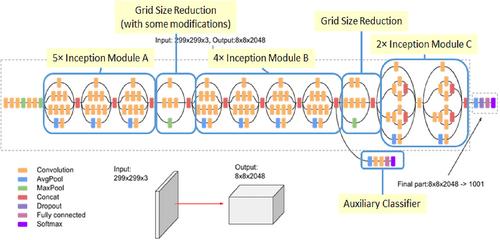
Alzheimer's disease is a type of progressive neurological disorder which is irreversible and the patient suffers from severe memory loss. This disease is the seventh largest cause of death across the globe. As yet there is no cure for this disease, the only way to control it is its early diagnosis. Deep Learning techniques are mostly preferred in classification tasks because of their high accuracy over a large dataset. The main focus of this paper is on fine-tuning and evaluating the Deep Convolutional Networks for Alzheimer's disease classification. An empirical analysis of various deep learning-based neural network models has been done. The architectures evaluation includes InceptionV3, ResNet with 50 layers and 101 layers and DenseNet with 169 layers. The dataset has been taken from Kaggle which is publicly available and comprises of four classes which represents the various stages of Alzheimer's disease. In our experiment, the accuracy of DenseNet consistently improved with the increase in the number of epochs resulting in a 99.94% testing accuracy score better than the rest of the architectures. Although the results obtained are satisfactory, but for future research, we can apply transfer learning on other deep models like Inception V4, AlexNet etc., to increase accuracy and decrease computational time. Also, in future we can work on other datasets like ADNI or OASIS and use Positron emitted tomography, diffusion tensor imaging neuroimages and their combinations for better result.




 京公网安备 11010802042870号
京ICP备2023020795号-1
京公网安备 11010802042870号
京ICP备2023020795号-1

 分享
分享
 求助内容:
求助内容: 应助结果提醒方式:
 扫码关注我们
