Effect of remimazolam versus sevoflurane on intraoperative hemodynamics in noncardiac surgery: a retrospective observational study using propensity score matching.
{"title":"Effect of remimazolam versus sevoflurane on intraoperative hemodynamics in noncardiac surgery: a retrospective observational study using propensity score matching.","authors":"Takayuki Katsuragawa, Soichiro Mimuro, Tsunehisa Sato, Yoshitaka Aoki, Matsuyuki Doi, Takasumi Katoh, Yoshiki Nakajima","doi":"10.1186/s40981-023-00661-5","DOIUrl":null,"url":null,"abstract":"<p><strong>Background: </strong>This study compared the effects of remimazolam and sevoflurane on intraoperative hemodynamics including intraoperative hypotension (IOH).</p><p><strong>Results: </strong>This study involved adult patients undergoing noncardiac surgery using remimazolam (Group R) or sevoflurane (Group S) for maintenance anesthesia, and invasive arterial pressure measurements, from September 2020 to March 2023 at our hospital. IOH was defined as a mean blood pressure < 65 mmHg occurring for a cumulative duration of at least 10 min. A 1:1 propensity score-matching method was used. The primary endpoint was the occurrence of IOH, and the secondary endpoints were the cumulative hypotensive time, incidence of vasopressor use, and dose of vasopressor used (ephedrine, phenylephrine, dopamine, and noradrenaline). Group R comprised 169 patients, Group S comprised 393 patients, and a matched cohort of 141 patients was created by propensity score matching. There was no significant difference in the incidence of IOH between the two groups (85.1% in Group R vs. 91.5% in Group S, p = 0.138). Patients in Group R had a significantly lower cumulative hypotension duration (55 [18-119] vs. 83 [39-144] min, p = 0.005), vasopressor use (81.6% vs. 91.5%, p = 0.023), and dose of ephedrine (4 [0-8] vs. 12 [4-20] mg, p < 0.001) than those in Group S. There were no significant differences in the doses of other vasopressors between groups.</p><p><strong>Conclusions: </strong>Compared with sevoflurane, the maintenance of anesthesia with remimazolam was not associated with a decreased incidence of IOH; however, it reduced the cumulative hypotension time, incidence of vasopressor use, and dose of ephedrine.</p>","PeriodicalId":14635,"journal":{"name":"JA Clinical Reports","volume":"9 1","pages":"70"},"PeriodicalIF":1.0000,"publicationDate":"2023-10-26","publicationTypes":"Journal Article","fieldsOfStudy":null,"isOpenAccess":false,"openAccessPdf":"https://www.ncbi.nlm.nih.gov/pmc/articles/PMC10600086/pdf/","citationCount":"0","resultStr":null,"platform":"Semanticscholar","paperid":null,"PeriodicalName":"JA Clinical Reports","FirstCategoryId":"1085","ListUrlMain":"https://doi.org/10.1186/s40981-023-00661-5","RegionNum":0,"RegionCategory":null,"ArticlePicture":[],"TitleCN":null,"AbstractTextCN":null,"PMCID":null,"EPubDate":"","PubModel":"","JCR":"Q3","JCRName":"ANESTHESIOLOGY","Score":null,"Total":0}
引用次数: 0
Abstract
Background: This study compared the effects of remimazolam and sevoflurane on intraoperative hemodynamics including intraoperative hypotension (IOH).
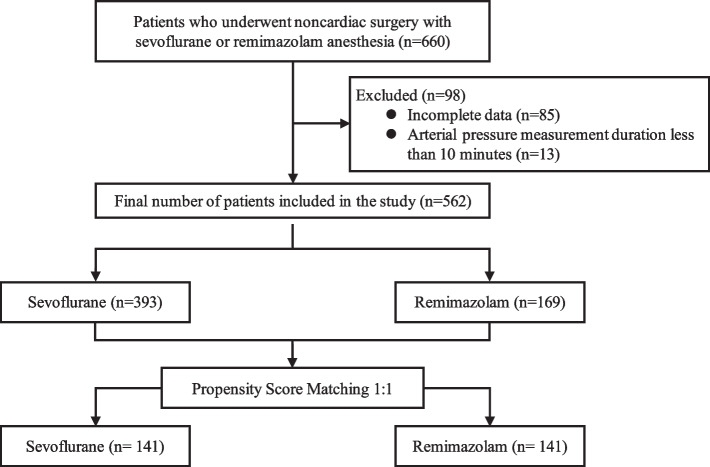
Results: This study involved adult patients undergoing noncardiac surgery using remimazolam (Group R) or sevoflurane (Group S) for maintenance anesthesia, and invasive arterial pressure measurements, from September 2020 to March 2023 at our hospital. IOH was defined as a mean blood pressure < 65 mmHg occurring for a cumulative duration of at least 10 min. A 1:1 propensity score-matching method was used. The primary endpoint was the occurrence of IOH, and the secondary endpoints were the cumulative hypotensive time, incidence of vasopressor use, and dose of vasopressor used (ephedrine, phenylephrine, dopamine, and noradrenaline). Group R comprised 169 patients, Group S comprised 393 patients, and a matched cohort of 141 patients was created by propensity score matching. There was no significant difference in the incidence of IOH between the two groups (85.1% in Group R vs. 91.5% in Group S, p = 0.138). Patients in Group R had a significantly lower cumulative hypotension duration (55 [18-119] vs. 83 [39-144] min, p = 0.005), vasopressor use (81.6% vs. 91.5%, p = 0.023), and dose of ephedrine (4 [0-8] vs. 12 [4-20] mg, p < 0.001) than those in Group S. There were no significant differences in the doses of other vasopressors between groups.
Conclusions: Compared with sevoflurane, the maintenance of anesthesia with remimazolam was not associated with a decreased incidence of IOH; however, it reduced the cumulative hypotension time, incidence of vasopressor use, and dose of ephedrine.
期刊介绍:
JA Clinical Reports is a companion journal to the Journal of Anesthesia (JA), the official journal of the Japanese Society of Anesthesiologists (JSA). This journal is an open access, peer-reviewed, online journal related to clinical anesthesia practices such as anesthesia management, pain management and intensive care. Case reports are very important articles from the viewpoint of education and the cultivation of scientific thinking in the field of anesthesia. However, submissions of anesthesia research and clinical reports from Japan are notably decreasing in major anesthesia journals. Therefore, the JSA has decided to launch a new journal, JA Clinical Reports, to encourage JSA members, particularly junior Japanese anesthesiologists, to publish papers in English language.



 京公网安备 11010802042870号
京ICP备2023020795号-1
京公网安备 11010802042870号
京ICP备2023020795号-1

 分享
分享
 求助内容:
求助内容: 应助结果提醒方式:
 扫码关注我们
