Manuel Villalobos-Cid , Márcio Dorn , Ángela Contreras , Mario Inostroza-Ponta
{"title":"An evolutionary algorithm based on parsimony for the multiobjective phylogenetic network inference problem","authors":"Manuel Villalobos-Cid , Márcio Dorn , Ángela Contreras , Mario Inostroza-Ponta","doi":"10.1016/j.asoc.2023.110270","DOIUrl":null,"url":null,"abstract":"<div><p>Phylogenetic networks can represent evolutionary phenomena that phylogenetic trees cannot describe, such as parallelism, convergence, reversion, hybridisation, recombination, and horizontal transference. The phylogenetic inference problem can be seen as an optimisation problem, searching for the most qualified network among the possible topologies, based on an inference criterion. However, different criteria may result in several topologies of networks, which could conflict with each other. Multi-objective optimisation can handle conflicting objectives, reducing the bias associated with the dependency on a specific criterion. In this work, we define the multi-objective phylogenetic inference problem based on networks to consider <em>reticular</em><span> phenomena and propose an ad-hoc evolutionary algorithm to treat it: </span><em>MO-PhyNet</em>. This algorithm is based on the Non-dominated Sorting Genetic Algorithm II designed to infer rooted phylogenetic networks by minimising three criteria: (1) parsimony <em>hardwired</em>, (2) parsimony <em>softwired</em>, and (3) the <em>number of reticulations</em>. The formalisation of the phylogenetic inference based on networks as a multi-objective optimisation problem allows us to obtain solutions considering conflicting inference criteria, resulting in different reticulated topologies representing distinct evolutionary hypotheses. The <em>MO-PhyNet</em> results identify Pareto set of solutions that show a relationship between the hardwired parsimony and the minimum reticulations criteria. Additionally, <em>MO-PhyNet</em> obtains better solutions than other strategies in terms of the optimised criteria by allowing to visualise incongruences and horizontal phenomena. This work is the first attempt to address the inference of phylogenetic networks considering multi-objective optimisation concerning the current literature to the best of our knowledge.</p></div>","PeriodicalId":50737,"journal":{"name":"Applied Soft Computing","volume":"139 ","pages":"Article 110270"},"PeriodicalIF":6.6000,"publicationDate":"2023-05-01","publicationTypes":"Journal Article","fieldsOfStudy":null,"isOpenAccess":false,"openAccessPdf":"","citationCount":"0","resultStr":null,"platform":"Semanticscholar","paperid":null,"PeriodicalName":"Applied Soft Computing","FirstCategoryId":"94","ListUrlMain":"https://www.sciencedirect.com/science/article/pii/S1568494623002880","RegionNum":1,"RegionCategory":"计算机科学","ArticlePicture":[],"TitleCN":null,"AbstractTextCN":null,"PMCID":null,"EPubDate":"2023/3/30 0:00:00","PubModel":"Epub","JCR":"Q1","JCRName":"COMPUTER SCIENCE, ARTIFICIAL INTELLIGENCE","Score":null,"Total":0}
引用次数: 0
Abstract
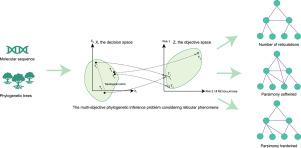
Phylogenetic networks can represent evolutionary phenomena that phylogenetic trees cannot describe, such as parallelism, convergence, reversion, hybridisation, recombination, and horizontal transference. The phylogenetic inference problem can be seen as an optimisation problem, searching for the most qualified network among the possible topologies, based on an inference criterion. However, different criteria may result in several topologies of networks, which could conflict with each other. Multi-objective optimisation can handle conflicting objectives, reducing the bias associated with the dependency on a specific criterion. In this work, we define the multi-objective phylogenetic inference problem based on networks to consider reticular phenomena and propose an ad-hoc evolutionary algorithm to treat it: MO-PhyNet. This algorithm is based on the Non-dominated Sorting Genetic Algorithm II designed to infer rooted phylogenetic networks by minimising three criteria: (1) parsimony hardwired, (2) parsimony softwired, and (3) the number of reticulations. The formalisation of the phylogenetic inference based on networks as a multi-objective optimisation problem allows us to obtain solutions considering conflicting inference criteria, resulting in different reticulated topologies representing distinct evolutionary hypotheses. The MO-PhyNet results identify Pareto set of solutions that show a relationship between the hardwired parsimony and the minimum reticulations criteria. Additionally, MO-PhyNet obtains better solutions than other strategies in terms of the optimised criteria by allowing to visualise incongruences and horizontal phenomena. This work is the first attempt to address the inference of phylogenetic networks considering multi-objective optimisation concerning the current literature to the best of our knowledge.
期刊介绍:
Applied Soft Computing is an international journal promoting an integrated view of soft computing to solve real life problems.The focus is to publish the highest quality research in application and convergence of the areas of Fuzzy Logic, Neural Networks, Evolutionary Computing, Rough Sets and other similar techniques to address real world complexities.
Applied Soft Computing is a rolling publication: articles are published as soon as the editor-in-chief has accepted them. Therefore, the web site will continuously be updated with new articles and the publication time will be short.



 京公网安备 11010802042870号
京ICP备2023020795号-1
京公网安备 11010802042870号
京ICP备2023020795号-1

 分享
分享
 求助内容:
求助内容: 应助结果提醒方式:
 扫码关注我们
