{"title":"Limnogeology of the Agua de la Zorra Formation (Middle–Upper Triassic), Cuyana Basin, NW Argentina: Emphasising lacustrine carbonates","authors":"Zuriñe Larena , Cecilia Andrea Benavente , Tomás Pedernera , Adriana Mancuso , Eduardo Guillermo Ottone","doi":"10.1016/j.sedgeo.2023.106513","DOIUrl":null,"url":null,"abstract":"<div><p><span>Lacustrine systems are complex and highly sensitive in responding to allogenic factors like tectonics, climate and volcanism but also present within lake processes that are difficult to disentangle. The Agua de la Zorra Formation (Middle–Upper Triassic) outcropping in the Paramillos de Uspallata sub-basin, Cuyana rift Basin (SW Gondwana), is composed of deltaic–fluvial–lacustrine–volcaniclastic deposits. The lacustrine system presents carbonate deposits, as almost every other sub-basin within the Cuyana rift. This makes it an exceptional case for analysing limnogeological questions in an </span>extensional tectonic<span><span> regime linked to volcanism (basalt flow and tuff deposits) and studying lacustrine carbonate in that particular setting. This study focuses on a high-resolution stratigraphic, sedimentologic, petrographic and limnogeological investigation of the Agua de la Zorra depositional system to understand its evolution through space and time; and to reconstruct the development of the carbonate factory within the palaeolake. Stratigraphic correlation of five sedimentary logs across the sub-basin allowed the identification of a deltaic–lacustrine facies association and a progradational–retrogradational stacking pattern interpreting the palaeolake as an overfilled lake basin type. Five facies associations represent a delta front, prodelta, lake margin, lake centre and volcanic episodes. The stratigraphic analysis allowed interpreting that volcanic episodes were diachronous during the evolution of the Agua de la Zorra system; the development of a well-established axial fluvial system upsection and the coeval migration of the highest accommodation point and lake centre northwards. Carbonate deposits are part of the lake margin subenvironment and immediately overlie volcanic basalts and are laterally linked to altered sandstones in contact with basalts. Their microfabric is characterised by fibro-radial spar mosaics and laminated carbonate, interpreted as inorganic authigenic </span>calcite<span> precipitation. This and their restricted extent support that alkaline lava flows in contact with the palaeolake water column triggered carbonate precipitation. Stratigraphic, sedimentologic, limnogeological and petrographic analyses strongly support volcanism and tectonics as the main allogenic factors controlling the Agua de La Zorra lacustrine system evolution.</span></span></p></div>","PeriodicalId":21575,"journal":{"name":"Sedimentary Geology","volume":"457 ","pages":"Article 106513"},"PeriodicalIF":2.9000,"publicationDate":"2023-09-21","publicationTypes":"Journal Article","fieldsOfStudy":null,"isOpenAccess":false,"openAccessPdf":"","citationCount":"0","resultStr":null,"platform":"Semanticscholar","paperid":null,"PeriodicalName":"Sedimentary Geology","FirstCategoryId":"89","ListUrlMain":"https://www.sciencedirect.com/science/article/pii/S0037073823001859","RegionNum":2,"RegionCategory":"地球科学","ArticlePicture":[],"TitleCN":null,"AbstractTextCN":null,"PMCID":null,"EPubDate":"","PubModel":"","JCR":"Q1","JCRName":"GEOLOGY","Score":null,"Total":0}
引用次数: 0
Abstract
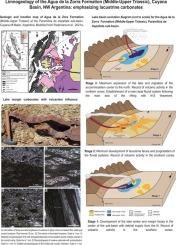
Lacustrine systems are complex and highly sensitive in responding to allogenic factors like tectonics, climate and volcanism but also present within lake processes that are difficult to disentangle. The Agua de la Zorra Formation (Middle–Upper Triassic) outcropping in the Paramillos de Uspallata sub-basin, Cuyana rift Basin (SW Gondwana), is composed of deltaic–fluvial–lacustrine–volcaniclastic deposits. The lacustrine system presents carbonate deposits, as almost every other sub-basin within the Cuyana rift. This makes it an exceptional case for analysing limnogeological questions in an extensional tectonic regime linked to volcanism (basalt flow and tuff deposits) and studying lacustrine carbonate in that particular setting. This study focuses on a high-resolution stratigraphic, sedimentologic, petrographic and limnogeological investigation of the Agua de la Zorra depositional system to understand its evolution through space and time; and to reconstruct the development of the carbonate factory within the palaeolake. Stratigraphic correlation of five sedimentary logs across the sub-basin allowed the identification of a deltaic–lacustrine facies association and a progradational–retrogradational stacking pattern interpreting the palaeolake as an overfilled lake basin type. Five facies associations represent a delta front, prodelta, lake margin, lake centre and volcanic episodes. The stratigraphic analysis allowed interpreting that volcanic episodes were diachronous during the evolution of the Agua de la Zorra system; the development of a well-established axial fluvial system upsection and the coeval migration of the highest accommodation point and lake centre northwards. Carbonate deposits are part of the lake margin subenvironment and immediately overlie volcanic basalts and are laterally linked to altered sandstones in contact with basalts. Their microfabric is characterised by fibro-radial spar mosaics and laminated carbonate, interpreted as inorganic authigenic calcite precipitation. This and their restricted extent support that alkaline lava flows in contact with the palaeolake water column triggered carbonate precipitation. Stratigraphic, sedimentologic, limnogeological and petrographic analyses strongly support volcanism and tectonics as the main allogenic factors controlling the Agua de La Zorra lacustrine system evolution.
阿根廷西北部Cuyana盆地Agua de la Zorra组(中上三叠世)的湖泊地质:强调湖相碳酸盐岩
湖泊系统是复杂的,对构造、气候和火山活动等同种因素的反应非常敏感,但也存在于难以理清的湖泊过程中。Cuyana裂谷盆地Paramillos de Uspallata次盆地(冈瓦纳大陆西南部)中出露的Agua de la Zorra组(中上三叠纪)由三角洲-河流-湖泊-火山碎屑沉积物组成。湖泊系统呈现碳酸盐沉积,与Cuyana裂谷内几乎所有其他子盆地一样。这使得它成为分析与火山活动(玄武岩流和凝灰岩矿床)有关的伸展构造体系中的湖沼地质问题以及研究该特定环境中的湖相碳酸盐的特例。本研究侧重于对Agua de la Zorra沉积体系进行高分辨率的地层、沉积学、岩石学和湖沼地质学调查,以了解其在空间和时间上的演变;以及重建古湖内碳酸盐工厂的发展。通过对整个子盆地的五个沉积测井进行地层对比,可以识别三角洲-湖泊相组合和进积-退积叠加模式,将古湖泊解释为过度填充湖盆类型。五个相组合代表三角洲前缘、前三角洲、湖泊边缘、湖泊中心和火山活动。地层分析可以解释,在阿瓜德拉佐拉系统的演化过程中,火山活动是历时性的;成熟的轴向河流系统紊乱的发展以及最高容纳点和湖泊中心向北的同时代迁移。碳酸盐矿床是湖缘亚环境的一部分,直接覆盖在火山玄武岩之上,并与玄武岩接触的蚀变砂岩横向相连。它们的微构造以纤维放射状的晶石镶嵌和层状碳酸盐为特征,被解释为无机自生方解石沉淀。这一点及其有限的范围支持了与古湖水柱接触的碱性熔岩流引发碳酸盐沉淀。地层学、沉积学、湖沼地质学和岩石学分析有力地支持火山活动和构造是控制Agua-de-LaZorra湖相系统演化的主要异成因因素。
期刊介绍:
Sedimentary Geology is a journal that rapidly publishes high quality, original research and review papers that cover all aspects of sediments and sedimentary rocks at all spatial and temporal scales. Submitted papers must make a significant contribution to the field of study and must place the research in a broad context, so that it is of interest to the diverse, international readership of the journal. Papers that are largely descriptive in nature, of limited scope or local geographical significance, or based on limited data will not be considered for publication.



 京公网安备 11010802042870号
京ICP备2023020795号-1
京公网安备 11010802042870号
京ICP备2023020795号-1

 分享
分享
 求助内容:
求助内容: 应助结果提醒方式:
 扫码关注我们
