{"title":"Effect of potato incorporation on the physico-chemical, textural and sensory properties of processed cheese","authors":"Syed Mansha Rafiq, Bikash C. Ghosh","doi":"10.1007/s11694-016-9448-3","DOIUrl":null,"url":null,"abstract":"<p>The aim of the present study was to incorporate potato for the development of processed cheese rich in carbohydrates with low fat content and to minimize the cost without affecting the overall quality. A blend of young and old Cheddar cheese was used in the preparation. Boiled and mashed potatoes were incorporated at a level of 20, 30 and 40% and the effect on the physico-chemical, textural and sensory properties were evaluated. Results showed that with the increased level of potato incorporation into the processed cheese, moisture content increased whereas fat and protein content decreased. On textural properties no significant difference (p?>?0.05) was found till 20 and 30% incorporation, but at 40%, hardness and gumminess was significantly (p?<?0.05) lower than the control. On sensory properties, flavour intensity decreased with the increased level of potato incorporation but was non-significant (p?>?0.05) till 30% level but at 40% it was significantly lower (p?<?0.05) than the control. Cheese samples with 40% potato level were found to be very soft and sticky but those with 20 and 30% were found to have a smooth firm body and a better mouth feel. Colour and appearance was almost similar in all samples. Our results suggest that an acceptable quality processed cheese can be made with up to 30% potato incorporation. However, with slight modification of processing parameters, more than 30% can also be incorporated without any adverse effect on the overall quality of the processed cheese.</p>","PeriodicalId":48735,"journal":{"name":"Journal of Food Measurement and Characterization","volume":"11 2","pages":"776 - 780"},"PeriodicalIF":3.3000,"publicationDate":"2016-12-19","publicationTypes":"Journal Article","fieldsOfStudy":null,"isOpenAccess":false,"openAccessPdf":"https://sci-hub-pdf.com/10.1007/s11694-016-9448-3","citationCount":"0","resultStr":null,"platform":"Semanticscholar","paperid":null,"PeriodicalName":"Journal of Food Measurement and Characterization","FirstCategoryId":"97","ListUrlMain":"https://link.springer.com/article/10.1007/s11694-016-9448-3","RegionNum":3,"RegionCategory":"农林科学","ArticlePicture":[],"TitleCN":null,"AbstractTextCN":null,"PMCID":null,"EPubDate":"","PubModel":"","JCR":"Q1","JCRName":"Engineering","Score":null,"Total":0}
引用次数: 0
Abstract
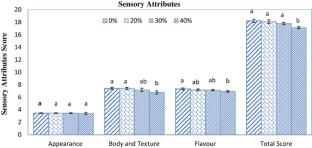
The aim of the present study was to incorporate potato for the development of processed cheese rich in carbohydrates with low fat content and to minimize the cost without affecting the overall quality. A blend of young and old Cheddar cheese was used in the preparation. Boiled and mashed potatoes were incorporated at a level of 20, 30 and 40% and the effect on the physico-chemical, textural and sensory properties were evaluated. Results showed that with the increased level of potato incorporation into the processed cheese, moisture content increased whereas fat and protein content decreased. On textural properties no significant difference (p?>?0.05) was found till 20 and 30% incorporation, but at 40%, hardness and gumminess was significantly (p?<?0.05) lower than the control. On sensory properties, flavour intensity decreased with the increased level of potato incorporation but was non-significant (p?>?0.05) till 30% level but at 40% it was significantly lower (p?<?0.05) than the control. Cheese samples with 40% potato level were found to be very soft and sticky but those with 20 and 30% were found to have a smooth firm body and a better mouth feel. Colour and appearance was almost similar in all samples. Our results suggest that an acceptable quality processed cheese can be made with up to 30% potato incorporation. However, with slight modification of processing parameters, more than 30% can also be incorporated without any adverse effect on the overall quality of the processed cheese.
期刊介绍:
This interdisciplinary journal publishes new measurement results, characteristic properties, differentiating patterns, measurement methods and procedures for such purposes as food process innovation, product development, quality control, and safety assurance.
The journal encompasses all topics related to food property measurement and characterization, including all types of measured properties of food and food materials, features and patterns, measurement principles and techniques, development and evaluation of technologies, novel uses and applications, and industrial implementation of systems and procedures.



 京公网安备 11010802042870号
京ICP备2023020795号-1
京公网安备 11010802042870号
京ICP备2023020795号-1

 分享
分享
 求助内容:
求助内容: 应助结果提醒方式:
 扫码关注我们
