下载PDF
{"title":"MR-guided interstitial laser-induced thermotherapy of hepatic metastasis combined with arterial blood flow reduction: Technique and first clinical results in an open MR system","authors":"Frank K. Wacker MD, Klaus Reither MD, Jörg P. Ritz MD, Andre Roggan MD, Christoph T. Germer MD, Karl-Jürgen Wolf MD","doi":"10.1002/1522-2586(200101)13:1<31::AID-JMRI1005>3.0.CO;2-I","DOIUrl":null,"url":null,"abstract":"<p>The feasibility and safety of percutaneous laser-induced thermotherapy (LITT) of liver metastases in an open low-field magnetic resonance imaging (MRI) system combined with microsphere-modulated blood flow reduction were tested. Nd:YAG laser therapy with an internally cooled laser applicator was performed under local anesthesia on 20 patients with 34 liver metastases. To increase the effectivenes of LITT, degradable starch microspheres were injected into the proper hepatic artery through an MR-visible catheter initially inserted under fluoroscopy. Near real-time imaging was used for positioning the laser applicator. A T1-weighted gradient-echo breath-hold sequence was used for catheter localization and temperature monitoring. The volumes of the liver metastases and the thermonecroses were determined. MRI-guided LITT could be performed in all patients with no clinically relevant complications. Intraprocedural imaging underestimated the extent of thermonecrosis. In conclusion, percutaneous LITT of liver metastases after injection of starch microspheres is both technically feasible and safe in an open MRI system. J. Magn. Reson. Imaging 2001;13:31–36. © 2001 Wiley-Liss, Inc.</p>","PeriodicalId":16140,"journal":{"name":"Journal of Magnetic Resonance Imaging","volume":"13 1","pages":"31-36"},"PeriodicalIF":3.5000,"publicationDate":"2001-01-09","publicationTypes":"Journal Article","fieldsOfStudy":null,"isOpenAccess":false,"openAccessPdf":"https://sci-hub-pdf.com/10.1002/1522-2586(200101)13:1<31::AID-JMRI1005>3.0.CO;2-I","citationCount":"69","resultStr":null,"platform":"Semanticscholar","paperid":null,"PeriodicalName":"Journal of Magnetic Resonance Imaging","FirstCategoryId":"3","ListUrlMain":"https://onlinelibrary.wiley.com/doi/10.1002/1522-2586%28200101%2913%3A1%3C31%3A%3AAID-JMRI1005%3E3.0.CO%3B2-I","RegionNum":2,"RegionCategory":"医学","ArticlePicture":[],"TitleCN":null,"AbstractTextCN":null,"PMCID":null,"EPubDate":"","PubModel":"","JCR":"Q1","JCRName":"RADIOLOGY, NUCLEAR MEDICINE & MEDICAL IMAGING","Score":null,"Total":0}
引用次数: 69
引用
批量引用
Abstract
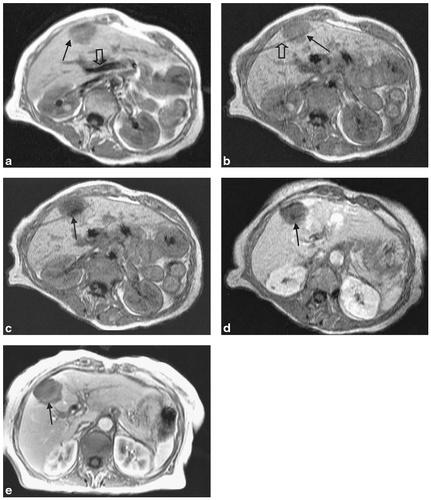
The feasibility and safety of percutaneous laser-induced thermotherapy (LITT) of liver metastases in an open low-field magnetic resonance imaging (MRI) system combined with microsphere-modulated blood flow reduction were tested. Nd:YAG laser therapy with an internally cooled laser applicator was performed under local anesthesia on 20 patients with 34 liver metastases. To increase the effectivenes of LITT, degradable starch microspheres were injected into the proper hepatic artery through an MR-visible catheter initially inserted under fluoroscopy. Near real-time imaging was used for positioning the laser applicator. A T1-weighted gradient-echo breath-hold sequence was used for catheter localization and temperature monitoring. The volumes of the liver metastases and the thermonecroses were determined. MRI-guided LITT could be performed in all patients with no clinically relevant complications. Intraprocedural imaging underestimated the extent of thermonecrosis. In conclusion, percutaneous LITT of liver metastases after injection of starch microspheres is both technically feasible and safe in an open MRI system. J. Magn. Reson. Imaging 2001;13:31–36. © 2001 Wiley-Liss, Inc.
磁共振引导间质激光热疗肝转移联合动脉血流减少:技术和首次临床结果在一个开放的磁共振系统
研究了开放低场磁共振成像(MRI)系统中经皮激光热疗(LITT)联合微球调节血流减少治疗肝转移瘤的可行性和安全性。本文对20例34例肝转移患者在局部麻醉下,应用内冷激光涂布器进行Nd:YAG激光治疗。为了提高LITT的有效性,可降解的淀粉微球通过mri可见导管注射到肝固有动脉,最初在透视下插入。近实时成像用于定位激光施药器。t1加权梯度回声屏气序列用于导管定位和温度监测。测定肝转移灶体积及热交叉。mri引导下的LITT可在所有无临床相关并发症的患者中进行。术中影像学低估了热坏死的程度。总之,在开放的MRI系统中,经皮肝转移灶注射淀粉微球后的肝转移LITT在技术上是可行和安全的。j .增效。的原因。成像2001;13:31-36。©2001 Wiley-Liss, Inc。
本文章由计算机程序翻译,如有差异,请以英文原文为准。



 京公网安备 11010802042870号
京ICP备2023020795号-1
京公网安备 11010802042870号
京ICP备2023020795号-1

 分享
分享
 求助内容:
求助内容: 应助结果提醒方式:
 扫码关注我们
