Effect of feeding a high- or low-rumen escape protein supplement to dry Holstein cows and heifers within 3 weeks of calving on their productive and reproductive performance in the subsequent lactation
{"title":"Effect of feeding a high- or low-rumen escape protein supplement to dry Holstein cows and heifers within 3 weeks of calving on their productive and reproductive performance in the subsequent lactation","authors":"P.H Robinson , J.M Moorby , M Arana , T Graham","doi":"10.1016/j.anifeedsci.2003.12.003","DOIUrl":null,"url":null,"abstract":"<div><p><span>Pregnant Holstein<span> heifers<span> (450) and dry cows (417) within 3 weeks of calving (i.e., close up) were assigned to one of three groups. These groups were offered a low-CP (0.117 of DM) ration based on corn silage, alfalfa cubes, oat hay, corn and barley grain, or a medium-CP (0.144) ration, as the low-CP ration plus 1</span></span></span> <span><span>kg per day per cow of a supplement (0.60 canola meal or </span>rumen protected (RP) canola meal and 0.40 other), or a high-CP (0.166) ration, as the low-CP ration plus 2</span> <span>kg per day per cow of one of the supplements. Use of bovine somatotropin (bST), movement through production groups, and breeding events were determined by the herd manager after calving. Production parameters were pooled to means for cows that successfully completed the lactation. The RP canola meal had an average 0.720 rumen undegraded crude protein content, based upon 16</span> <!-->h in situ incubation, versus 0.252 for untreated canola meal. Primiparous cows produced no more milk or milk components in their full lactation, or had higher peak milk yields, if supplemented with canola meal at any level from either source. However average body condition score in lactation was higher (<em>P</em><0.01) for cows supplemented with RP canola meal. While multiparous cows supplemented with RP canola meal in their close up dry period peaked at higher levels of milk (<em>P</em><0.01), they did not produce more milk or milk components during their full lactation. There is no indication that time in the close up group (between 1 and 19 days) had a substantive impact on milk production of multiparous cows, although primiparous cows produced 71<!--> <!-->kg more milk (<em>P</em><span><span><0.01) in their subsequent lactation for each extra day close up. In general, reproductive performance was not affected by any treatment and small differences among treatments in use of bST were judged to have been unlikely to have impacted milk production among treatments. These results are broadly consistent with results of others, and supportive of recent NRC [Nutrient Requirements of Dairy Cattle, 7th rev. ed., update. National Academy of Science, Washington, DC, USA, 2001] protein recommendations for close up heifers and multiparous cows. However the milk production </span>lactation curves of cows of both parities differed between the period prior to bST use and the period of bST use. During the period prior to use of bST, cows supplemented with RP canola meal in the close up period outperformed those supplemented with untreated canola meal, whereas during the period of bST use the reverse occurred, primarily due to cows supplemented with RP canola meal being less responsive to bST. While no convincing explanation exists for this occurrence, its existence supports the high level of RUP determined in situ for the RP canola meal.</span></p></div>","PeriodicalId":7861,"journal":{"name":"Animal Feed Science and Technology","volume":"114 1","pages":"Pages 42-57"},"PeriodicalIF":2.7000,"publicationDate":"2004-05-03","publicationTypes":"Journal Article","fieldsOfStudy":null,"isOpenAccess":false,"openAccessPdf":"https://sci-hub-pdf.com/10.1016/j.anifeedsci.2003.12.003","citationCount":"6","resultStr":null,"platform":"Semanticscholar","paperid":null,"PeriodicalName":"Animal Feed Science and Technology","FirstCategoryId":"97","ListUrlMain":"https://www.sciencedirect.com/science/article/pii/S0377840103003523","RegionNum":2,"RegionCategory":"农林科学","ArticlePicture":[],"TitleCN":null,"AbstractTextCN":null,"PMCID":null,"EPubDate":"2004/1/23 0:00:00","PubModel":"Epub","JCR":"Q1","JCRName":"AGRICULTURE, DAIRY & ANIMAL SCIENCE","Score":null,"Total":0}
引用次数: 6
Abstract
Pregnant Holstein heifers (450) and dry cows (417) within 3 weeks of calving (i.e., close up) were assigned to one of three groups. These groups were offered a low-CP (0.117 of DM) ration based on corn silage, alfalfa cubes, oat hay, corn and barley grain, or a medium-CP (0.144) ration, as the low-CP ration plus 1kg per day per cow of a supplement (0.60 canola meal or rumen protected (RP) canola meal and 0.40 other), or a high-CP (0.166) ration, as the low-CP ration plus 2kg per day per cow of one of the supplements. Use of bovine somatotropin (bST), movement through production groups, and breeding events were determined by the herd manager after calving. Production parameters were pooled to means for cows that successfully completed the lactation. The RP canola meal had an average 0.720 rumen undegraded crude protein content, based upon 16 h in situ incubation, versus 0.252 for untreated canola meal. Primiparous cows produced no more milk or milk components in their full lactation, or had higher peak milk yields, if supplemented with canola meal at any level from either source. However average body condition score in lactation was higher (P<0.01) for cows supplemented with RP canola meal. While multiparous cows supplemented with RP canola meal in their close up dry period peaked at higher levels of milk (P<0.01), they did not produce more milk or milk components during their full lactation. There is no indication that time in the close up group (between 1 and 19 days) had a substantive impact on milk production of multiparous cows, although primiparous cows produced 71 kg more milk (P<0.01) in their subsequent lactation for each extra day close up. In general, reproductive performance was not affected by any treatment and small differences among treatments in use of bST were judged to have been unlikely to have impacted milk production among treatments. These results are broadly consistent with results of others, and supportive of recent NRC [Nutrient Requirements of Dairy Cattle, 7th rev. ed., update. National Academy of Science, Washington, DC, USA, 2001] protein recommendations for close up heifers and multiparous cows. However the milk production lactation curves of cows of both parities differed between the period prior to bST use and the period of bST use. During the period prior to use of bST, cows supplemented with RP canola meal in the close up period outperformed those supplemented with untreated canola meal, whereas during the period of bST use the reverse occurred, primarily due to cows supplemented with RP canola meal being less responsive to bST. While no convincing explanation exists for this occurrence, its existence supports the high level of RUP determined in situ for the RP canola meal.
期刊介绍:
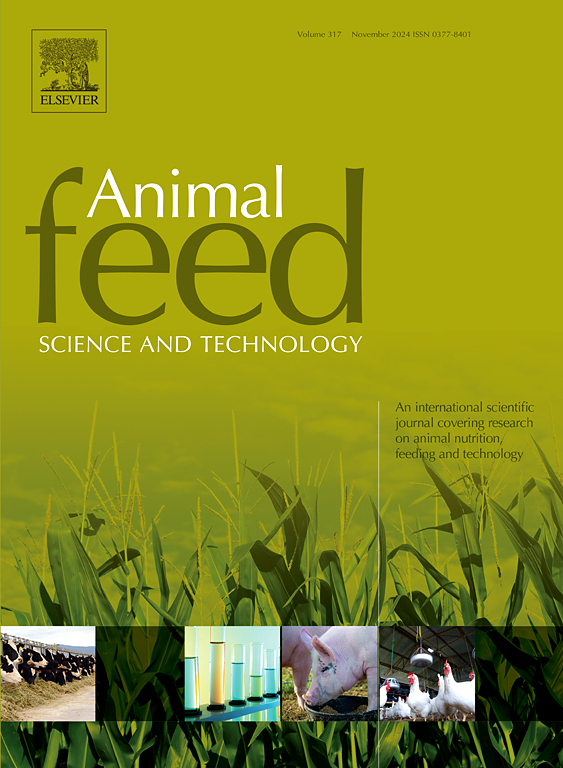
Animal Feed Science and Technology is a unique journal publishing scientific papers of international interest focusing on animal feeds and their feeding.
Papers describing research on feed for ruminants and non-ruminants, including poultry, horses, companion animals and aquatic animals, are welcome.
The journal covers the following areas:
Nutritive value of feeds (e.g., assessment, improvement)
Methods of conserving and processing feeds that affect their nutritional value
Agronomic and climatic factors influencing the nutritive value of feeds
Utilization of feeds and the improvement of such
Metabolic, production, reproduction and health responses, as well as potential environmental impacts, of diet inputs and feed technologies (e.g., feeds, feed additives, feed components, mycotoxins)
Mathematical models relating directly to animal-feed interactions
Analytical and experimental methods for feed evaluation
Environmental impacts of feed technologies in animal production.



 京公网安备 11010802042870号
京ICP备2023020795号-1
京公网安备 11010802042870号
京ICP备2023020795号-1

 分享
分享
 求助内容:
求助内容: 应助结果提醒方式:
 扫码关注我们
