Comparative Study of Minimally Invasive Plate Osteosynthesis (MIPO) and Intramedullary Nailing (IMN) for Treating Extraarticular Distal Tibial Fractures: Clinical and Radiological Outcomes.
Oğuz Kaya, Hacı Bayram Tosun, Hüseyin Kürüm, Sancar Serbest, Abuzer Uludağ, Orhan Ayas
{"title":"Comparative Study of Minimally Invasive Plate Osteosynthesis (MIPO) and Intramedullary Nailing (IMN) for Treating Extraarticular Distal Tibial Fractures: Clinical and Radiological Outcomes.","authors":"Oğuz Kaya, Hacı Bayram Tosun, Hüseyin Kürüm, Sancar Serbest, Abuzer Uludağ, Orhan Ayas","doi":"10.12659/MSM.942154","DOIUrl":null,"url":null,"abstract":"<p><p>BACKGROUND Treatment of extra-articular distal tibial fractures is problematic owing to limited soft tissue cover, poor vascularity of the location, and adjacency to the ankle, and thus continues to be controversial. This study aimed to compare clinical and radiological outcomes in 69 patients with extra-articular distal tibia fractures treated with minimally invasive plate osteosynthesis (MIPO) and an interlocking intramedullary nail (IMN). MATERIAL AND METHODS Sixty-nine patients, with mean of age 39.8±18.3 years, were retrospectively evaluated. Thirty-five patients were treated with IMN, and 34 patients were treated with MIPO. Clinical and radiological outcomes were evaluated. RESULTS The average follow-up was 13.3±6 months and union time was 16.2±5.4 weeks. Nonunion was observed in only 4.3% of patients treated with MIPO (P=0.114). Non-acceptable malalignment of extremity was observed in 4.3% of patients with IMN and 7.2% of patients with MIPO. There were no significant differences in union time, nonunion, surgical timing, operating time, malalignment, and complications between groups (P>0.05). The mean American Orthopaedic Foot and Ankle Society (AOFAS) surgery score was 95.8±5 in IMN and 91.9±14.3 in MIPO. AOFAS, Tenny-Wiss radiological, and Ovadia-Beals clinical scores were better in IMN than MIPO (P=0.019, P=0.03, P=0.02, respectively). Mean time of full weight-bearing and of return to daily life with IMN was significantly shorter than with MIPO (P.</p>","PeriodicalId":48888,"journal":{"name":"Medical Science Monitor","volume":"29 ","pages":"e942154"},"PeriodicalIF":2.1000,"publicationDate":"2023-10-16","publicationTypes":"Journal Article","fieldsOfStudy":null,"isOpenAccess":false,"openAccessPdf":"https://ftp.ncbi.nlm.nih.gov/pub/pmc/oa_pdf/23/9a/medscimonit-29-e942154.PMC10588510.pdf","citationCount":"0","resultStr":null,"platform":"Semanticscholar","paperid":null,"PeriodicalName":"Medical Science Monitor","FirstCategoryId":"3","ListUrlMain":"https://doi.org/10.12659/MSM.942154","RegionNum":4,"RegionCategory":"医学","ArticlePicture":[],"TitleCN":null,"AbstractTextCN":null,"PMCID":null,"EPubDate":"","PubModel":"","JCR":"Q1","JCRName":"Medicine","Score":null,"Total":0}
引用次数: 0
Abstract
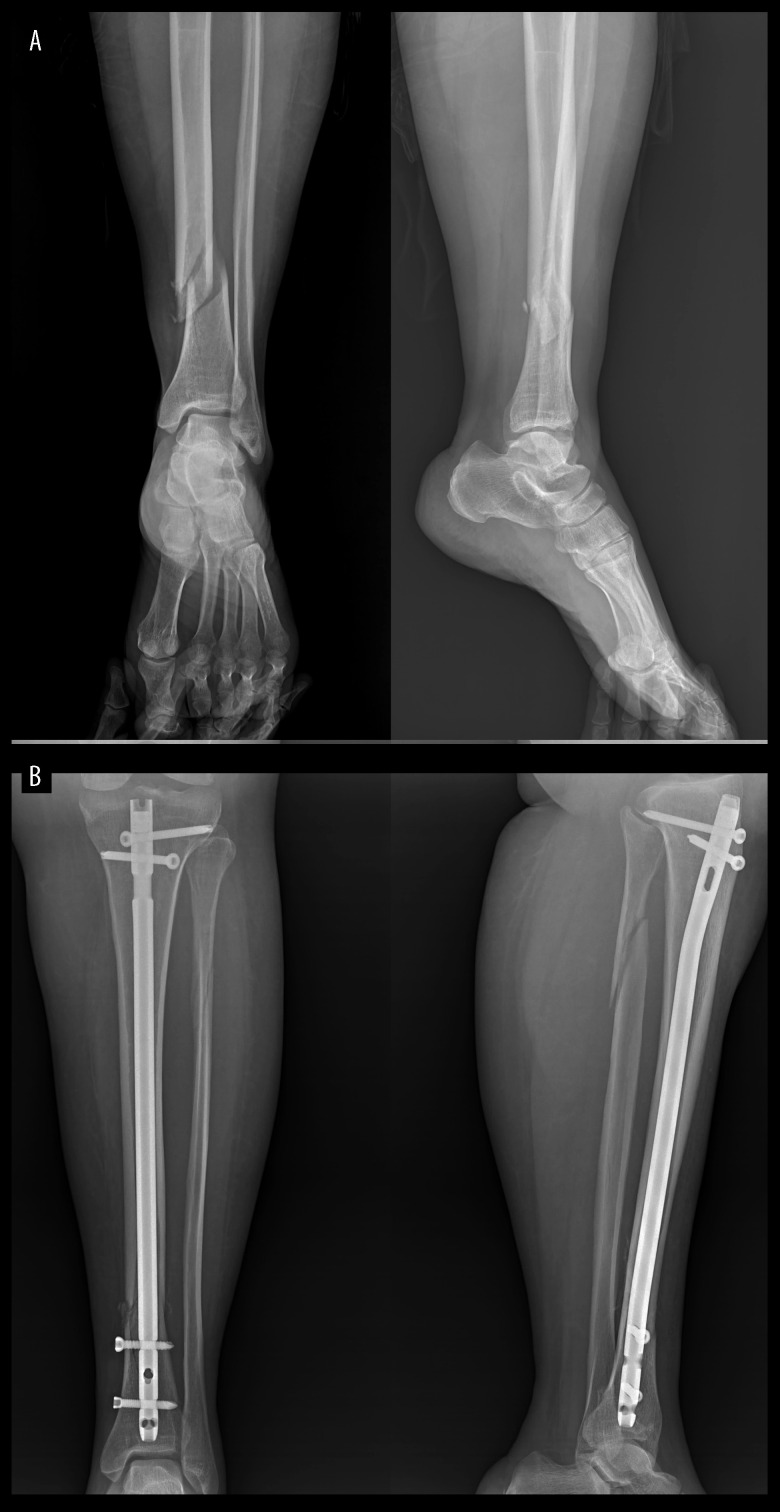
BACKGROUND Treatment of extra-articular distal tibial fractures is problematic owing to limited soft tissue cover, poor vascularity of the location, and adjacency to the ankle, and thus continues to be controversial. This study aimed to compare clinical and radiological outcomes in 69 patients with extra-articular distal tibia fractures treated with minimally invasive plate osteosynthesis (MIPO) and an interlocking intramedullary nail (IMN). MATERIAL AND METHODS Sixty-nine patients, with mean of age 39.8±18.3 years, were retrospectively evaluated. Thirty-five patients were treated with IMN, and 34 patients were treated with MIPO. Clinical and radiological outcomes were evaluated. RESULTS The average follow-up was 13.3±6 months and union time was 16.2±5.4 weeks. Nonunion was observed in only 4.3% of patients treated with MIPO (P=0.114). Non-acceptable malalignment of extremity was observed in 4.3% of patients with IMN and 7.2% of patients with MIPO. There were no significant differences in union time, nonunion, surgical timing, operating time, malalignment, and complications between groups (P>0.05). The mean American Orthopaedic Foot and Ankle Society (AOFAS) surgery score was 95.8±5 in IMN and 91.9±14.3 in MIPO. AOFAS, Tenny-Wiss radiological, and Ovadia-Beals clinical scores were better in IMN than MIPO (P=0.019, P=0.03, P=0.02, respectively). Mean time of full weight-bearing and of return to daily life with IMN was significantly shorter than with MIPO (P.
期刊介绍:
Medical Science Monitor (MSM) established in 1995 is an international, peer-reviewed scientific journal which publishes original articles in Clinical Medicine and related disciplines such as Epidemiology and Population Studies, Product Investigations, Development of Laboratory Techniques :: Diagnostics and Medical Technology which enable presentation of research or review works in overlapping areas of medicine and technology such us (but not limited to): medical diagnostics, medical imaging systems, computer simulation of health and disease processes, new medical devices, etc. Reviews and Special Reports - papers may be accepted on the basis that they provide a systematic, critical and up-to-date overview of literature pertaining to research or clinical topics. Meta-analyses are considered as reviews. A special attention will be paid to a teaching value of a review paper.
Medical Science Monitor is internationally indexed in Thomson-Reuters Web of Science, Journals Citation Report (JCR), Science Citation Index Expanded (SCI), Index Medicus MEDLINE, PubMed, PMC, EMBASE/Excerpta Medica, Chemical Abstracts CAS and Index Copernicus.





 京公网安备 11010802042870号
京ICP备2023020795号-1
京公网安备 11010802042870号
京ICP备2023020795号-1

 分享
分享
 求助内容:
求助内容: 应助结果提醒方式:
 扫码关注我们
