Abdul Waris , Misbahud Din , Asmat Ali , Muhammad Ali , Shakeeb Afridi , Abdul Baset , Atta Ullah Khan
{"title":"A comprehensive review of green synthesis of copper oxide nanoparticles and their diverse biomedical applications","authors":"Abdul Waris , Misbahud Din , Asmat Ali , Muhammad Ali , Shakeeb Afridi , Abdul Baset , Atta Ullah Khan","doi":"10.1016/j.inoche.2020.108369","DOIUrl":null,"url":null,"abstract":"<div><p>The recent development in the field of science and technology, immensely nanotechnology has contributed to the diverse applications of metal oxide nanoparticle in various fields of sciences, industries, and research institutes. Among all nanoparticles, especially in metal oxide nanoparticles, copper oxide nanoparticles (CuONPs) has attracted close attention due to its multifarious properties and applications in various fields, especially in nanomedicine and biomedical sciences. Copper oxide nanoparticles can be synthesized by different approaches such as chemical, physical, and biological methods. The physicochemical techniques are expensive, release high toxic chemicals to the environment, and consume high energy. In contrast, the biological method is an eco-friendly, cost-effective, reliable, and comfortable and simple way to synthesize copper oxide nanoparticles. This review explores the biomediated synthesis of copper oxide nanoparticles, their biomedical applications mainly the antibacterial, antifungal, antiviral, anticancer, and as novel therapeutic agents for combating other diseases.</p></div>","PeriodicalId":13609,"journal":{"name":"Inorganic Chemistry Communications","volume":"123 ","pages":"Article 108369"},"PeriodicalIF":5.4000,"publicationDate":"2021-01-01","publicationTypes":"Journal Article","fieldsOfStudy":null,"isOpenAccess":false,"openAccessPdf":"https://sci-hub-pdf.com/10.1016/j.inoche.2020.108369","citationCount":"115","resultStr":null,"platform":"Semanticscholar","paperid":null,"PeriodicalName":"Inorganic Chemistry Communications","FirstCategoryId":"92","ListUrlMain":"https://www.sciencedirect.com/science/article/pii/S138770032030959X","RegionNum":3,"RegionCategory":"化学","ArticlePicture":[],"TitleCN":null,"AbstractTextCN":null,"PMCID":null,"EPubDate":"2020/12/1 0:00:00","PubModel":"Epub","JCR":"Q1","JCRName":"CHEMISTRY, INORGANIC & NUCLEAR","Score":null,"Total":0}
引用次数: 115
Abstract
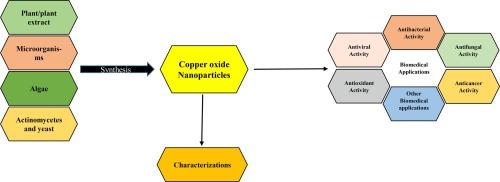
The recent development in the field of science and technology, immensely nanotechnology has contributed to the diverse applications of metal oxide nanoparticle in various fields of sciences, industries, and research institutes. Among all nanoparticles, especially in metal oxide nanoparticles, copper oxide nanoparticles (CuONPs) has attracted close attention due to its multifarious properties and applications in various fields, especially in nanomedicine and biomedical sciences. Copper oxide nanoparticles can be synthesized by different approaches such as chemical, physical, and biological methods. The physicochemical techniques are expensive, release high toxic chemicals to the environment, and consume high energy. In contrast, the biological method is an eco-friendly, cost-effective, reliable, and comfortable and simple way to synthesize copper oxide nanoparticles. This review explores the biomediated synthesis of copper oxide nanoparticles, their biomedical applications mainly the antibacterial, antifungal, antiviral, anticancer, and as novel therapeutic agents for combating other diseases.
期刊介绍:
Launched in January 1998, Inorganic Chemistry Communications is an international journal dedicated to the rapid publication of short communications in the major areas of inorganic, organometallic and supramolecular chemistry. Topics include synthetic and reaction chemistry, kinetics and mechanisms of reactions, bioinorganic chemistry, photochemistry and the use of metal and organometallic compounds in stoichiometric and catalytic synthesis or organic compounds.



 京公网安备 11010802042870号
京ICP备2023020795号-1
京公网安备 11010802042870号
京ICP备2023020795号-1

 分享
分享
 求助内容:
求助内容: 应助结果提醒方式:
 扫码关注我们
