Antonio Tabernero, Eva M. Martín del Valle, Miguel Á. Galán
{"title":"A comparison between semiempirical equations to predict the solubility of pharmaceutical compounds in supercritical carbon dioxide","authors":"Antonio Tabernero, Eva M. Martín del Valle, Miguel Á. Galán","doi":"10.1016/j.supflu.2010.01.009","DOIUrl":null,"url":null,"abstract":"<div><p>The aim of this work is to determine, depending on the operation conditions, which semiempirical equation provides the best fit to solubility data of pharmaceutical compounds in supercritical CO<sub>2</sub>. Solubility data from 27 different pharmaceutical solutes were collected from literature and the different density-based models (Chrastil, Adachi-Lu, del Valle-Aguilera, Sparks, Kumar-Johnston, Bartle, Méndez Santiago-Teja) together with the Yu's model and Gordillo's model were employed. The results showed that, in general, Sparks’ equation provides the best fit to the solubility data for this kind of solids in supercritical CO<sub>2</sub>. However, at certain specific conditions, the best correlation is obtained using Gordillo's equation. By means of a brief comparison with Peng-Robinson equation of state, semiempirical equations present a more accuracy prediction compared to cubic equations of state, and present no drawbacks such as properties estimation and computational difficulties.</p></div>","PeriodicalId":17078,"journal":{"name":"Journal of Supercritical Fluids","volume":"52 2","pages":"Pages 161-174"},"PeriodicalIF":4.4000,"publicationDate":"2010-03-01","publicationTypes":"Journal Article","fieldsOfStudy":null,"isOpenAccess":false,"openAccessPdf":"https://sci-hub-pdf.com/10.1016/j.supflu.2010.01.009","citationCount":"62","resultStr":null,"platform":"Semanticscholar","paperid":null,"PeriodicalName":"Journal of Supercritical Fluids","FirstCategoryId":"5","ListUrlMain":"https://www.sciencedirect.com/science/article/pii/S0896844610000410","RegionNum":3,"RegionCategory":"工程技术","ArticlePicture":[],"TitleCN":null,"AbstractTextCN":null,"PMCID":null,"EPubDate":"2010/1/25 0:00:00","PubModel":"Epub","JCR":"Q2","JCRName":"CHEMISTRY, PHYSICAL","Score":null,"Total":0}
引用次数: 62
Abstract
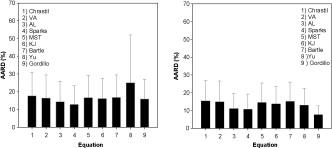
The aim of this work is to determine, depending on the operation conditions, which semiempirical equation provides the best fit to solubility data of pharmaceutical compounds in supercritical CO2. Solubility data from 27 different pharmaceutical solutes were collected from literature and the different density-based models (Chrastil, Adachi-Lu, del Valle-Aguilera, Sparks, Kumar-Johnston, Bartle, Méndez Santiago-Teja) together with the Yu's model and Gordillo's model were employed. The results showed that, in general, Sparks’ equation provides the best fit to the solubility data for this kind of solids in supercritical CO2. However, at certain specific conditions, the best correlation is obtained using Gordillo's equation. By means of a brief comparison with Peng-Robinson equation of state, semiempirical equations present a more accuracy prediction compared to cubic equations of state, and present no drawbacks such as properties estimation and computational difficulties.
期刊介绍:
The Journal of Supercritical Fluids is an international journal devoted to the fundamental and applied aspects of supercritical fluids and processes. Its aim is to provide a focused platform for academic and industrial researchers to report their findings and to have ready access to the advances in this rapidly growing field. Its coverage is multidisciplinary and includes both basic and applied topics.
Thermodynamics and phase equilibria, reaction kinetics and rate processes, thermal and transport properties, and all topics related to processing such as separations (extraction, fractionation, purification, chromatography) nucleation and impregnation are within the scope. Accounts of specific engineering applications such as those encountered in food, fuel, natural products, minerals, pharmaceuticals and polymer industries are included. Topics related to high pressure equipment design, analytical techniques, sensors, and process control methodologies are also within the scope of the journal.



 京公网安备 11010802042870号
京ICP备2023020795号-1
京公网安备 11010802042870号
京ICP备2023020795号-1

 分享
分享
 求助内容:
求助内容: 应助结果提醒方式:
 扫码关注我们
