{"title":"Mechanochemical synthesis of tobermorite by wet grinding in a planetary ball mill","authors":"Guomin Mi , Fumio Saito , Mitsuo Hanada","doi":"10.1016/S0032-5910(97)03261-0","DOIUrl":null,"url":null,"abstract":"<div><p>Wet grinding of mixtures of calcium hydroxide and silica gel with different molar ratios (Ca/Si) ranging from 0.5 to 3.0 was conducted in a planetary ball mill. Three hours of wet grinding enables us to synthesize tobermorite mechanochemically when the molar ratio of the mixture is controlled at about unity, while calcium silicate hydrate-(B) (CSH (B)) is mechanochemically synthesized within about 1.5 h. The presence of excess water, by about four times the mixture's weight in the mill, leads effectively to the mechanochemical synthesis of tobermorite by grinding. Tobermorite synthesized mechanochemically shows similar thermal behavior to that synthesized hydrothermally. However, crystallinity of the former compound is slightly inferior to that latter one. The ground mixture containing tobermorite is thermally decomposed at about 1120 K, forming wollastonite via an amorphous phase, while the mixture with synthesized CSH (B) is decomposed at about 1100 K, forming ϵ-wollastonite via a transitional crystalline phase.</p></div>","PeriodicalId":407,"journal":{"name":"Powder Technology","volume":"93 1","pages":"Pages 77-81"},"PeriodicalIF":4.6000,"publicationDate":"1997-09-01","publicationTypes":"Journal Article","fieldsOfStudy":null,"isOpenAccess":false,"openAccessPdf":"https://sci-hub-pdf.com/10.1016/S0032-5910(97)03261-0","citationCount":"27","resultStr":null,"platform":"Semanticscholar","paperid":null,"PeriodicalName":"Powder Technology","FirstCategoryId":"5","ListUrlMain":"https://www.sciencedirect.com/science/article/pii/S0032591097032610","RegionNum":2,"RegionCategory":"工程技术","ArticlePicture":[],"TitleCN":null,"AbstractTextCN":null,"PMCID":null,"EPubDate":"","PubModel":"","JCR":"Q2","JCRName":"ENGINEERING, CHEMICAL","Score":null,"Total":0}
引用次数: 27
Abstract
Wet grinding of mixtures of calcium hydroxide and silica gel with different molar ratios (Ca/Si) ranging from 0.5 to 3.0 was conducted in a planetary ball mill. Three hours of wet grinding enables us to synthesize tobermorite mechanochemically when the molar ratio of the mixture is controlled at about unity, while calcium silicate hydrate-(B) (CSH (B)) is mechanochemically synthesized within about 1.5 h. The presence of excess water, by about four times the mixture's weight in the mill, leads effectively to the mechanochemical synthesis of tobermorite by grinding. Tobermorite synthesized mechanochemically shows similar thermal behavior to that synthesized hydrothermally. However, crystallinity of the former compound is slightly inferior to that latter one. The ground mixture containing tobermorite is thermally decomposed at about 1120 K, forming wollastonite via an amorphous phase, while the mixture with synthesized CSH (B) is decomposed at about 1100 K, forming ϵ-wollastonite via a transitional crystalline phase.
期刊介绍:
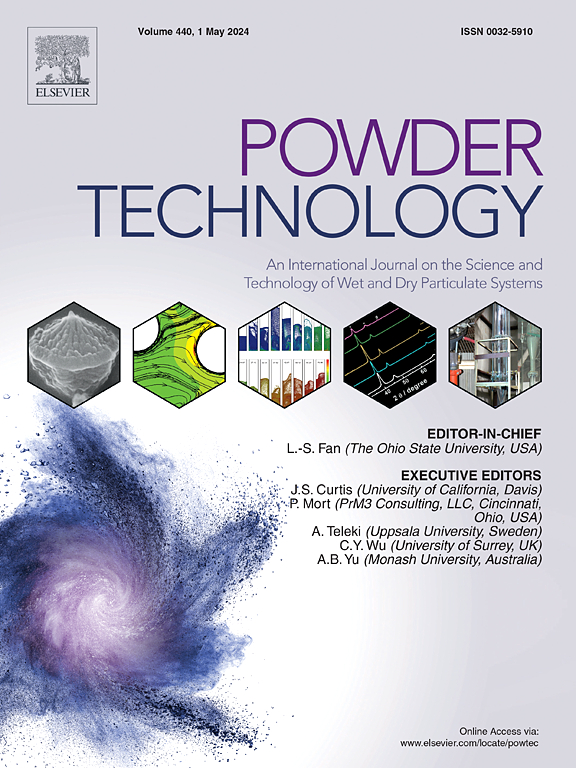
Powder Technology is an International Journal on the Science and Technology of Wet and Dry Particulate Systems. Powder Technology publishes papers on all aspects of the formation of particles and their characterisation and on the study of systems containing particulate solids. No limitation is imposed on the size of the particles, which may range from nanometre scale, as in pigments or aerosols, to that of mined or quarried materials. The following list of topics is not intended to be comprehensive, but rather to indicate typical subjects which fall within the scope of the journal's interests:
Formation and synthesis of particles by precipitation and other methods.
Modification of particles by agglomeration, coating, comminution and attrition.
Characterisation of the size, shape, surface area, pore structure and strength of particles and agglomerates (including the origins and effects of inter particle forces).
Packing, failure, flow and permeability of assemblies of particles.
Particle-particle interactions and suspension rheology.
Handling and processing operations such as slurry flow, fluidization, pneumatic conveying.
Interactions between particles and their environment, including delivery of particulate products to the body.
Applications of particle technology in production of pharmaceuticals, chemicals, foods, pigments, structural, and functional materials and in environmental and energy related matters.
For materials-oriented contributions we are looking for articles revealing the effect of particle/powder characteristics (size, morphology and composition, in that order) on material performance or functionality and, ideally, comparison to any industrial standard.



 京公网安备 11010802042870号
京ICP备2023020795号-1
京公网安备 11010802042870号
京ICP备2023020795号-1

 分享
分享
 求助内容:
求助内容: 应助结果提醒方式:
 扫码关注我们
