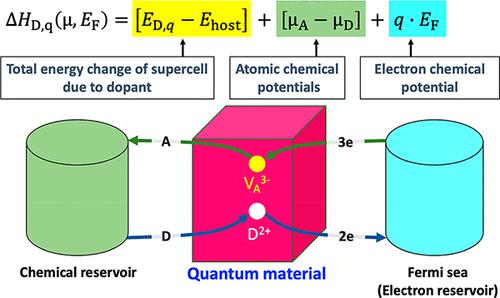
{"title":"Understanding Doping of Quantum Materials","authors":"Alex Zunger*, Oleksandr I. Malyi","doi":"10.1021/acs.chemrev.0c00608","DOIUrl":null,"url":null,"abstract":"<p >Doping mobile carriers into ordinary semiconductors such as Si, GaAs, and ZnO was the enabling step in the electronic and optoelectronic revolutions. The recent emergence of a class of “quantum materials”, where uniquely quantum interactions between the components produce specific behaviors such as topological insulation, unusual magnetism, superconductivity, spin–orbit-induced and magnetically induced spin splitting, polaron formation, and transparency of electrical conductors, pointed attention to a range of doping-related phenomena associated with chemical classes that differ from the traditional semiconductors. These include wide-gap oxides, compounds containing open-shell d electrons, and compounds made of heavy elements yet having significant band gaps. The atomistic electronic structure theory of doping that has been developed over the past two decades in the subfield of semiconductor physics has recently been extended and applied to quantum materials. The present review focuses on explaining the main concepts needed for a basic understanding of the doping phenomenology and indeed peculiarities in quantum materials from the perspective of condensed matter theory, with the hope of forging bridges to the chemists that have enabled the synthesis of some of the most interesting compounds in this field.</p>","PeriodicalId":32,"journal":{"name":"Chemical Reviews","volume":"121 5","pages":"3031–3060"},"PeriodicalIF":55.8000,"publicationDate":"2021-01-22","publicationTypes":"Journal Article","fieldsOfStudy":null,"isOpenAccess":false,"openAccessPdf":"https://sci-hub-pdf.com/10.1021/acs.chemrev.0c00608","citationCount":"75","resultStr":null,"platform":"Semanticscholar","paperid":null,"PeriodicalName":"Chemical Reviews","FirstCategoryId":"92","ListUrlMain":"https://pubs.acs.org/doi/10.1021/acs.chemrev.0c00608","RegionNum":1,"RegionCategory":"化学","ArticlePicture":[],"TitleCN":null,"AbstractTextCN":null,"PMCID":null,"EPubDate":"","PubModel":"","JCR":"Q1","JCRName":"CHEMISTRY, MULTIDISCIPLINARY","Score":null,"Total":0}
引用次数: 75
Abstract
Doping mobile carriers into ordinary semiconductors such as Si, GaAs, and ZnO was the enabling step in the electronic and optoelectronic revolutions. The recent emergence of a class of “quantum materials”, where uniquely quantum interactions between the components produce specific behaviors such as topological insulation, unusual magnetism, superconductivity, spin–orbit-induced and magnetically induced spin splitting, polaron formation, and transparency of electrical conductors, pointed attention to a range of doping-related phenomena associated with chemical classes that differ from the traditional semiconductors. These include wide-gap oxides, compounds containing open-shell d electrons, and compounds made of heavy elements yet having significant band gaps. The atomistic electronic structure theory of doping that has been developed over the past two decades in the subfield of semiconductor physics has recently been extended and applied to quantum materials. The present review focuses on explaining the main concepts needed for a basic understanding of the doping phenomenology and indeed peculiarities in quantum materials from the perspective of condensed matter theory, with the hope of forging bridges to the chemists that have enabled the synthesis of some of the most interesting compounds in this field.
期刊介绍:
Chemical Reviews is a highly regarded and highest-ranked journal covering the general topic of chemistry. Its mission is to provide comprehensive, authoritative, critical, and readable reviews of important recent research in organic, inorganic, physical, analytical, theoretical, and biological chemistry.
Since 1985, Chemical Reviews has also published periodic thematic issues that focus on a single theme or direction of emerging research.



 京公网安备 11010802042870号
京ICP备2023020795号-1
京公网安备 11010802042870号
京ICP备2023020795号-1

 分享
分享
 求助内容:
求助内容: 应助结果提醒方式:
 扫码关注我们
