Combination of Two Monoclonal Anti–Citrullinated Protein Antibodies Induced Tenosynovitis, Pain, and Bone Loss in Mice in a Peptidyl Arginine Deiminase-4–Dependent Manner
Akilan Krishnamurthy, Alexandra Circiumaru, Jitong Sun, Yogan Kisten, Peter Damberg, Koji Sakuraba, Katalin Sandor, Patrik Jarvoll, Tunhe Zhou, Vivianne Malmström, Camilla I. Svensson, Aase Hensvold, Anca I. Catrina, Lars Klareskog, Bence Réthi
{"title":"Combination of Two Monoclonal Anti–Citrullinated Protein Antibodies Induced Tenosynovitis, Pain, and Bone Loss in Mice in a Peptidyl Arginine Deiminase-4–Dependent Manner","authors":"Akilan Krishnamurthy, Alexandra Circiumaru, Jitong Sun, Yogan Kisten, Peter Damberg, Koji Sakuraba, Katalin Sandor, Patrik Jarvoll, Tunhe Zhou, Vivianne Malmström, Camilla I. Svensson, Aase Hensvold, Anca I. Catrina, Lars Klareskog, Bence Réthi","doi":"10.1002/art.42320","DOIUrl":null,"url":null,"abstract":"<div>\n \n <section>\n \n <h3> Objective</h3>\n \n <p>The appearance of anti–citrullinated protein antibodies (ACPAs) in the circulation represents a major risk factor for developing rheumatoid arthritis (RA). Patient-derived ACPAs have been shown to induce pain and bone erosion in mice, suggesting an active role in the pathogenicity of RA. We undertook this study to investigate whether ACPAs can induce tenosynovitis, an early sign of RA, in addition to pain and bone loss and whether these symptoms are dependent on peptidyl arginine deiminase 4 (PAD4).</p>\n </section>\n \n <section>\n \n <h3> Methods</h3>\n \n <p>Monoclonal ACPAs generated from plasma cells of RA patients were transferred to wild-type and PAD4-deficient mice. Pain-like behavior and macroscopic inflammation were monitored for a period of 4 weeks, followed by the analyses of tenosynovitis in the ankle joints using magnetic resonance imaging (MRI) and bone microarchitecture in the tibia using an X-ray microscope. Microscopic changes in the tendon sheath were analyzed in decalcified ankle joint sections.</p>\n </section>\n \n <section>\n \n <h3> Results</h3>\n \n <p>The combination of 2 monoclonal ACPAs (1325:04C03 and 1325:01B09) induced long-lasting pain-like behavior and trabecular bone loss in mice. Although no synovitis was observed macroscopically, we detected tenosynovitis in the ACPA-injected mice by MRI. Microscopic analyses of the joints revealed a cellular hyperplasia and a consequent enlargement of the tendon sheath in the ACPA-treated group. In PAD4<sup>−/−</sup> mice, the effects of ACPAs on pain-like behavior, tenosynovitis, and bone loss were significantly reduced.</p>\n </section>\n \n <section>\n \n <h3> Conclusion</h3>\n \n <p>Monoclonal ACPAs can induce tenosynovitis in addition to pain and bone loss via mechanisms dependent on PAD4-mediated citrullination.</p>\n \n <div>\n <figure>\n <div><picture>\n <source></source></picture><p></p>\n </div>\n </figure>\n </div>\n </section>\n </div>","PeriodicalId":129,"journal":{"name":"Arthritis & Rheumatology","volume":"75 2","pages":"164-170"},"PeriodicalIF":10.9000,"publicationDate":"2022-08-05","publicationTypes":"Journal Article","fieldsOfStudy":null,"isOpenAccess":false,"openAccessPdf":"https://acrjournals.onlinelibrary.wiley.com/doi/epdf/10.1002/art.42320","citationCount":"10","resultStr":null,"platform":"Semanticscholar","paperid":null,"PeriodicalName":"Arthritis & Rheumatology","FirstCategoryId":"3","ListUrlMain":"https://onlinelibrary.wiley.com/doi/10.1002/art.42320","RegionNum":1,"RegionCategory":"医学","ArticlePicture":[],"TitleCN":null,"AbstractTextCN":null,"PMCID":null,"EPubDate":"","PubModel":"","JCR":"Q1","JCRName":"RHEUMATOLOGY","Score":null,"Total":0}
引用次数: 10
Abstract
Objective
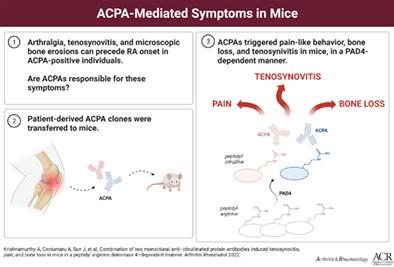
The appearance of anti–citrullinated protein antibodies (ACPAs) in the circulation represents a major risk factor for developing rheumatoid arthritis (RA). Patient-derived ACPAs have been shown to induce pain and bone erosion in mice, suggesting an active role in the pathogenicity of RA. We undertook this study to investigate whether ACPAs can induce tenosynovitis, an early sign of RA, in addition to pain and bone loss and whether these symptoms are dependent on peptidyl arginine deiminase 4 (PAD4).
Methods
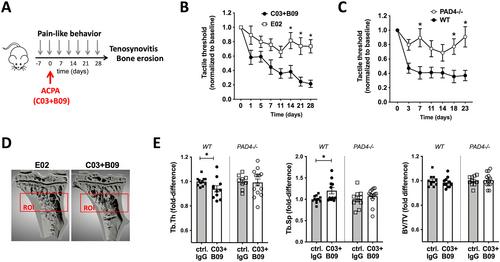
Monoclonal ACPAs generated from plasma cells of RA patients were transferred to wild-type and PAD4-deficient mice. Pain-like behavior and macroscopic inflammation were monitored for a period of 4 weeks, followed by the analyses of tenosynovitis in the ankle joints using magnetic resonance imaging (MRI) and bone microarchitecture in the tibia using an X-ray microscope. Microscopic changes in the tendon sheath were analyzed in decalcified ankle joint sections.
Results
The combination of 2 monoclonal ACPAs (1325:04C03 and 1325:01B09) induced long-lasting pain-like behavior and trabecular bone loss in mice. Although no synovitis was observed macroscopically, we detected tenosynovitis in the ACPA-injected mice by MRI. Microscopic analyses of the joints revealed a cellular hyperplasia and a consequent enlargement of the tendon sheath in the ACPA-treated group. In PAD4−/− mice, the effects of ACPAs on pain-like behavior, tenosynovitis, and bone loss were significantly reduced.
Conclusion
Monoclonal ACPAs can induce tenosynovitis in addition to pain and bone loss via mechanisms dependent on PAD4-mediated citrullination.
期刊介绍:
Arthritis & Rheumatology is the official journal of the American College of Rheumatology and focuses on the natural history, pathophysiology, treatment, and outcome of rheumatic diseases. It is a peer-reviewed publication that aims to provide the highest quality basic and clinical research in this field. The journal covers a wide range of investigative areas and also includes review articles, editorials, and educational material for researchers and clinicians. Being recognized as a leading research journal in rheumatology, Arthritis & Rheumatology serves the global community of rheumatology investigators and clinicians.



 京公网安备 11010802042870号
京ICP备2023020795号-1
京公网安备 11010802042870号
京ICP备2023020795号-1

 分享
分享
 求助内容:
求助内容: 应助结果提醒方式:
 扫码关注我们
