Differentiation of roughness and surface defect impact on dielectric strength of polymeric thin films

IF 3.8 Q2 ENGINEERING, ELECTRICAL & ELECTRONIC IET Nanodielectrics Pub Date : 2020-02-10 DOI:10.1049/iet-nde.2019.0031
Daniel Qi Tan
{"title":"Differentiation of roughness and surface defect impact on dielectric strength of polymeric thin films","authors":"Daniel Qi Tan","doi":"10.1049/iet-nde.2019.0031","DOIUrl":null,"url":null,"abstract":"<div>\n <p>Increasing the dielectric strength of polymer films has been a key theme as it is directly responsible for increasing energy density of relevant components such as film capacitors and insulation tapes. Dielectric films with higher roughness and surface defects are subject to the formation of an air gap at the interface between dielectric film and metallised polymer electrodes, which results in inaccurate dielectric strength. The air gap due to roughness was found to result in dielectric strength of 25% higher than that using depositing metal on dielectric films (integral electrode). The integral electrode method is proven to be a better way to test the genuine dielectric strength of thin and rough dielectric films. Surface defects, on the other hand, were revealed to cause lowering of dielectric strength because of their contribution to the localised electric field and charge injection. The detrimental effect of surface defects can be suppressed by submerging the film in oil or coating the film with an oxide layer.</p>\n </div>","PeriodicalId":36855,"journal":{"name":"IET Nanodielectrics","volume":"3 1","pages":"28-31"},"PeriodicalIF":3.8000,"publicationDate":"2020-02-10","publicationTypes":"Journal Article","fieldsOfStudy":null,"isOpenAccess":false,"openAccessPdf":"https://sci-hub-pdf.com/10.1049/iet-nde.2019.0031","citationCount":"19","resultStr":null,"platform":"Semanticscholar","paperid":null,"PeriodicalName":"IET Nanodielectrics","FirstCategoryId":"1085","ListUrlMain":"https://onlinelibrary.wiley.com/doi/10.1049/iet-nde.2019.0031","RegionNum":0,"RegionCategory":null,"ArticlePicture":[],"TitleCN":null,"AbstractTextCN":null,"PMCID":null,"EPubDate":"","PubModel":"","JCR":"Q2","JCRName":"ENGINEERING, ELECTRICAL & ELECTRONIC","Score":null,"Total":0}
引用次数: 19

Abstract

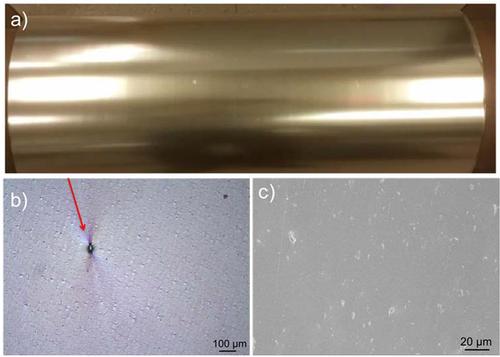
Increasing the dielectric strength of polymer films has been a key theme as it is directly responsible for increasing energy density of relevant components such as film capacitors and insulation tapes. Dielectric films with higher roughness and surface defects are subject to the formation of an air gap at the interface between dielectric film and metallised polymer electrodes, which results in inaccurate dielectric strength. The air gap due to roughness was found to result in dielectric strength of 25% higher than that using depositing metal on dielectric films (integral electrode). The integral electrode method is proven to be a better way to test the genuine dielectric strength of thin and rough dielectric films. Surface defects, on the other hand, were revealed to cause lowering of dielectric strength because of their contribution to the localised electric field and charge injection. The detrimental effect of surface defects can be suppressed by submerging the film in oil or coating the film with an oxide layer.

Abstract Image

查看原文
分享 分享
微信好友 朋友圈 QQ好友 复制链接
本刊更多论文
粗糙度和表面缺陷的差异对聚合物薄膜介电强度的影响
提高聚合物薄膜的介电强度一直是一个关键的主题,因为它直接关系到薄膜电容器和绝缘胶带等相关部件的能量密度的提高。具有较高粗糙度和表面缺陷的介电膜会在介电膜和金属化聚合物电极之间的界面处形成气隙,从而导致不准确的介电强度。发现由于粗糙度造成的气隙导致介电强度比使用沉积金属在介电薄膜(整体电极)上高25%。结果表明,积分电极法是一种较好的测试薄、粗介质薄膜真实介电强度的方法。另一方面,表面缺陷由于对局域电场和电荷注入的贡献而导致介电强度的降低。表面缺陷的有害影响可以通过将薄膜浸入油中或在薄膜上涂上氧化层来抑制。
本文章由计算机程序翻译,如有差异,请以英文原文为准。
求助全文
约1分钟内获得全文 去求助
来源期刊
IET Nanodielectrics
IET Nanodielectrics Materials Science-Materials Chemistry
CiteScore
5.60
自引率
3.70%
发文量
7
审稿时长
21 weeks
期刊最新文献
Improvement of Dielectric and Energy Storage Performances in Surface Modified High-Crystallinity BOPP Capacitor Films Molecular Dynamics Simulation of Carbon Nano-Doped Modified Epoxy Resin Under High Humidity Conditions Enhancement of Breakdown Strength and Stability of Transformer Oil by Flaxseed, Blackseed, and Castor Oils Blending Based Novel Nanofluid via Green Synthesis Revolution Revisiting the Dielectric Spectrum: Tricks and Treats of Analysis and Interpretation Around the Conductivity Relaxation Composite Dielectrics BaTiO3–Fe Consolidated via Field-Assisted Sintering Technology
×
引用
GB/T 7714-2015
复制
MLA
复制
APA
复制
导出至
BibTeX EndNote RefMan NoteFirst NoteExpress
×
×
提示
您的信息不完整,为了账户安全,请先补充。
现在去补充
×
提示
您因"违规操作"
具体请查看互助需知
我知道了
×
提示
现在去查看 取消
×
提示
确定
0
微信
客服QQ
Book学术公众号 扫码关注我们
反馈
×
意见反馈
请填写您的意见或建议
请填写您的手机或邮箱
已复制链接
已复制链接
快去分享给好友吧!
我知道了
×
扫码分享
扫码分享
Book学术官方微信
Book学术文献互助
Book学术文献互助群
群 号:604180095
Book学术
文献互助 智能选刊 最新文献 互助须知 联系我们:info@booksci.cn
Book学术提供免费学术资源搜索服务,方便国内外学者检索中英文文献。致力于提供最便捷和优质的服务体验。
Copyright © 2023 Book学术 All rights reserved.
ghs 京公网安备 11010802042870号 京ICP备2023020795号-1





