Beom Jin Kim, Sol Han, Kyung-Bok Lee, Insung S. Choi
{"title":"Biphasic Supramolecular Self-Assembly of Ferric Ions and Tannic Acid across Interfaces for Nanofilm Formation","authors":"Beom Jin Kim, Sol Han, Kyung-Bok Lee, Insung S. Choi","doi":"10.1002/adma.201700784","DOIUrl":null,"url":null,"abstract":"<p>Cell nanoencapsulation provides a chemical tool for the isolation and protection of living cells from harmful, and often lethal, external environments. Although several strategies are available to form nanometric films, most methods heavily rely on time-consuming multistep processes and are not biocompatible. Here, the interfacial supramolecular self-assembly and film formation of ferric ions (Fe<sup>III</sup>) and tannic acid (TA) in biphasic systems is reported, where Fe<sup>III</sup> and TA come into contact each other and self-assemble across the interface of two immiscible phases. The interfacial nanofilm formation developed is simple, fast, and cytocompatible. Its versatility is demonstrated with various biphasic systems: hollow microcapsules, encasing microbial or mammalian cells, that are generated at the water–oil interface in a microfluidic device; a cytoprotective Fe<sup>III</sup>–TA shell that forms on the surface of the alginate microbead, which then entraps probiotic <i>Lactobacillus acidophilus</i>; and a pericellular Fe<sup>III</sup>–TA shell that forms on individual <i>Saccharomyces cerevisiae</i>. This biphasic interfacial reaction system provides a simple but versatile structural motif in materials science, as well as advancing chemical manipulability of living cells.</p>","PeriodicalId":114,"journal":{"name":"Advanced Materials","volume":"29 28","pages":""},"PeriodicalIF":26.8000,"publicationDate":"2017-05-19","publicationTypes":"Journal Article","fieldsOfStudy":null,"isOpenAccess":false,"openAccessPdf":"https://sci-hub-pdf.com/10.1002/adma.201700784","citationCount":"91","resultStr":null,"platform":"Semanticscholar","paperid":null,"PeriodicalName":"Advanced Materials","FirstCategoryId":"88","ListUrlMain":"https://onlinelibrary.wiley.com/doi/10.1002/adma.201700784","RegionNum":1,"RegionCategory":"材料科学","ArticlePicture":[],"TitleCN":null,"AbstractTextCN":null,"PMCID":null,"EPubDate":"","PubModel":"","JCR":"Q1","JCRName":"CHEMISTRY, MULTIDISCIPLINARY","Score":null,"Total":0}
引用次数: 91
Abstract
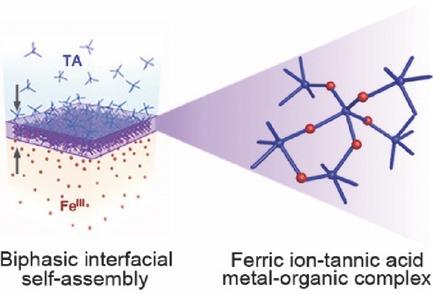
Cell nanoencapsulation provides a chemical tool for the isolation and protection of living cells from harmful, and often lethal, external environments. Although several strategies are available to form nanometric films, most methods heavily rely on time-consuming multistep processes and are not biocompatible. Here, the interfacial supramolecular self-assembly and film formation of ferric ions (FeIII) and tannic acid (TA) in biphasic systems is reported, where FeIII and TA come into contact each other and self-assemble across the interface of two immiscible phases. The interfacial nanofilm formation developed is simple, fast, and cytocompatible. Its versatility is demonstrated with various biphasic systems: hollow microcapsules, encasing microbial or mammalian cells, that are generated at the water–oil interface in a microfluidic device; a cytoprotective FeIII–TA shell that forms on the surface of the alginate microbead, which then entraps probiotic Lactobacillus acidophilus; and a pericellular FeIII–TA shell that forms on individual Saccharomyces cerevisiae. This biphasic interfacial reaction system provides a simple but versatile structural motif in materials science, as well as advancing chemical manipulability of living cells.
期刊介绍:
Advanced Materials, one of the world's most prestigious journals and the foundation of the Advanced portfolio, is the home of choice for best-in-class materials science for more than 30 years. Following this fast-growing and interdisciplinary field, we are considering and publishing the most important discoveries on any and all materials from materials scientists, chemists, physicists, engineers as well as health and life scientists and bringing you the latest results and trends in modern materials-related research every week.



 京公网安备 11010802042870号
京ICP备2023020795号-1
京公网安备 11010802042870号
京ICP备2023020795号-1

 分享
分享
 求助内容:
求助内容: 应助结果提醒方式:
 扫码关注我们
