Kai Zhang, Zhiming Chen, Ardalan Armin, Sheng Dong, Ruoxi Xia, Hin-Lap Yip, Safa Shoaee, Fei Huang, Yong Cao
{"title":"Efficient Large Area Organic Solar Cells Processed by Blade-Coating With Single-Component Green Solvent","authors":"Kai Zhang, Zhiming Chen, Ardalan Armin, Sheng Dong, Ruoxi Xia, Hin-Lap Yip, Safa Shoaee, Fei Huang, Yong Cao","doi":"10.1002/solr.201700169","DOIUrl":null,"url":null,"abstract":"<div>\n \n <section>\n \n <p>While the performance of laboratory-scale organic solar cells (OSCs) continues to grow, development of high efficiency large area OSCs remains a big challenge. Although a few attempts to produce large area organic solar cells (OSCs) have been reported, there are still challenges on the way to realizing efficient module devices, such as the low compatibility of the thickness-sensitive active layer with large area coating techniques, the frequent need for toxic solvents and tedious optimization processes used during device fabrication. In this work, highly efficient thickness-insensitive OSCs based on PTB7-Th:PC<sub>71</sub>BM that processed with single-component green solvent 2-methylanisole are presented, in which both junction thickness limitation and solvent toxicity issues are simultaneously addressed. Careful investigation reveals that this green solvent prevents the evolution of PC<sub>71</sub>BM into large area clusters resulting in reduced charge carrier recombination, and largely eliminates trapping centers, and thus improves the thickness tolerance of the films. These findings enable us to address the scalability and solvent toxicity issues and to fabricate a 16 cm<sup>2</sup> OSC with doctor-blade coating with a state-of-the-art power conversion efficiency of 7.5% using green solvent.</p>\n </section>\n </div>","PeriodicalId":230,"journal":{"name":"Solar RRL","volume":"2 1","pages":""},"PeriodicalIF":6.0000,"publicationDate":"2017-12-06","publicationTypes":"Journal Article","fieldsOfStudy":null,"isOpenAccess":false,"openAccessPdf":"https://sci-hub-pdf.com/10.1002/solr.201700169","citationCount":"78","resultStr":null,"platform":"Semanticscholar","paperid":null,"PeriodicalName":"Solar RRL","FirstCategoryId":"5","ListUrlMain":"https://onlinelibrary.wiley.com/doi/10.1002/solr.201700169","RegionNum":3,"RegionCategory":"工程技术","ArticlePicture":[],"TitleCN":null,"AbstractTextCN":null,"PMCID":null,"EPubDate":"","PubModel":"","JCR":"Q2","JCRName":"ENERGY & FUELS","Score":null,"Total":0}
引用次数: 78
Abstract
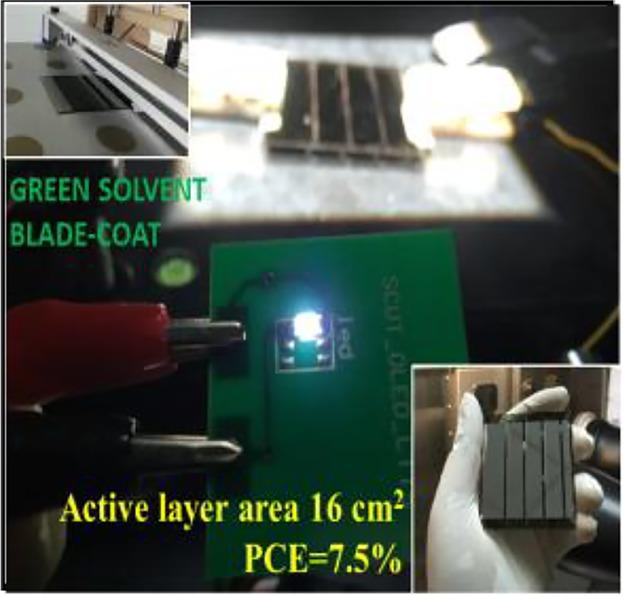
While the performance of laboratory-scale organic solar cells (OSCs) continues to grow, development of high efficiency large area OSCs remains a big challenge. Although a few attempts to produce large area organic solar cells (OSCs) have been reported, there are still challenges on the way to realizing efficient module devices, such as the low compatibility of the thickness-sensitive active layer with large area coating techniques, the frequent need for toxic solvents and tedious optimization processes used during device fabrication. In this work, highly efficient thickness-insensitive OSCs based on PTB7-Th:PC71BM that processed with single-component green solvent 2-methylanisole are presented, in which both junction thickness limitation and solvent toxicity issues are simultaneously addressed. Careful investigation reveals that this green solvent prevents the evolution of PC71BM into large area clusters resulting in reduced charge carrier recombination, and largely eliminates trapping centers, and thus improves the thickness tolerance of the films. These findings enable us to address the scalability and solvent toxicity issues and to fabricate a 16 cm2 OSC with doctor-blade coating with a state-of-the-art power conversion efficiency of 7.5% using green solvent.
Solar RRLPhysics and Astronomy-Atomic and Molecular Physics, and Optics
CiteScore
12.10
自引率
6.30%
发文量
460
期刊介绍:
Solar RRL, formerly known as Rapid Research Letters, has evolved to embrace a broader and more encompassing format. We publish Research Articles and Reviews covering all facets of solar energy conversion. This includes, but is not limited to, photovoltaics and solar cells (both established and emerging systems), as well as the development, characterization, and optimization of materials and devices. Additionally, we cover topics such as photovoltaic modules and systems, their installation and deployment, photocatalysis, solar fuels, photothermal and photoelectrochemical solar energy conversion, energy distribution, grid issues, and other relevant aspects. Join us in exploring the latest advancements in solar energy conversion research.



 京公网安备 11010802042870号
京ICP备2023020795号-1
京公网安备 11010802042870号
京ICP备2023020795号-1

 分享
分享
 求助内容:
求助内容: 应助结果提醒方式:
 扫码关注我们
