Single-catalyst reactions from depolymerization to repolymerization: Transformation of polyethylene terephthalate to polyisocyanurate foam with deep eutectic solvents
{"title":"Single-catalyst reactions from depolymerization to repolymerization: Transformation of polyethylene terephthalate to polyisocyanurate foam with deep eutectic solvents","authors":"Pyung Soo Lee, Simon MoonGeun Jung","doi":"10.1002/app.53205","DOIUrl":null,"url":null,"abstract":"<p>Polyisocyanurate (PIR) has been used as a flame retardant insulation material because of its improved thermal insulation and flame-retarding effects due to its cyclic structure with an isocyanate trimer group. When a deep eutectic solvent (DES) is used as a catalyst, PET glycolysis produces bis(2- hydroxyethyl terephthalate) (BHET) and its derivatives. These recycled polyols react with isocyanate to form PIR foam (PIRF) in the presence of a physical blowing agent. DES-based glycolysis is a low-energy process with a relatively low temperature and short reaction time. In this study, a potassium-based DES system was applied for the sequential depolymerization and repolymerization of waste PET into PIRFs. Potassium-based DESs were used as hydrogen bond acceptors (HBAs), and ethylene glycol (EG), glycerol, and urea were used as hydrogen bond donors (HBDs). The PIRF was obtained through one-pot depolymerization and repolymerization with a single-catalyst DES system. All DES catalyst systems effectively decomposed PET; the PET conversion efficiency reached 95% after 2 h reaction. The recycled PIR was more thermally stable (approximately 26.9% limiting oxygen index (LOI) and approximately 68.8 W/g heat release rate (HRR)). This paper presents an environmentally friendly and robust upcycling process for the transformation of waste PET into PIRF.</p>","PeriodicalId":183,"journal":{"name":"Journal of Applied Polymer Science","volume":"139 47","pages":""},"PeriodicalIF":2.8000,"publicationDate":"2022-10-07","publicationTypes":"Journal Article","fieldsOfStudy":null,"isOpenAccess":false,"openAccessPdf":"https://onlinelibrary.wiley.com/doi/epdf/10.1002/app.53205","citationCount":"3","resultStr":null,"platform":"Semanticscholar","paperid":null,"PeriodicalName":"Journal of Applied Polymer Science","FirstCategoryId":"92","ListUrlMain":"https://onlinelibrary.wiley.com/doi/10.1002/app.53205","RegionNum":3,"RegionCategory":"化学","ArticlePicture":[],"TitleCN":null,"AbstractTextCN":null,"PMCID":null,"EPubDate":"","PubModel":"","JCR":"Q2","JCRName":"POLYMER SCIENCE","Score":null,"Total":0}
引用次数: 3
Abstract
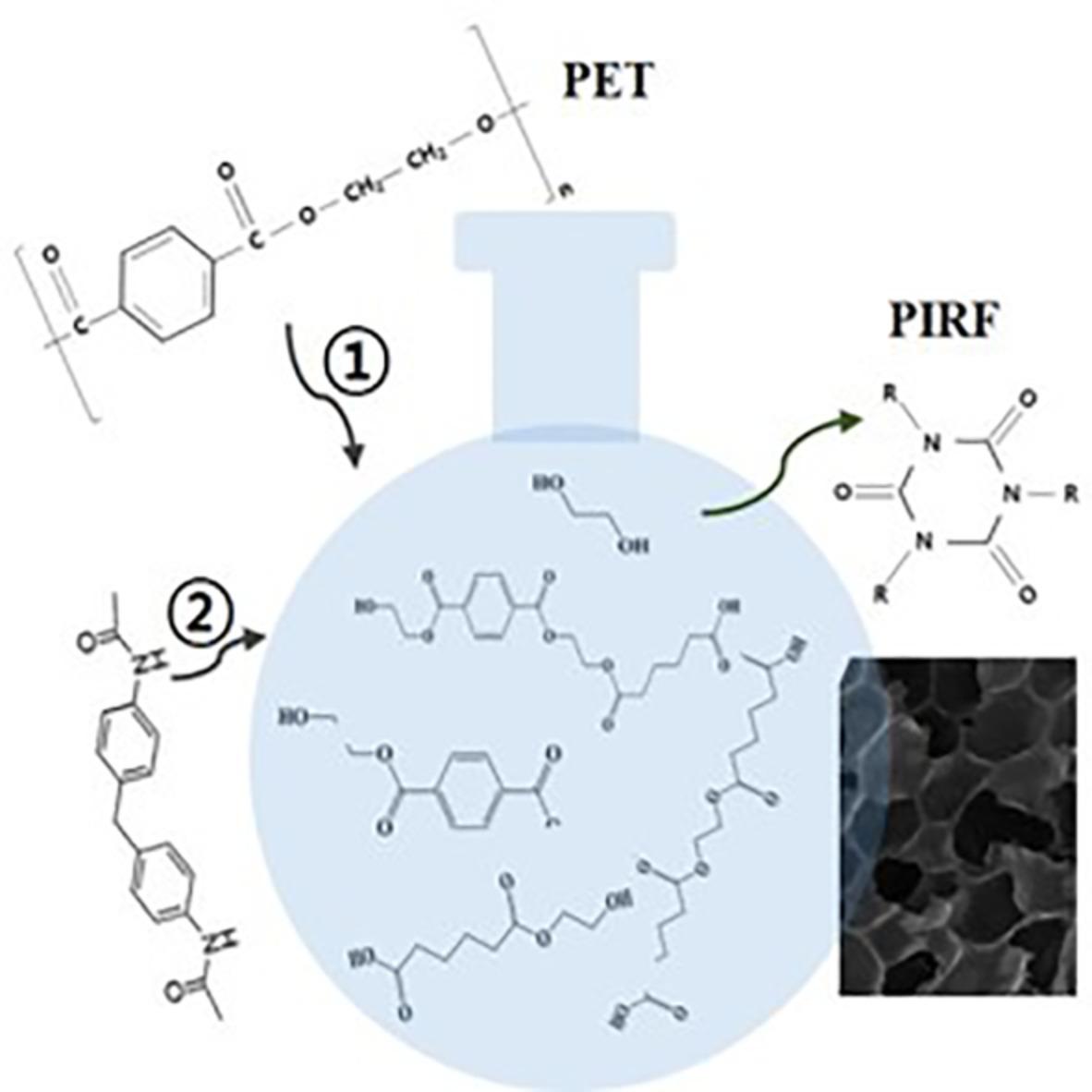
Polyisocyanurate (PIR) has been used as a flame retardant insulation material because of its improved thermal insulation and flame-retarding effects due to its cyclic structure with an isocyanate trimer group. When a deep eutectic solvent (DES) is used as a catalyst, PET glycolysis produces bis(2- hydroxyethyl terephthalate) (BHET) and its derivatives. These recycled polyols react with isocyanate to form PIR foam (PIRF) in the presence of a physical blowing agent. DES-based glycolysis is a low-energy process with a relatively low temperature and short reaction time. In this study, a potassium-based DES system was applied for the sequential depolymerization and repolymerization of waste PET into PIRFs. Potassium-based DESs were used as hydrogen bond acceptors (HBAs), and ethylene glycol (EG), glycerol, and urea were used as hydrogen bond donors (HBDs). The PIRF was obtained through one-pot depolymerization and repolymerization with a single-catalyst DES system. All DES catalyst systems effectively decomposed PET; the PET conversion efficiency reached 95% after 2 h reaction. The recycled PIR was more thermally stable (approximately 26.9% limiting oxygen index (LOI) and approximately 68.8 W/g heat release rate (HRR)). This paper presents an environmentally friendly and robust upcycling process for the transformation of waste PET into PIRF.
期刊介绍:
The Journal of Applied Polymer Science is the largest peer-reviewed publication in polymers, #3 by total citations, and features results with real-world impact on membranes, polysaccharides, and much more.



 京公网安备 11010802042870号
京ICP备2023020795号-1
京公网安备 11010802042870号
京ICP备2023020795号-1

 分享
分享
 求助内容:
求助内容: 应助结果提醒方式:
 扫码关注我们
