{"title":"Looking back, and forward to 2015","authors":"","doi":"10.1111/cod.12339","DOIUrl":null,"url":null,"abstract":"The turn of the year is a notoriously appropriate time for reviewing what has happened in the past year and for elaborating good intentions for the next year. After for some years a very attractive impact factor (IF) for such a specialised journal of around 3.5 had been achieved, a drop of the 2012 IF to 2.95 was a concern and it was predicted that it would drop further for 2013, which was to be published in 2014. Prompted by proactive disbelief of the Editor emeritus, the publisher checked the data underlying the IF (basically the number of times eligible papers for the journal had been cited in the two preceding years divided by the number of eligible papers appearing in the index year) and found that Thomson Reuters had miscalculated the IF. This had affected also a number of earlier years and some other journals. Subsequently, the error was fixed, and the true IF for 2012 is actually 3.84 and the IF for 2013 is 3.62 – again on a very satisfying level. It will be the summer before the 2014 IF is available. What does this demonstrate? We seem to be more and more fixed on this bibliometric measure, and should not forget the virtues (of a journal) unrelated to the IF. Looking forward, a number of management changes have been implemented in the journal with this issue, to adapt it to the needs of the future: • The section editors and the editorial board have been carefully renewed, with the aim of involving younger, active researchers; • The instructions for authors have been slightly updated and made more precise (in practice, it is not that these instructions have been unclear or insufficient, but the failure of authors to read them rendered handling of some manuscripts unnecessarily difficult).","PeriodicalId":10527,"journal":{"name":"Contact Dermatitis","volume":"72 1","pages":"1"},"PeriodicalIF":4.6000,"publicationDate":"2014-12-18","publicationTypes":"Journal Article","fieldsOfStudy":null,"isOpenAccess":false,"openAccessPdf":"https://sci-hub-pdf.com/10.1111/cod.12339","citationCount":"0","resultStr":null,"platform":"Semanticscholar","paperid":null,"PeriodicalName":"Contact Dermatitis","FirstCategoryId":"3","ListUrlMain":"https://onlinelibrary.wiley.com/doi/10.1111/cod.12339","RegionNum":1,"RegionCategory":"医学","ArticlePicture":[],"TitleCN":null,"AbstractTextCN":null,"PMCID":null,"EPubDate":"","PubModel":"","JCR":"Q2","JCRName":"ALLERGY","Score":null,"Total":0}
引用次数: 0
Abstract
The turn of the year is a notoriously appropriate time for reviewing what has happened in the past year and for elaborating good intentions for the next year. After for some years a very attractive impact factor (IF) for such a specialised journal of around 3.5 had been achieved, a drop of the 2012 IF to 2.95 was a concern and it was predicted that it would drop further for 2013, which was to be published in 2014. Prompted by proactive disbelief of the Editor emeritus, the publisher checked the data underlying the IF (basically the number of times eligible papers for the journal had been cited in the two preceding years divided by the number of eligible papers appearing in the index year) and found that Thomson Reuters had miscalculated the IF. This had affected also a number of earlier years and some other journals. Subsequently, the error was fixed, and the true IF for 2012 is actually 3.84 and the IF for 2013 is 3.62 – again on a very satisfying level. It will be the summer before the 2014 IF is available. What does this demonstrate? We seem to be more and more fixed on this bibliometric measure, and should not forget the virtues (of a journal) unrelated to the IF. Looking forward, a number of management changes have been implemented in the journal with this issue, to adapt it to the needs of the future: • The section editors and the editorial board have been carefully renewed, with the aim of involving younger, active researchers; • The instructions for authors have been slightly updated and made more precise (in practice, it is not that these instructions have been unclear or insufficient, but the failure of authors to read them rendered handling of some manuscripts unnecessarily difficult).
期刊介绍:
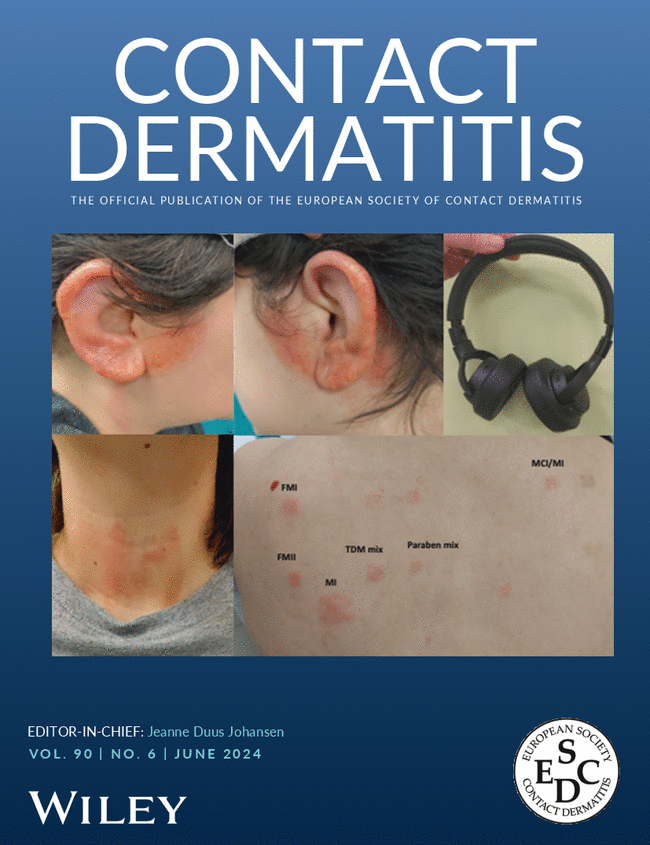
Contact Dermatitis is designed primarily as a journal for clinicians who are interested in various aspects of environmental dermatitis. This includes both allergic and irritant (toxic) types of contact dermatitis, occupational (industrial) dermatitis and consumers" dermatitis from such products as cosmetics and toiletries. The journal aims at promoting and maintaining communication among dermatologists, industrial physicians, allergists and clinical immunologists, as well as chemists and research workers involved in industry and the production of consumer goods. Papers are invited on clinical observations, diagnosis and methods of investigation of patients, therapeutic measures, organisation and legislation relating to the control of occupational and consumers".



 京公网安备 11010802042870号
京ICP备2023020795号-1
京公网安备 11010802042870号
京ICP备2023020795号-1

 分享
分享
 求助内容:
求助内容: 应助结果提醒方式:
 扫码关注我们
