下载PDF
{"title":"Influence of processing condition and carbon nanotube on mechanical properties of injection molded multi-walled carbon nanotube/poly(methyl methacrylate) nanocomposites","authors":"Amir Navidfar, Taher Azdast, Ayub Karimzad Ghavidel","doi":"10.1002/app.43738","DOIUrl":null,"url":null,"abstract":"<div>\n \n <p>In this work, multi-walled carbon nanotubes (MWCNT) and poly(methyl methacrylate) (PMMA) pellets were compounded via corotating twin-screw extruder. The produced MWCNT/PMMA nanocomposite pellets were injection molded. The effect of MWCNT concentration, injection melt temperature and holding pressure on mechanical properties of the nanocomposites were investigated. To examine the mechanical properties of the MWCNT/PMMA nanocomposites, tensile test, charpy impact test, and Rockwell hardness are considered as the outputs. Design of experiments (DoE) is done by full factorial method. The morphology of the nanocomposites was performed using scanning electron microscopy (SEM). The results revealed when MWCNT concentration are increased from 0 to 1.5 wt %, tensile strength and elongation at break were reduced about 30 and 40%, respectively, but a slight increase in hardness was observed. In addition, highest impact strength belongs to the nanocomposite with 1 wt % MWCNT. This study also shows that processing condition significantly influence on mechanical behavior of the injection molded nanocomposite. In maximum holding pressure (100 bar), the nanocomposites show highest tensile strength, elongation, impact strength and hardness. According to findings, melt temperature has a trifle effect on elongation, but it has a remarkable influence on tensile strength. In the case of impact strength, higher melt temperature is favorable. © 2016 Wiley Periodicals, Inc. J. Appl. Polym. Sci. <b>2016</b>, <i>133</i>, 43738.</p>\n </div>","PeriodicalId":183,"journal":{"name":"Journal of Applied Polymer Science","volume":"133 31","pages":""},"PeriodicalIF":2.8000,"publicationDate":"2016-05-04","publicationTypes":"Journal Article","fieldsOfStudy":null,"isOpenAccess":false,"openAccessPdf":"https://sci-hub-pdf.com/10.1002/app.43738","citationCount":"33","resultStr":null,"platform":"Semanticscholar","paperid":null,"PeriodicalName":"Journal of Applied Polymer Science","FirstCategoryId":"92","ListUrlMain":"https://onlinelibrary.wiley.com/doi/10.1002/app.43738","RegionNum":3,"RegionCategory":"化学","ArticlePicture":[],"TitleCN":null,"AbstractTextCN":null,"PMCID":null,"EPubDate":"","PubModel":"","JCR":"Q2","JCRName":"POLYMER SCIENCE","Score":null,"Total":0}
引用次数: 33
引用
批量引用
Abstract
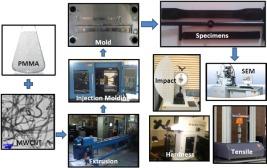
In this work, multi-walled carbon nanotubes (MWCNT) and poly(methyl methacrylate) (PMMA) pellets were compounded via corotating twin-screw extruder. The produced MWCNT/PMMA nanocomposite pellets were injection molded. The effect of MWCNT concentration, injection melt temperature and holding pressure on mechanical properties of the nanocomposites were investigated. To examine the mechanical properties of the MWCNT/PMMA nanocomposites, tensile test, charpy impact test, and Rockwell hardness are considered as the outputs. Design of experiments (DoE) is done by full factorial method. The morphology of the nanocomposites was performed using scanning electron microscopy (SEM). The results revealed when MWCNT concentration are increased from 0 to 1.5 wt %, tensile strength and elongation at break were reduced about 30 and 40%, respectively, but a slight increase in hardness was observed. In addition, highest impact strength belongs to the nanocomposite with 1 wt % MWCNT. This study also shows that processing condition significantly influence on mechanical behavior of the injection molded nanocomposite. In maximum holding pressure (100 bar), the nanocomposites show highest tensile strength, elongation, impact strength and hardness. According to findings, melt temperature has a trifle effect on elongation, but it has a remarkable influence on tensile strength. In the case of impact strength, higher melt temperature is favorable. © 2016 Wiley Periodicals, Inc. J. Appl. Polym. Sci. 2016 , 133 , 43738.
工艺条件和碳纳米管对注射成型多壁碳纳米管/聚甲基丙烯酸甲酯纳米复合材料力学性能的影响
本研究采用双螺杆挤出机对多壁碳纳米管(MWCNT)和聚甲基丙烯酸甲酯(PMMA)颗粒进行了复合。对制备的MWCNT/PMMA纳米复合微球进行注塑成型。研究了MWCNT浓度、注射熔体温度和保温压力对复合材料力学性能的影响。为了检验MWCNT/PMMA纳米复合材料的力学性能,将拉伸试验、夏比冲击试验和洛氏硬度作为输出。实验设计采用全因子法进行。利用扫描电子显微镜(SEM)观察了纳米复合材料的形貌。结果表明,当MWCNT浓度从0 wt %增加到1.5 wt %时,材料的抗拉强度和断裂伸长率分别降低了约30%和40%,但硬度略有增加。此外,MWCNT含量为1 wt %的纳米复合材料的冲击强度最高。研究还表明,工艺条件对注射成型纳米复合材料的力学性能有显著影响。在最大保压压力(100 bar)下,纳米复合材料具有最高的抗拉强度、伸长率、冲击强度和硬度。结果表明,熔体温度对伸长率影响不大,但对拉伸强度影响显著。在冲击强度的情况下,较高的熔体温度是有利的。©2016 Wiley期刊公司j:。变异较大。科学通报,2016,33,43738。
本文章由计算机程序翻译,如有差异,请以英文原文为准。



 京公网安备 11010802042870号
京ICP备2023020795号-1
京公网安备 11010802042870号
京ICP备2023020795号-1

 分享
分享
 求助内容:
求助内容: 应助结果提醒方式:
 扫码关注我们
