E. Raabe, J. Maciaczyk, U. Kahlert, G. Nikkhah, C. Eberhart
{"title":"Abstract 4352: Using human neural stem cells to model pediatric high grade gliomas: The role of p53, c-myc, and EGFRvIII in neoplastic transformation","authors":"E. Raabe, J. Maciaczyk, U. Kahlert, G. Nikkhah, C. Eberhart","doi":"10.1158/1538-7445.AM10-4352","DOIUrl":null,"url":null,"abstract":"Brain tumors are a heterogeneous group of cancers that can arise at multiple locations in the central nervous system. Some brain tumors are restricted to specific anatomical sites, such as medulloblastoma, which is found only in the cerebellum. In the context of this heterogeneity, there are common molecular pathways which are altered across different types of brain tumors. Some of these molecular lesions include inactivation of tumor suppressors such as p53, overexpression of pro-proliferative factors such as c-myc, and alteration of cytokine pathways involving PDGF and EGF. We have isolated neural stem and progenitor cells from multiple sites in the developing human brain, including spinal cord, brain stem, cerebellum, thalamus, and cerebral cortex. These cells can be grown as neurospheres in long term culture, and can differentiate into neurons, astrocytes and oligodendrocytes. To test the hypothesis that these human neurosphere cells can give rise to brain tumors, we infected them with lentivirus encoding hTERT as well as dominant-negative p53, c-myc, and EGFRvIII. The resultant clones derived from cortex, brain stem and spinal cord grow at an increased rate compared to control GFP-infected cells. Interestingly, thalamus-derived cells in the initial analysis do not proliferate rapidly in response to dominant negative p53 and c-myc overexpression, highlighting the potential differences in neural stem and progenitor cell response to oncogenic stimuli. Dominant negative p53 and c-myc overexpressing cells maintain an ability to differentiate in vitro, similar to that observed in human glioblastoma neurosphere lines. Experiments to test the in vitro clonogenic potential and in vivo engraftment of control and infected cells are pending. Our studies suggest that, in contrast to some previous reports, human neural precursor cells can be transformed. They also form the basis for future experiments aimed at creating genetically and pathologically relevant models for pediatric brain tumors. Citation Format: {Authors}. {Abstract title} [abstract]. In: Proceedings of the 101st Annual Meeting of the American Association for Cancer Research; 2010 Apr 17-21; Washington, DC. Philadelphia (PA): AACR; Cancer Res 2010;70(8 Suppl):Abstract nr 4352.","PeriodicalId":9441,"journal":{"name":"Cancer research","volume":"70 1","pages":"4352-4352"},"PeriodicalIF":16.6000,"publicationDate":"2010-04-15","publicationTypes":"Journal Article","fieldsOfStudy":null,"isOpenAccess":false,"openAccessPdf":"","citationCount":"0","resultStr":null,"platform":"Semanticscholar","paperid":null,"PeriodicalName":"Cancer research","FirstCategoryId":"3","ListUrlMain":"https://doi.org/10.1158/1538-7445.AM10-4352","RegionNum":1,"RegionCategory":"医学","ArticlePicture":[],"TitleCN":null,"AbstractTextCN":null,"PMCID":null,"EPubDate":"","PubModel":"","JCR":"Q1","JCRName":"ONCOLOGY","Score":null,"Total":0}
引用次数: 0
Abstract
Brain tumors are a heterogeneous group of cancers that can arise at multiple locations in the central nervous system. Some brain tumors are restricted to specific anatomical sites, such as medulloblastoma, which is found only in the cerebellum. In the context of this heterogeneity, there are common molecular pathways which are altered across different types of brain tumors. Some of these molecular lesions include inactivation of tumor suppressors such as p53, overexpression of pro-proliferative factors such as c-myc, and alteration of cytokine pathways involving PDGF and EGF. We have isolated neural stem and progenitor cells from multiple sites in the developing human brain, including spinal cord, brain stem, cerebellum, thalamus, and cerebral cortex. These cells can be grown as neurospheres in long term culture, and can differentiate into neurons, astrocytes and oligodendrocytes. To test the hypothesis that these human neurosphere cells can give rise to brain tumors, we infected them with lentivirus encoding hTERT as well as dominant-negative p53, c-myc, and EGFRvIII. The resultant clones derived from cortex, brain stem and spinal cord grow at an increased rate compared to control GFP-infected cells. Interestingly, thalamus-derived cells in the initial analysis do not proliferate rapidly in response to dominant negative p53 and c-myc overexpression, highlighting the potential differences in neural stem and progenitor cell response to oncogenic stimuli. Dominant negative p53 and c-myc overexpressing cells maintain an ability to differentiate in vitro, similar to that observed in human glioblastoma neurosphere lines. Experiments to test the in vitro clonogenic potential and in vivo engraftment of control and infected cells are pending. Our studies suggest that, in contrast to some previous reports, human neural precursor cells can be transformed. They also form the basis for future experiments aimed at creating genetically and pathologically relevant models for pediatric brain tumors. Citation Format: {Authors}. {Abstract title} [abstract]. In: Proceedings of the 101st Annual Meeting of the American Association for Cancer Research; 2010 Apr 17-21; Washington, DC. Philadelphia (PA): AACR; Cancer Res 2010;70(8 Suppl):Abstract nr 4352.
期刊介绍:
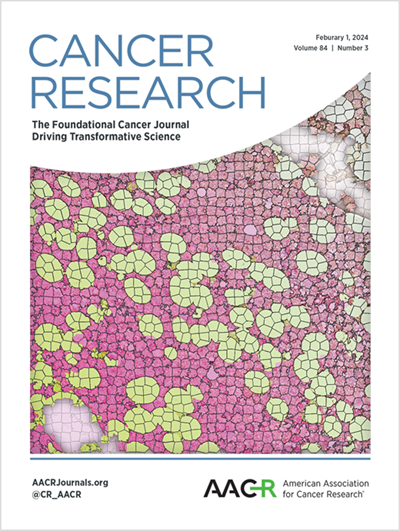
Cancer Research, published by the American Association for Cancer Research (AACR), is a journal that focuses on impactful original studies, reviews, and opinion pieces relevant to the broad cancer research community. Manuscripts that present conceptual or technological advances leading to insights into cancer biology are particularly sought after. The journal also places emphasis on convergence science, which involves bridging multiple distinct areas of cancer research.
With primary subsections including Cancer Biology, Cancer Immunology, Cancer Metabolism and Molecular Mechanisms, Translational Cancer Biology, Cancer Landscapes, and Convergence Science, Cancer Research has a comprehensive scope. It is published twice a month and has one volume per year, with a print ISSN of 0008-5472 and an online ISSN of 1538-7445.
Cancer Research is abstracted and/or indexed in various databases and platforms, including BIOSIS Previews (R) Database, MEDLINE, Current Contents/Life Sciences, Current Contents/Clinical Medicine, Science Citation Index, Scopus, and Web of Science.



 京公网安备 11010802042870号
京ICP备2023020795号-1
京公网安备 11010802042870号
京ICP备2023020795号-1

 分享
分享
 求助内容:
求助内容: 应助结果提醒方式:
 扫码关注我们
