Kristine J Chua, Aaron W Lukaszewski, DeMond M Grant, Oliver Sng
{"title":"Human Life History Strategies.","authors":"Kristine J Chua, Aaron W Lukaszewski, DeMond M Grant, Oliver Sng","doi":"10.1177/1474704916677342","DOIUrl":null,"url":null,"abstract":"<p><p>Human life history (LH) strategies are theoretically regulated by developmental exposure to environmental cues that ancestrally predicted LH-relevant world states (e.g., risk of morbidity-mortality). Recent modeling work has raised the question of whether the association of childhood family factors with adult LH variation arises via (i) direct sampling of external environmental cues during development and/or (ii) calibration of LH strategies to internal somatic condition (i.e., health), which itself reflects exposure to variably favorable environments. The present research tested between these possibilities through three online surveys involving a total of over 26,000 participants. Participants completed questionnaires assessing components of self-reported environmental harshness (i.e., socioeconomic status, family neglect, and neighborhood crime), health status, and various LH-related psychological and behavioral phenotypes (e.g., mating strategies, paranoia, and anxiety), modeled as a unidimensional latent variable. Structural equation models suggested that exposure to harsh ecologies had direct effects on latent LH strategy as well as indirect effects on latent LH strategy mediated via health status. These findings suggest that human LH strategies may be calibrated to both external and internal cues and that such calibrational effects manifest in a wide range of psychological and behavioral phenotypes.</p>","PeriodicalId":47499,"journal":{"name":"Evolutionary Psychology","volume":"15 1","pages":"1474704916677342"},"PeriodicalIF":0.9000,"publicationDate":"2017-01-01","publicationTypes":"Journal Article","fieldsOfStudy":null,"isOpenAccess":false,"openAccessPdf":"https://www.ncbi.nlm.nih.gov/pmc/articles/PMC10638872/pdf/","citationCount":"0","resultStr":null,"platform":"Semanticscholar","paperid":null,"PeriodicalName":"Evolutionary Psychology","FirstCategoryId":"102","ListUrlMain":"https://doi.org/10.1177/1474704916677342","RegionNum":4,"RegionCategory":"心理学","ArticlePicture":[],"TitleCN":null,"AbstractTextCN":null,"PMCID":null,"EPubDate":"","PubModel":"","JCR":"Q4","JCRName":"PSYCHOLOGY, EXPERIMENTAL","Score":null,"Total":0}
引用次数: 0
Abstract
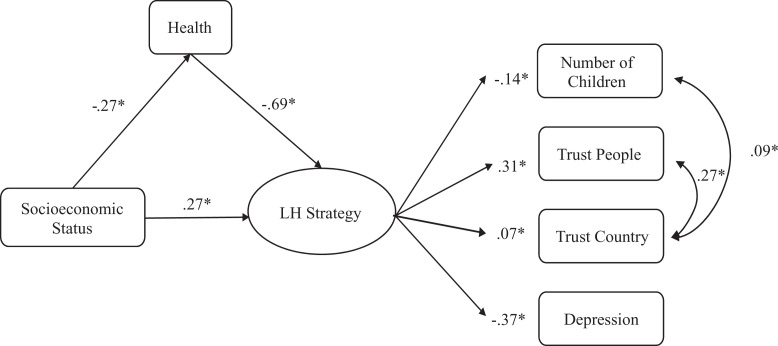
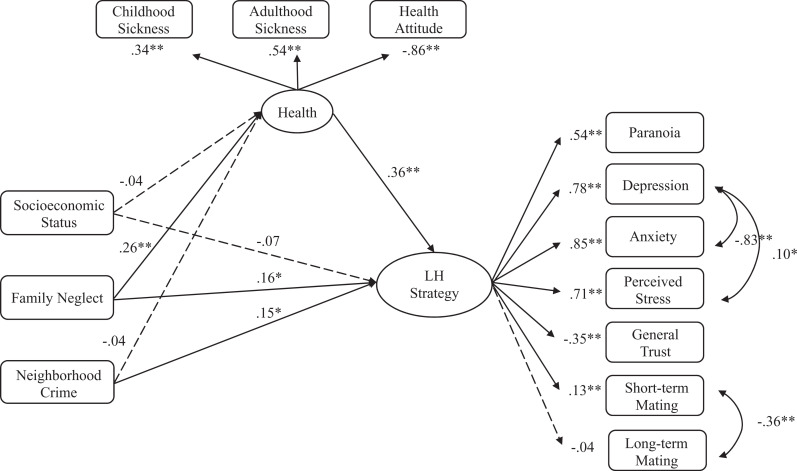
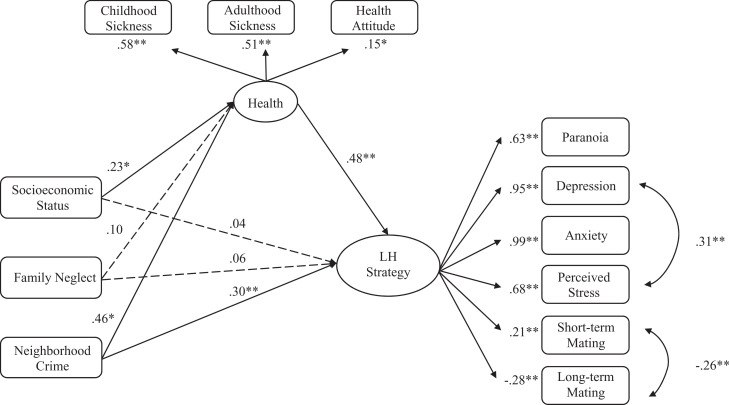
Human life history (LH) strategies are theoretically regulated by developmental exposure to environmental cues that ancestrally predicted LH-relevant world states (e.g., risk of morbidity-mortality). Recent modeling work has raised the question of whether the association of childhood family factors with adult LH variation arises via (i) direct sampling of external environmental cues during development and/or (ii) calibration of LH strategies to internal somatic condition (i.e., health), which itself reflects exposure to variably favorable environments. The present research tested between these possibilities through three online surveys involving a total of over 26,000 participants. Participants completed questionnaires assessing components of self-reported environmental harshness (i.e., socioeconomic status, family neglect, and neighborhood crime), health status, and various LH-related psychological and behavioral phenotypes (e.g., mating strategies, paranoia, and anxiety), modeled as a unidimensional latent variable. Structural equation models suggested that exposure to harsh ecologies had direct effects on latent LH strategy as well as indirect effects on latent LH strategy mediated via health status. These findings suggest that human LH strategies may be calibrated to both external and internal cues and that such calibrational effects manifest in a wide range of psychological and behavioral phenotypes.
期刊介绍:
Evolutionary Psychology is an open-access peer-reviewed journal that aims to foster communication between experimental and theoretical work on the one hand and historical, conceptual and interdisciplinary writings across the whole range of the biological and human sciences on the other.




 京公网安备 11010802042870号
京ICP备2023020795号-1
京公网安备 11010802042870号
京ICP备2023020795号-1

 分享
分享
 求助内容:
求助内容: 应助结果提醒方式:
 扫码关注我们
