{"title":"Interactions between resource availability and enemy release in plant invasion","authors":"Dana M. Blumenthal","doi":"10.1111/j.1461-0248.2006.00934.x","DOIUrl":null,"url":null,"abstract":"<p>Understanding why some exotic species become invasive is essential to controlling their populations. This review discusses the possibility that two mechanisms of invasion, release from natural enemies and increased resource availability, may interact. When plants invade new continents, they leave many herbivores and pathogens behind. Species most regulated by enemies in their native range have the most potential for enemy release, and enemy regulation may be strongest for high-resource species. High resource availability is associated with low defence investment, high nutritional value, high enemy damage and consequently strong enemy regulation. Therefore, invasive plant species adapted to high resource availability may also gain most from enemy release. Strong release of high-resource species would predict that: (i) both enemy release and resources may underlie plant invasion, leading to potential interactions among control measures; (ii) increases in resource availability due to disturbance or eutrophication may increase the advantage of exotic over native species; (iii) exotic species will tend to have high-resource traits relative to coexisting native species; and (iv) although high-resource plants may experience strong enemy release in ecological time, well-defended low-resource plants may have stronger evolutionary responses to the absence of enemies.</p>","PeriodicalId":161,"journal":{"name":"Ecology Letters","volume":"9 7","pages":"887-895"},"PeriodicalIF":7.9000,"publicationDate":"2006-05-25","publicationTypes":"Journal Article","fieldsOfStudy":null,"isOpenAccess":false,"openAccessPdf":"https://sci-hub-pdf.com/10.1111/j.1461-0248.2006.00934.x","citationCount":"289","resultStr":null,"platform":"Semanticscholar","paperid":null,"PeriodicalName":"Ecology Letters","FirstCategoryId":"93","ListUrlMain":"https://onlinelibrary.wiley.com/doi/10.1111/j.1461-0248.2006.00934.x","RegionNum":1,"RegionCategory":"环境科学与生态学","ArticlePicture":[],"TitleCN":null,"AbstractTextCN":null,"PMCID":null,"EPubDate":"","PubModel":"","JCR":"Q1","JCRName":"ECOLOGY","Score":null,"Total":0}
引用次数: 289
Abstract
Understanding why some exotic species become invasive is essential to controlling their populations. This review discusses the possibility that two mechanisms of invasion, release from natural enemies and increased resource availability, may interact. When plants invade new continents, they leave many herbivores and pathogens behind. Species most regulated by enemies in their native range have the most potential for enemy release, and enemy regulation may be strongest for high-resource species. High resource availability is associated with low defence investment, high nutritional value, high enemy damage and consequently strong enemy regulation. Therefore, invasive plant species adapted to high resource availability may also gain most from enemy release. Strong release of high-resource species would predict that: (i) both enemy release and resources may underlie plant invasion, leading to potential interactions among control measures; (ii) increases in resource availability due to disturbance or eutrophication may increase the advantage of exotic over native species; (iii) exotic species will tend to have high-resource traits relative to coexisting native species; and (iv) although high-resource plants may experience strong enemy release in ecological time, well-defended low-resource plants may have stronger evolutionary responses to the absence of enemies.
期刊介绍:
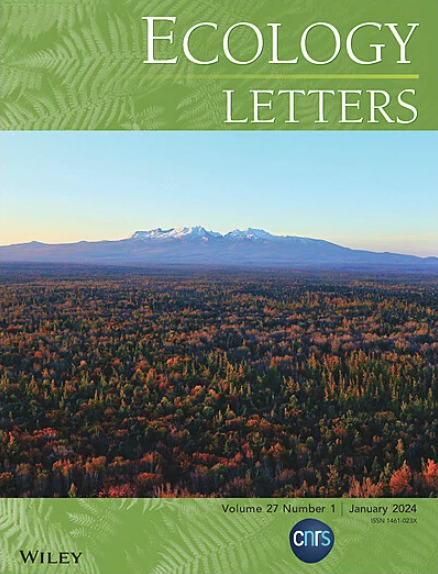
Ecology Letters serves as a platform for the rapid publication of innovative research in ecology. It considers manuscripts across all taxa, biomes, and geographic regions, prioritizing papers that investigate clearly stated hypotheses. The journal publishes concise papers of high originality and general interest, contributing to new developments in ecology. Purely descriptive papers and those that only confirm or extend previous results are discouraged.



 京公网安备 11010802042870号
京ICP备2023020795号-1
京公网安备 11010802042870号
京ICP备2023020795号-1

 分享
分享
 求助内容:
求助内容: 应助结果提醒方式:
 扫码关注我们
