Patrick R. Fitzgerald, Wesley G. Cochrane and Brian M. Paegel*,
{"title":"Dose–Response Activity-Based DNA-Encoded Library Screening","authors":"Patrick R. Fitzgerald, Wesley G. Cochrane and Brian M. Paegel*, ","doi":"10.1021/acsmedchemlett.3c00159","DOIUrl":null,"url":null,"abstract":"<p >Dose–response, or “conforming” behavior, increases confidence in a screening hit’s authenticity. Here, we demonstrate dose–response solid-phase DNA-encoded library (DEL) screening. Compound dose in microfluidic droplets is modulated via the UV intensity of photocleavage from DEL beads. A 55,296-member DEL was screened at different UV intensities against model enzyme drug targets factor Xa (FXa) and autotaxin (ATX). Both screens yielded photochemical dose-dependent hit rates (FXa hit rates of 0.08/0.05% at 100/30% UV exposure; ATX hit rates of 0.24/0.08% at 100/20% UV exposure). FXa hits contained structures reflective of FXa inhibitors and four hits inhibited FXa (IC<sub>50</sub> = 4.2 ± 0.1, 7.4 ± 0.3, 9.0 ± 0.3, and 19 ± 2 μM.) The top ATX hits (two dihydrobenzamidazolones and a tetrahydroisoquinoline) were validated as inhibitors (IC<sub>50</sub> = 7 ± 2, 13 ± 2, and 1 ± 0.3 μM). Photochemical dose–response DEL screening data prioritized hits for synthesis, the rate-limiting step in DEL lead identification.</p>","PeriodicalId":20,"journal":{"name":"ACS Medicinal Chemistry Letters","volume":"14 9","pages":"1295–1303"},"PeriodicalIF":4.0000,"publicationDate":"2023-08-21","publicationTypes":"Journal Article","fieldsOfStudy":null,"isOpenAccess":false,"openAccessPdf":"https://pubs.acs.org/doi/epdf/10.1021/acsmedchemlett.3c00159","citationCount":"0","resultStr":null,"platform":"Semanticscholar","paperid":null,"PeriodicalName":"ACS Medicinal Chemistry Letters","FirstCategoryId":"3","ListUrlMain":"https://pubs.acs.org/doi/10.1021/acsmedchemlett.3c00159","RegionNum":3,"RegionCategory":"医学","ArticlePicture":[],"TitleCN":null,"AbstractTextCN":null,"PMCID":null,"EPubDate":"","PubModel":"","JCR":"Q2","JCRName":"CHEMISTRY, MEDICINAL","Score":null,"Total":0}
引用次数: 0
Abstract
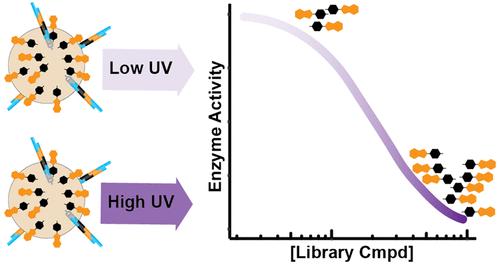
Dose–response, or “conforming” behavior, increases confidence in a screening hit’s authenticity. Here, we demonstrate dose–response solid-phase DNA-encoded library (DEL) screening. Compound dose in microfluidic droplets is modulated via the UV intensity of photocleavage from DEL beads. A 55,296-member DEL was screened at different UV intensities against model enzyme drug targets factor Xa (FXa) and autotaxin (ATX). Both screens yielded photochemical dose-dependent hit rates (FXa hit rates of 0.08/0.05% at 100/30% UV exposure; ATX hit rates of 0.24/0.08% at 100/20% UV exposure). FXa hits contained structures reflective of FXa inhibitors and four hits inhibited FXa (IC50 = 4.2 ± 0.1, 7.4 ± 0.3, 9.0 ± 0.3, and 19 ± 2 μM.) The top ATX hits (two dihydrobenzamidazolones and a tetrahydroisoquinoline) were validated as inhibitors (IC50 = 7 ± 2, 13 ± 2, and 1 ± 0.3 μM). Photochemical dose–response DEL screening data prioritized hits for synthesis, the rate-limiting step in DEL lead identification.
期刊介绍:
ACS Medicinal Chemistry Letters is interested in receiving manuscripts that discuss various aspects of medicinal chemistry. The journal will publish studies that pertain to a broad range of subject matter, including compound design and optimization, biological evaluation, drug delivery, imaging agents, and pharmacology of both small and large bioactive molecules. Specific areas include but are not limited to:
Identification, synthesis, and optimization of lead biologically active molecules and drugs (small molecules and biologics)
Biological characterization of new molecular entities in the context of drug discovery
Computational, cheminformatics, and structural studies for the identification or SAR analysis of bioactive molecules, ligands and their targets, etc.
Novel and improved methodologies, including radiation biochemistry, with broad application to medicinal chemistry
Discovery technologies for biologically active molecules from both synthetic and natural (plant and other) sources
Pharmacokinetic/pharmacodynamic studies that address mechanisms underlying drug disposition and response
Pharmacogenetic and pharmacogenomic studies used to enhance drug design and the translation of medicinal chemistry into the clinic
Mechanistic drug metabolism and regulation of metabolic enzyme gene expression
Chemistry patents relevant to the medicinal chemistry field.



 京公网安备 11010802042870号
京ICP备2023020795号-1
京公网安备 11010802042870号
京ICP备2023020795号-1

 分享
分享
 求助内容:
求助内容: 应助结果提醒方式:
 扫码关注我们
