A. Bourrier, F. Carrat, J.-F. Colombel, A.-M. Bouvier, V. Abitbol, P. Marteau, J. Cosnes, T. Simon, L. Peyrin-Biroulet, L. Beaugerie, the CESAME study group
{"title":"Excess risk of urinary tract cancers in patients receiving thiopurines for inflammatory bowel disease: a prospective observational cohort study","authors":"A. Bourrier, F. Carrat, J.-F. Colombel, A.-M. Bouvier, V. Abitbol, P. Marteau, J. Cosnes, T. Simon, L. Peyrin-Biroulet, L. Beaugerie, the CESAME study group","doi":"10.1111/apt.13466","DOIUrl":null,"url":null,"abstract":"<div>\n \n \n <section>\n \n <h3> Background</h3>\n \n <p>The risk of urinary tract cancers, including kidney and bladder cancers, was increased in transplant recipients receiving thiopurines.</p>\n </section>\n \n <section>\n \n <h3> Aim</h3>\n \n <p>To assess the risk of urinary tract cancers in patients with inflammatory bowel disease (IBD) receiving thiopurines in the CESAME observational cohort.</p>\n </section>\n \n <section>\n \n <h3> Methods</h3>\n \n <p>Between May 2004 and June 2005, 19 486 patients with IBD, 30.1% of whom were receiving thiopurines, were enrolled. Median follow-up was 35 months (IQR: 29–40).</p>\n </section>\n \n <section>\n \n <h3> Results</h3>\n \n <p>Ten and six patients developed respectively kidney and bladder cancer. The incidence rates of urinary tract cancer were 0.48/1000 patient-years in patients receiving thiopurines (95% CI: 0.21–0.95), 0.10/1000 patient-years in patients who discontinued thiopurines (95% CI: 0.00–0.56) and 0.30/1000 patient-years in patients never treated with thiopurines (95% CI: 0.12–0.62) at entry. The standardised incidence ratio of urinary tract cancer was 3.40 (95% CI: 1.47–6.71, <i>P</i> = 0.006) in patients receiving thiopurines, 0.64 (95% CI: 0.01–3.56, <i>P</i> = 0.92) in patients previously exposed to thiopurines and 1.17 (95% CI: 0.47–12.42, <i>P</i> = 0.78) in patients never treated with thiopurines. The multivariate-adjusted hazard ratio (HR) of urinary tract cancer between patients receiving thiopurines and those not receiving thiopurines was 2.82 (95% CI: 1.04–7.68, <i>P</i> = 0.04). Other significant risk factors were male gender (HR: 3.98, 95% CI: 1.12–14.10, <i>P</i> = 0.03) and increasing age (HR after 65 years (ref <50): 13.26, 95% CI: 3.52–50.03, <i>P</i> = 0.0001).</p>\n </section>\n \n <section>\n \n <h3> Conclusion</h3>\n \n <p>Patients with IBD receiving thiopurines have an increased risk of urinary tract cancers. Clinically relevant excess risk is observed in older men.</p>\n </section>\n </div>","PeriodicalId":121,"journal":{"name":"Alimentary Pharmacology & Therapeutics","volume":"43 2","pages":"252-261"},"PeriodicalIF":6.7000,"publicationDate":"2015-11-09","publicationTypes":"Journal Article","fieldsOfStudy":null,"isOpenAccess":false,"openAccessPdf":"https://sci-hub-pdf.com/10.1111/apt.13466","citationCount":"111","resultStr":null,"platform":"Semanticscholar","paperid":null,"PeriodicalName":"Alimentary Pharmacology & Therapeutics","FirstCategoryId":"3","ListUrlMain":"https://onlinelibrary.wiley.com/doi/10.1111/apt.13466","RegionNum":1,"RegionCategory":"医学","ArticlePicture":[],"TitleCN":null,"AbstractTextCN":null,"PMCID":null,"EPubDate":"","PubModel":"","JCR":"Q1","JCRName":"GASTROENTEROLOGY & HEPATOLOGY","Score":null,"Total":0}
引用次数: 111
Abstract
Background
The risk of urinary tract cancers, including kidney and bladder cancers, was increased in transplant recipients receiving thiopurines.
Aim
To assess the risk of urinary tract cancers in patients with inflammatory bowel disease (IBD) receiving thiopurines in the CESAME observational cohort.
Methods
Between May 2004 and June 2005, 19 486 patients with IBD, 30.1% of whom were receiving thiopurines, were enrolled. Median follow-up was 35 months (IQR: 29–40).
Results
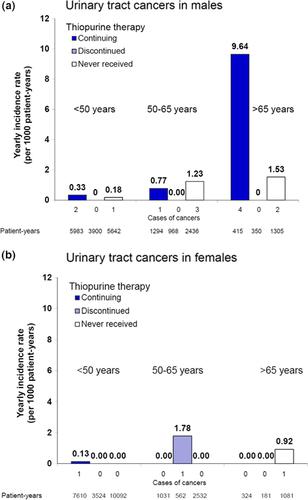
Ten and six patients developed respectively kidney and bladder cancer. The incidence rates of urinary tract cancer were 0.48/1000 patient-years in patients receiving thiopurines (95% CI: 0.21–0.95), 0.10/1000 patient-years in patients who discontinued thiopurines (95% CI: 0.00–0.56) and 0.30/1000 patient-years in patients never treated with thiopurines (95% CI: 0.12–0.62) at entry. The standardised incidence ratio of urinary tract cancer was 3.40 (95% CI: 1.47–6.71, P = 0.006) in patients receiving thiopurines, 0.64 (95% CI: 0.01–3.56, P = 0.92) in patients previously exposed to thiopurines and 1.17 (95% CI: 0.47–12.42, P = 0.78) in patients never treated with thiopurines. The multivariate-adjusted hazard ratio (HR) of urinary tract cancer between patients receiving thiopurines and those not receiving thiopurines was 2.82 (95% CI: 1.04–7.68, P = 0.04). Other significant risk factors were male gender (HR: 3.98, 95% CI: 1.12–14.10, P = 0.03) and increasing age (HR after 65 years (ref <50): 13.26, 95% CI: 3.52–50.03, P = 0.0001).
Conclusion
Patients with IBD receiving thiopurines have an increased risk of urinary tract cancers. Clinically relevant excess risk is observed in older men.
期刊介绍:
Alimentary Pharmacology & Therapeutics is a global pharmacology journal focused on the impact of drugs on the human gastrointestinal and hepato-biliary systems. It covers a diverse range of topics, often with immediate clinical relevance to its readership.



 京公网安备 11010802042870号
京ICP备2023020795号-1
京公网安备 11010802042870号
京ICP备2023020795号-1

 分享
分享
 求助内容:
求助内容: 应助结果提醒方式:
 扫码关注我们
