Robert O. Dillman MD, FACP, Neil M. Barth MD, Robert K. Oldham MD, Richard J. Cohen MD, David R. Minor MD, Robert Birch PhD, Jerri Arnold RN, John R. Yannelli PhD, James R. Maleckar PhD, Anthony Sferruzza PhD, William H. West MD
{"title":"Continuous interleukin-2 and tumor-infiltrating lymphocytes as treatment of advanced melanoma. A national biotherapy study group trial","authors":"Robert O. Dillman MD, FACP, Neil M. Barth MD, Robert K. Oldham MD, Richard J. Cohen MD, David R. Minor MD, Robert Birch PhD, Jerri Arnold RN, John R. Yannelli PhD, James R. Maleckar PhD, Anthony Sferruzza PhD, William H. West MD","doi":"10.1002/1097-0142(19910701)68:1<1::AID-CNCR2820680102>3.0.CO;2-K","DOIUrl":null,"url":null,"abstract":"<p>Melanoma metastases were harvested from 82 patients for the purpose of growing and expanding tumor-infiltrating lymphocytes (TIL). Tumor tissue cell suspensions were incubated with interleukin-2 (IL-2), followed by repeated exposure to tumor antigen with or without OKT3 monoclonal antibody (MoAb). Initial growth success was achieved in 56 of 82 cultures (72%). Efforts were made to expand 26 of these 56 cultures for therapeutic TIL; 23 of 26 early cultures (88%) were successfully expanded for <i>in vivo</i> therapy. It took a mean of 78.5 ± 25.4 days to grow sufficient TIL for treatment. Therapy included cyclophosphamide (1 g/m<sup>2</sup>) on day 1, followed by a 96-hour continuous infusion of IL-2 (18 × 10<sup>6</sup> IU/m<sup>2</sup>/d) on days 2 to 5, and approximately 10<sup>11</sup> (mean 1.49 ± 0.93 × 10<sup>11</sup>) TIL on day 2. Patients who responded received monthly IL-2 as a 96-hour infusion. Median patient age was 45 years of age. Sixty-seven percent of the patients were men. Performance status was 0 to 1 in 77% of patients. Thirty-four percent of the patients had liver metastases. The usual IL-2 toxicities were seen. Response rate for 21 patients was 24% (95% confidence interval, 10% to 49%). One complete response was achieved with cells 98% CD4+; four partial responses were achieved with cells 80%, 94%, 98%, and 98% CD8+, respectively. Four of eight patients who received TIL, which had never been stimulated with OKT3, had tumor response. The authors conclude that a treatment plan for IL-2/TIL is technically difficult, costly, and effective for only a minority of patients. Overall, clinical results are not clearly superior to those obtained with other IL-2 regimens.</p>","PeriodicalId":138,"journal":{"name":"Cancer","volume":"68 1","pages":"1-8"},"PeriodicalIF":5.1000,"publicationDate":"1991-07-01","publicationTypes":"Journal Article","fieldsOfStudy":null,"isOpenAccess":false,"openAccessPdf":"https://onlinelibrary.wiley.com/doi/epdf/10.1002/1097-0142%2819910701%2968%3A1%3C1%3A%3AAID-CNCR2820680102%3E3.0.CO%3B2-K","citationCount":"113","resultStr":null,"platform":"Semanticscholar","paperid":null,"PeriodicalName":"Cancer","FirstCategoryId":"3","ListUrlMain":"https://onlinelibrary.wiley.com/doi/10.1002/1097-0142%2819910701%2968%3A1%3C1%3A%3AAID-CNCR2820680102%3E3.0.CO%3B2-K","RegionNum":2,"RegionCategory":"医学","ArticlePicture":[],"TitleCN":null,"AbstractTextCN":null,"PMCID":null,"EPubDate":"","PubModel":"","JCR":"Q1","JCRName":"ONCOLOGY","Score":null,"Total":0}
引用次数: 113
Abstract
Melanoma metastases were harvested from 82 patients for the purpose of growing and expanding tumor-infiltrating lymphocytes (TIL). Tumor tissue cell suspensions were incubated with interleukin-2 (IL-2), followed by repeated exposure to tumor antigen with or without OKT3 monoclonal antibody (MoAb). Initial growth success was achieved in 56 of 82 cultures (72%). Efforts were made to expand 26 of these 56 cultures for therapeutic TIL; 23 of 26 early cultures (88%) were successfully expanded for in vivo therapy. It took a mean of 78.5 ± 25.4 days to grow sufficient TIL for treatment. Therapy included cyclophosphamide (1 g/m2) on day 1, followed by a 96-hour continuous infusion of IL-2 (18 × 106 IU/m2/d) on days 2 to 5, and approximately 1011 (mean 1.49 ± 0.93 × 10¹¹) TIL on day 2. Patients who responded received monthly IL-2 as a 96-hour infusion. Median patient age was 45 years of age. Sixty-seven percent of the patients were men. Performance status was 0 to 1 in 77% of patients. Thirty-four percent of the patients had liver metastases. The usual IL-2 toxicities were seen. Response rate for 21 patients was 24% (95% confidence interval, 10% to 49%). One complete response was achieved with cells 98% CD4+; four partial responses were achieved with cells 80%, 94%, 98%, and 98% CD8+, respectively. Four of eight patients who received TIL, which had never been stimulated with OKT3, had tumor response. The authors conclude that a treatment plan for IL-2/TIL is technically difficult, costly, and effective for only a minority of patients. Overall, clinical results are not clearly superior to those obtained with other IL-2 regimens.
期刊介绍:
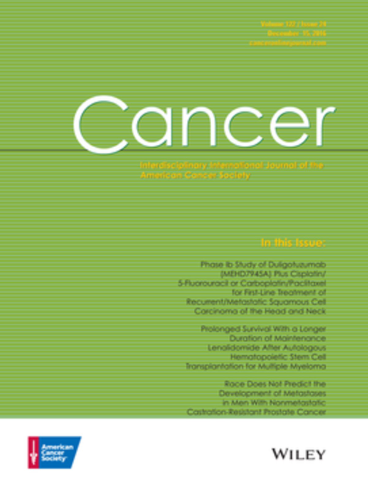
The CANCER site is a full-text, electronic implementation of CANCER, an Interdisciplinary International Journal of the American Cancer Society, and CANCER CYTOPATHOLOGY, a Journal of the American Cancer Society.
CANCER publishes interdisciplinary oncologic information according to, but not limited to, the following disease sites and disciplines: blood/bone marrow; breast disease; endocrine disorders; epidemiology; gastrointestinal tract; genitourinary disease; gynecologic oncology; head and neck disease; hepatobiliary tract; integrated medicine; lung disease; medical oncology; neuro-oncology; pathology radiation oncology; translational research



 京公网安备 11010802042870号
京ICP备2023020795号-1
京公网安备 11010802042870号
京ICP备2023020795号-1

 分享
分享
 求助内容:
求助内容: 应助结果提醒方式:
 扫码关注我们
