{"title":"Risk of developing another basal cell carcinoma. A 5-year prospective study","authors":"June K. Robinson MD","doi":"10.1002/1097-0142(19870701)60:1<118::AID-CNCR2820600122>3.0.CO;2-1","DOIUrl":null,"url":null,"abstract":"<p>This 5-year prospective study of 1000 people, who had one basal cell carcinoma treated, found that 36% develop a second basal cell carcinoma. The most important risk factors are a skin complexion with inability to tan and frequent sun exposure. There was no significant correlation between multiple basal cell carcinomas and sex or age.</p>","PeriodicalId":138,"journal":{"name":"Cancer","volume":"60 1","pages":"118-120"},"PeriodicalIF":5.1000,"publicationDate":"1987-07-01","publicationTypes":"Journal Article","fieldsOfStudy":null,"isOpenAccess":false,"openAccessPdf":"https://onlinelibrary.wiley.com/doi/epdf/10.1002/1097-0142%2819870701%2960%3A1%3C118%3A%3AAID-CNCR2820600122%3E3.0.CO%3B2-1","citationCount":"149","resultStr":null,"platform":"Semanticscholar","paperid":null,"PeriodicalName":"Cancer","FirstCategoryId":"3","ListUrlMain":"https://onlinelibrary.wiley.com/doi/10.1002/1097-0142%2819870701%2960%3A1%3C118%3A%3AAID-CNCR2820600122%3E3.0.CO%3B2-1","RegionNum":2,"RegionCategory":"医学","ArticlePicture":[],"TitleCN":null,"AbstractTextCN":null,"PMCID":null,"EPubDate":"","PubModel":"","JCR":"Q1","JCRName":"ONCOLOGY","Score":null,"Total":0}
引用次数: 149
Abstract
This 5-year prospective study of 1000 people, who had one basal cell carcinoma treated, found that 36% develop a second basal cell carcinoma. The most important risk factors are a skin complexion with inability to tan and frequent sun exposure. There was no significant correlation between multiple basal cell carcinomas and sex or age.
期刊介绍:
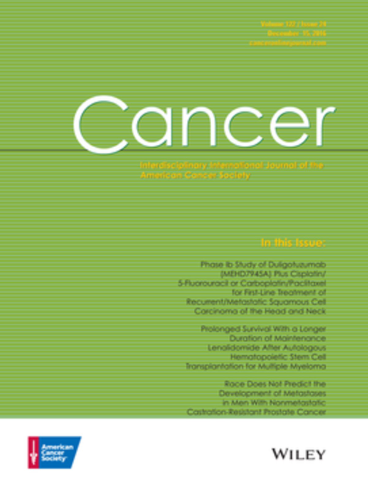
The CANCER site is a full-text, electronic implementation of CANCER, an Interdisciplinary International Journal of the American Cancer Society, and CANCER CYTOPATHOLOGY, a Journal of the American Cancer Society.
CANCER publishes interdisciplinary oncologic information according to, but not limited to, the following disease sites and disciplines: blood/bone marrow; breast disease; endocrine disorders; epidemiology; gastrointestinal tract; genitourinary disease; gynecologic oncology; head and neck disease; hepatobiliary tract; integrated medicine; lung disease; medical oncology; neuro-oncology; pathology radiation oncology; translational research



 京公网安备 11010802042870号
京ICP备2023020795号-1
京公网安备 11010802042870号
京ICP备2023020795号-1

 分享
分享
 求助内容:
求助内容: 应助结果提醒方式:
 扫码关注我们
