{"title":"Interleukin-13: Targeting an underestimated cytokine in atopic dermatitis","authors":"Thomas Bieber","doi":"10.1111/all.13954","DOIUrl":null,"url":null,"abstract":"<p>Atopic dermatitis (AD) is a common inflammatory skin condition that has traditionally been considered a paradigmatic type 2 immunity (T2)-driven disease. Interleukin (IL)-4 and IL-13 are both pivotal cytokines involved in the generation of allergic diseases. Currently, besides dupilumab, which blocks the binding of both cytokines to their receptors, a number of new pharmacologic entities have been designed to target both T2 cytokines and/or their receptors and/or receptor-associated signal transduction machinery such as Janus kinases. Recently, IL-13 has been suggested to be the key T2 cytokine driving inflammation in the periphery, while IL-4 may merely have a central effect. There is increasing evidence that this concept holds true for the inflammatory reaction underlying AD, where IL-13 is overexpressed locally and has a significant impact on skin biology, including the recruitment of inflammatory cells, the alteration of the skin microbiome, and the decrease in the epidermal barrier function. This review provides an update on the role of IL-13 in AD and discusses the different strategies aimed at interfering with its biologic activity as well as their potential in a precision medicine approach in the management of AD.</p>","PeriodicalId":122,"journal":{"name":"Allergy","volume":"75 1","pages":"54-62"},"PeriodicalIF":12.0000,"publicationDate":"2019-06-22","publicationTypes":"Journal Article","fieldsOfStudy":null,"isOpenAccess":false,"openAccessPdf":"https://sci-hub-pdf.com/10.1111/all.13954","citationCount":"178","resultStr":null,"platform":"Semanticscholar","paperid":null,"PeriodicalName":"Allergy","FirstCategoryId":"3","ListUrlMain":"https://onlinelibrary.wiley.com/doi/10.1111/all.13954","RegionNum":1,"RegionCategory":"医学","ArticlePicture":[],"TitleCN":null,"AbstractTextCN":null,"PMCID":null,"EPubDate":"","PubModel":"","JCR":"Q1","JCRName":"ALLERGY","Score":null,"Total":0}
引用次数: 178
Abstract
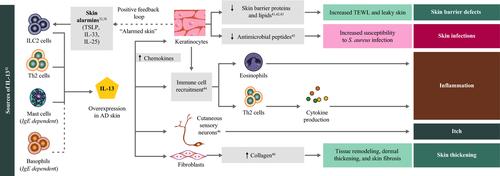
Atopic dermatitis (AD) is a common inflammatory skin condition that has traditionally been considered a paradigmatic type 2 immunity (T2)-driven disease. Interleukin (IL)-4 and IL-13 are both pivotal cytokines involved in the generation of allergic diseases. Currently, besides dupilumab, which blocks the binding of both cytokines to their receptors, a number of new pharmacologic entities have been designed to target both T2 cytokines and/or their receptors and/or receptor-associated signal transduction machinery such as Janus kinases. Recently, IL-13 has been suggested to be the key T2 cytokine driving inflammation in the periphery, while IL-4 may merely have a central effect. There is increasing evidence that this concept holds true for the inflammatory reaction underlying AD, where IL-13 is overexpressed locally and has a significant impact on skin biology, including the recruitment of inflammatory cells, the alteration of the skin microbiome, and the decrease in the epidermal barrier function. This review provides an update on the role of IL-13 in AD and discusses the different strategies aimed at interfering with its biologic activity as well as their potential in a precision medicine approach in the management of AD.
期刊介绍:
Allergy is an international and multidisciplinary journal that aims to advance, impact, and communicate all aspects of the discipline of Allergy/Immunology. It publishes original articles, reviews, position papers, guidelines, editorials, news and commentaries, letters to the editors, and correspondences. The journal accepts articles based on their scientific merit and quality.
Allergy seeks to maintain contact between basic and clinical Allergy/Immunology and encourages contributions from contributors and readers from all countries. In addition to its publication, Allergy also provides abstracting and indexing information. Some of the databases that include Allergy abstracts are Abstracts on Hygiene & Communicable Disease, Academic Search Alumni Edition, AgBiotech News & Information, AGRICOLA Database, Biological Abstracts, PubMed Dietary Supplement Subset, and Global Health, among others.



 京公网安备 11010802042870号
京ICP备2023020795号-1
京公网安备 11010802042870号
京ICP备2023020795号-1

 分享
分享
 求助内容:
求助内容: 应助结果提醒方式:
 扫码关注我们
