Sriraj Aiyer, Hoi Ching Kam, Ka Yuk Ng, Nathaniel A Young, Jiaxin Shi, Gilad Feldman
{"title":"Outcomes Affect Evaluations of Decision Quality: Replication and Extensions of Baron and Hershey's (1988) Outcome Bias Experiment 1.","authors":"Sriraj Aiyer, Hoi Ching Kam, Ka Yuk Ng, Nathaniel A Young, Jiaxin Shi, Gilad Feldman","doi":"10.5334/irsp.751","DOIUrl":null,"url":null,"abstract":"<p><p>Outcome bias is the phenomenon whereby decisions which resulted in successful outcomes were rated more favorably than when the same decisions resulted in failures. We conducted a pre-registered replication and extension of Experiment 1 (original's: <i>N</i> = 20) from the classic Baron and Hershey (1988) with an online Amazon Mechanical Turk sample using CloudResearch (<i>N</i> = 692), switching from a within-participants design in the original experiment to a between-participants design. We tested outcome bias by measuring participants' ratings of the quality of decisions in medical scenarios. For the replication (pre-registered) part of the study, we successfully replicated signal and direction of the outcome bias (original: <i>d<sub>paired</sub></i> = 0.21 - 0.53; replication: <i>d<sub>independent</sub></i> = 0.77 [0.62, 0.93] to 1.1 [0.94, 1.26]), and even for participants who stated that outcomes should not be taken into consideration when evaluating decisions (<i>d</i> = 0.64 [0.21, 1.08]). For the extension part of the study, we found differences, dependent on outcome types, in evaluations of the perceived importance of considering the outcome, the perceived responsibility of decision-makers, and the perception that others would act similarly given the choice by outcome type. Materials, data, and code are available on Open Science Framework (OSF): https://osf.io/knjhu/.</p>","PeriodicalId":45461,"journal":{"name":"International Review of Social Psychology","volume":"1 1","pages":"12"},"PeriodicalIF":1.6000,"publicationDate":"2023-07-28","publicationTypes":"Journal Article","fieldsOfStudy":null,"isOpenAccess":false,"openAccessPdf":"https://www.ncbi.nlm.nih.gov/pmc/articles/PMC12372742/pdf/","citationCount":"0","resultStr":null,"platform":"Semanticscholar","paperid":null,"PeriodicalName":"International Review of Social Psychology","FirstCategoryId":"102","ListUrlMain":"https://doi.org/10.5334/irsp.751","RegionNum":4,"RegionCategory":"心理学","ArticlePicture":[],"TitleCN":null,"AbstractTextCN":null,"PMCID":null,"EPubDate":"2023/1/1 0:00:00","PubModel":"eCollection","JCR":"Q3","JCRName":"PSYCHOLOGY, SOCIAL","Score":null,"Total":0}
引用次数: 0
Abstract
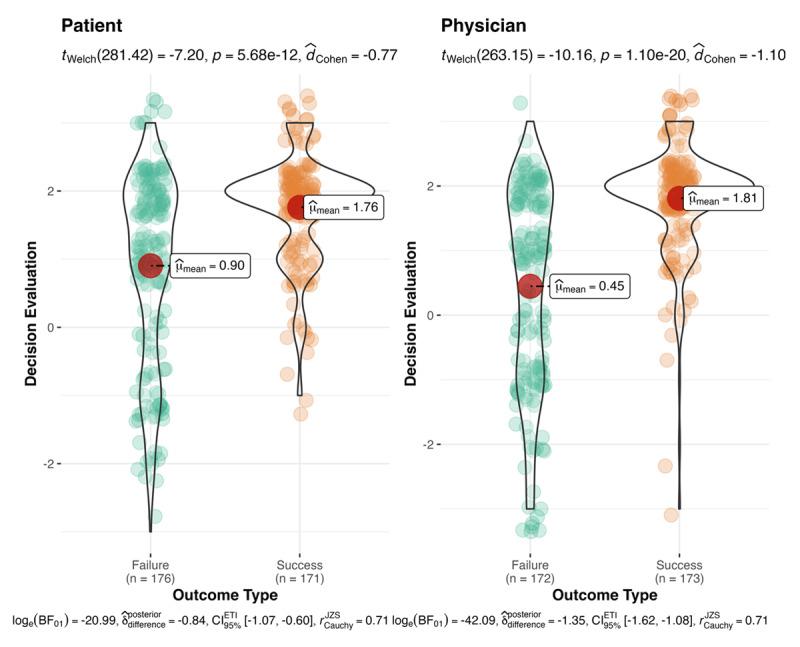
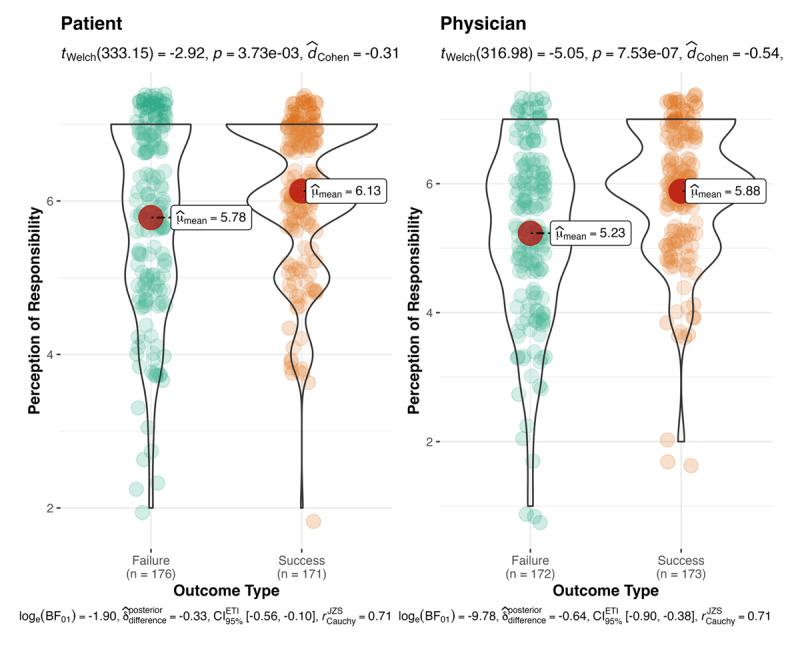
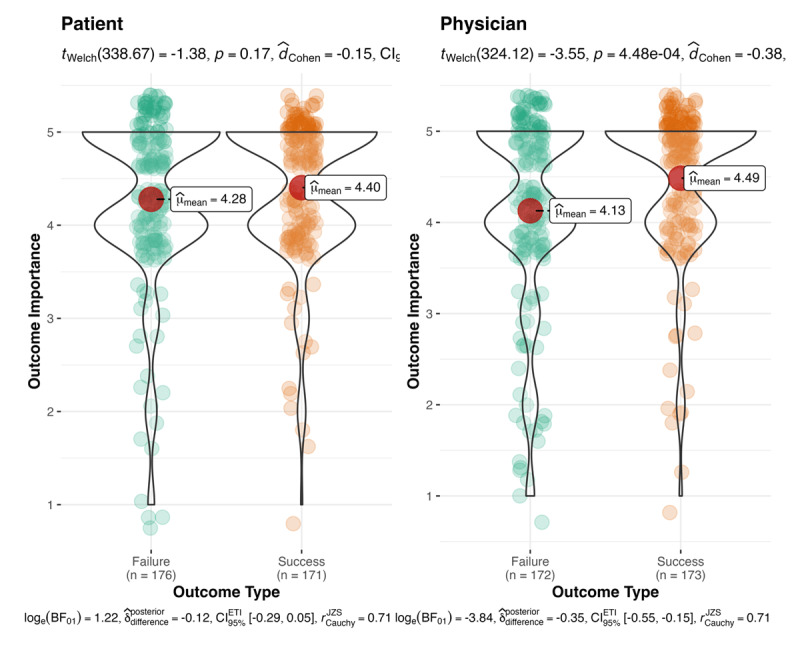
Outcome bias is the phenomenon whereby decisions which resulted in successful outcomes were rated more favorably than when the same decisions resulted in failures. We conducted a pre-registered replication and extension of Experiment 1 (original's: N = 20) from the classic Baron and Hershey (1988) with an online Amazon Mechanical Turk sample using CloudResearch (N = 692), switching from a within-participants design in the original experiment to a between-participants design. We tested outcome bias by measuring participants' ratings of the quality of decisions in medical scenarios. For the replication (pre-registered) part of the study, we successfully replicated signal and direction of the outcome bias (original: dpaired = 0.21 - 0.53; replication: dindependent = 0.77 [0.62, 0.93] to 1.1 [0.94, 1.26]), and even for participants who stated that outcomes should not be taken into consideration when evaluating decisions (d = 0.64 [0.21, 1.08]). For the extension part of the study, we found differences, dependent on outcome types, in evaluations of the perceived importance of considering the outcome, the perceived responsibility of decision-makers, and the perception that others would act similarly given the choice by outcome type. Materials, data, and code are available on Open Science Framework (OSF): https://osf.io/knjhu/.
期刊介绍:
The International Review of Social Psychology (IRSP) is supported by the Association pour la Diffusion de la Recherche Internationale en Psychologie Sociale (A.D.R.I.P.S.). The International Review of Social Psychology publishes empirical research and theoretical notes in all areas of social psychology. Articles are written preferably in English but can also be written in French. The journal was created to reflect research advances in a field where theoretical and fundamental questions inevitably convey social significance and implications. It emphasizes scientific quality of its publications in every area of social psychology. Any kind of research can be considered, as long as the results significantly enhance the understanding of a general social psychological phenomenon and the methodology is appropriate.




 京公网安备 11010802042870号
京ICP备2023020795号-1
京公网安备 11010802042870号
京ICP备2023020795号-1

 分享
分享
 求助内容:
求助内容: 应助结果提醒方式:
 扫码关注我们
